No. 51747
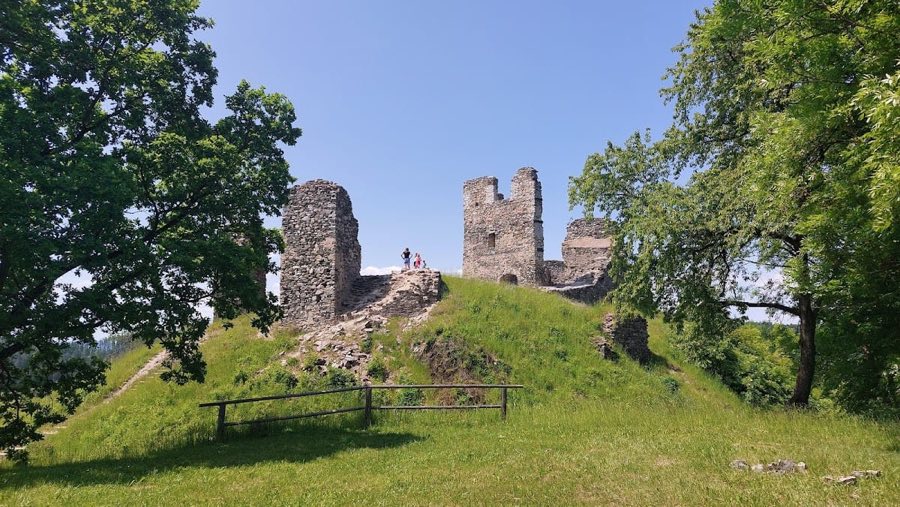
Hrad Brníčko
Czechia
CastleRuin14th century

No. 54341
Manor house · Czechia
No. 54341 · 49.945 N, 16.998 E
For events
Třemešek Castle, Králec is marked as a château or castle venue lead. Capacity, indoor/outdoor spaces, catering rules, and accommodation options are published only after public verification.
Event types: Private events, Cultural gatherings, Filming and photography
Quick summary
Třemešek Castle, Králec is a manor house in Králec, Czechia with origins associated with the 14th century.
See all castles in CzechiaTřemešek Castle in Králec, Czechia, began as a medieval stronghold in the 14th century and later evolved into a Renaissance residence before receiving a 19th‑century Empire (late Neoclassical) remodelling. Its long sequence of construction, ownership changes and military events links the site to regional conflicts and local noble administration, and in the 18th century the castle even served an astronomical purpose.
A fortified manor stood here by the mid‑1300s, with the first indirect reference dated 1346. During the Hussite wars, the property belonged to the Manx (possibly Menšík) branch of the Kravař family; the Hussite wars were the early 15th‑century religious and social conflicts in Bohemia. In the later 15th century the medieval settlement called Třemešek was devastated during the Czech–Hungarian wars, a period of fighting for control in the border region, and the village disappeared. A new settlement, later called Králec, developed in the same general area.
In 1471 a Hungarian force captured the fortress and left it partly ruined. In 1527 Petr of Žerotín acquired the estate. The property passed in 1559 to the Bukůvka family, who rebuilt the residence in the Renaissance manner and completed their project in 1587. Under Jan Bukuvky, whose active period ran from 1587 to 1617, the locality—also referred to by the German form Johrnsdorf—was elevated to the status of a free manorial estate.
Ownership transferred from the Bukůvka line to the counts Zierotin in 1653, who held the property until 1771. Josef Karel Zierotin converted the castle tower for use as an astronomical observatory in 1751 and commissioned a telescope from the English optician Jesse Ramsden. The castle was ceded in 1771 to the Šumperk merchant Franz Tersch. In the mid‑19th century the house underwent a major rebuilding in the Empire style begun in 1857 and finished in the late 1850s to early 1860s (dates are reported as 1857–1861 or alternatively 1857–1863).
After the Second World War the state took possession of the complex and it was used as a carpentry apprenticeship college for Northern Moravia. In the early decades of the 21st century the building functioned as a hostel until a serious fire caused extensive damage and authorities decided on restoration. The entire castle complex is protected as a cultural monument of the Czech Republic, listed under catalogue number 1000142028.
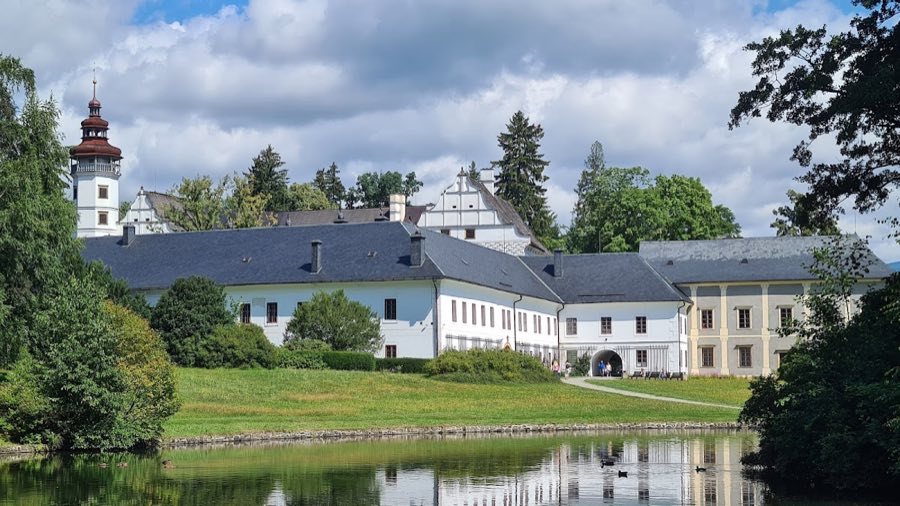
The castle occupies a rectangular plan and stands within a surrounding park. The present palatial block rises across three storeys, with a central section that is one level higher and a small roof turret placed above the middle axis. The late‑19th‑century reconstruction produced the building’s current external character, while much of the earlier fabric was retained or reshaped during that campaign.
A Renaissance entrance portal dated 1587 remains on the rear façade and is the most prominent survivals from the 16th‑century phase. The stone portal carries carved portrait medallions showing the patrons Johann Bukovky of Bukovka and Estelka Strakovsky of Bierkov. Italian stonemasons executed the carving, and the portal is noted for its artistic quality. The residence completed in 1587 was originally a single‑storey house with a high, two‑sloped gable roof and a wooden tower; later descriptions remark on uncertainty about whether that wooden tower occupied the exact site of the older medieval fortress.
Alterations carried out in the reconstruction that began in 1857 raised the palace by an additional upper floor, introduced a new entrance ramp supported on rusticated (rough‑textured) pillars, changed the small rooftop turret, and altered the principal façades. Mid‑20th‑century interventions are recorded as having significantly altered the building’s appearance. A severe fire in the early 21st century seriously damaged the structure, and plans were made to restore the complex. The portal of 1587 survives in situ, while the overall ensemble remains protected as a state cultural monument under catalogue number 1000142028.
No. 51747
No. 37997
No. 99013
No. 74441
Comments
Comments for Třemešek Castle, Králec will require a verified account before posting.
We'll send a verification link before your first comment is published.