No. 21872
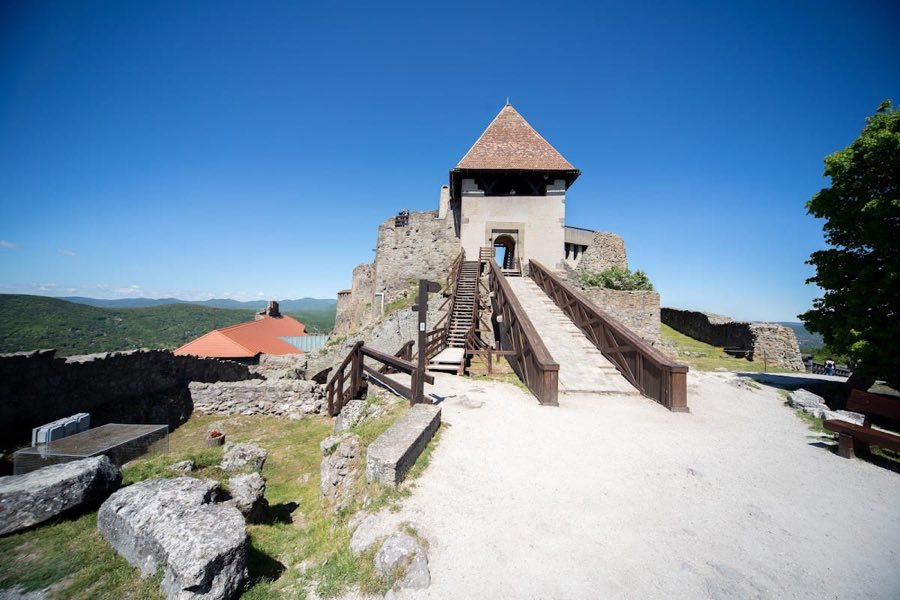
Visegrád Castle
Hungary
CastleRuin14th century
No. 75718
Palace · Hungary
No. 75718 · 47.792 N, 18.974 E
Quick summary
Visegrád Royal Palace is a palace in Hungary with origins associated with the 14th century.
See all castles in HungaryThe royal palace of Visegrád in Visegrád, Hungary, is a medieval royal residence erected by the Hungarian kingdom during the later Middle Ages, with major building phases from the 13th through the 15th centuries and architectural character drawn from Gothic and emerging Renaissance styles. The place gained international importance in the 14th century as the site of the 1335 Congress of Visegrád and the Peace of Visegrád, and it figures in royal history through violent and political episodes that affected the Hungarian crown.
Construction on the palace began under King Charles I Robert in 1323, establishing a royal seat that hosted court life and state business. In 1330 the household there endured a violent episode when the noble Felicián Záh attempted to kill members of the royal family. Two years later the site played a diplomatic role at the congress that led to the 1335 peace agreement between regional powers.
In the final decades of the 14th century the complex underwent substantial rebuilding during the reigns of King Louis I and King Sigismund. Sigismund added a new royal court chapel and reorganized the palace plan to give it a more rectangular footprint, and he linked the north side to gardens and the south side to a Franciscan monastery founded in 1424 on the location of an older royal chapel. Between 1405 and 1408 Sigismund transferred his main seat to Buda; thereafter Visegrád served largely as a country residence where the king continued to stay from time to time.
King Matthias Corvinus carried out extensive renovations between 1476 and 1484, recasting parts of the palace in late Gothic manner and introducing Renaissance features. These additions under Matthias are the earliest examples of Italian Renaissance style recorded north of the Alps. The palace remained in use until the Ottoman advance reached the region; following the Turkish conquest in 1544 the royal residence was abandoned and fell into ruin. The surviving masonry suffered further reduction when demolition took place in the 18th century.
Archaeological work resumed in 1934 and has continued intermittently since then, enabling large-scale restorations and partial reconstructions of the palace and its gardens. Portions of the interior were rebuilt and are on public display, and the complex now houses the King Matthias Museum, a branch of the Hungarian National Museum. A long-term program plans to restore the entire palace complex and its surroundings, with work beginning in mid-2022 and a target completion date in 2035.
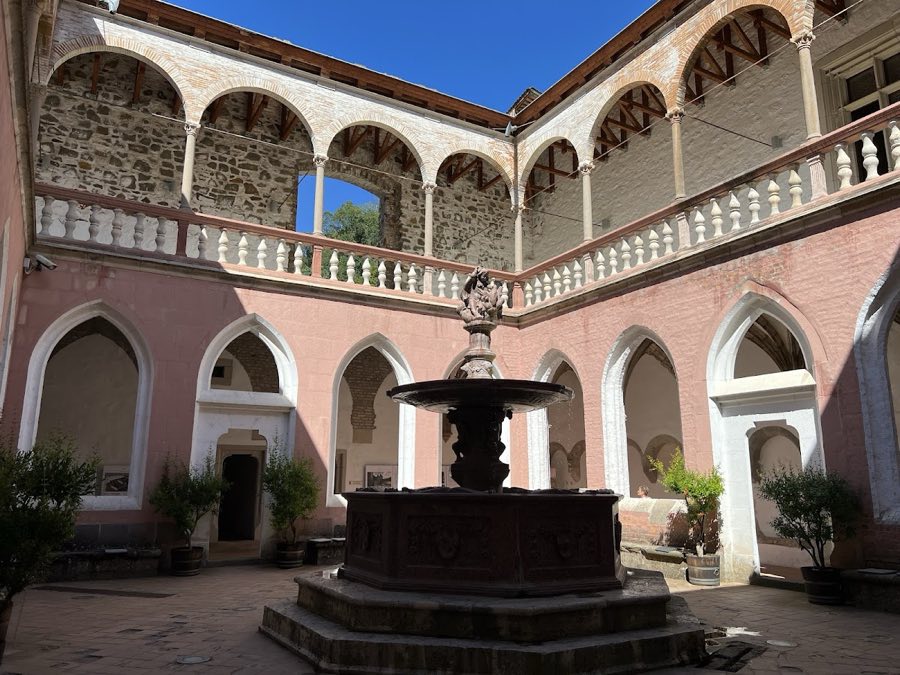
The palace occupies an exact rectangular platform measuring 123 by 123 metres, a clear geometric layout that unites Gothic and Renaissance elements from its long construction history. Surviving masonry and reconstructed areas present the palace as a cohesive quadrilateral plan, with domestic and ceremonial spaces arranged around an inner court.
A loggia opens onto an ornate inner courtyard, providing a covered gallery that faces the enclosure. The court chapel retains interior fittings recorded as altars, and an organ gallery is associated with the royal liturgical space. Sigismund’s construction of a new royal court chapel altered circulation and helped give the palace its later rectangular form. Nearby the Hercules Fountain and the Mússák spring (a natural water source) lie within the palace precincts, the spring sitting inside the defensive walls and historically supplying water to the complex.
Gardens and planted terraces formed an integral part of the ensemble. A Pergola Garden and a Flower Garden are identified within the palace grounds, while a stair complex is attributed to the period of Matthias Corvinus, sometimes called the Raven King. On the west side a first-floor pergola garden once opened from the upper story, with a lower castle garden and an orchard positioned beneath the pergola. A first-floor herb-and-flower garden is traced to the time of King Louis I. These arranged outdoor spaces link the palace buildings and show continuous landscaping from the fourteenth to the fifteenth centuries.
Several interior rooms have been reconstructed and are presented to visitors as examples of royal household use. The bedroom associated with King Sigismund, a ceremonial hall from the age of King Matthias, and a kitchen have been rebuilt and furnished to reflect their historical functions. Overall the site survives as a combination of ruinous fabric and restored sections; some terraces, roofs and garden areas have been rebuilt, while portions of the medieval masonry remain as fragmentary ruins following 18th-century demolition and later excavation beginning in 1934.
No. 21872
No. 40775
No. 76789
No. 50615
Comments
Comments for Visegrád Royal Palace will require a verified account before posting.
We'll send a verification link before your first comment is published.