No. 52153
Wołek Castle
Poland
CastleRuin14th century
No. 80996
No. 80996 · 49.660 N, 19.196 E
Quick summary
Zamek na wzgórzu Grojec is a castle in Poland with origins associated with the 15th century.
See all castles in PolandZamek na wzgórzu Grojec is located on Grojec Hill in Żywiec, Poland. The site originally hosted an early medieval stronghold whose origins cannot be precisely dated today due to destruction in the post-World War II era.
In the early 15th century, the hilltop became the site of a documented castle established by Bożywoj and Włodek Skrzyński, knights bearing the Łabędź coat of arms. These nobles, known as knightly robbers and vassals of the Duchy of Oświęcim, constructed the fortress for defensive and territorial control. Later on, the Komorowski family, who bore the Korczak coat of arms, assumed ownership. This family notably supported Matthias Corvinus, King of Hungary, aligning themselves with the Teutonic Order in opposition to the Kingdom of Poland.
During the late 1470s, tensions culminated in royal intervention under King Casimir IV Jagiellon. In 1477, forces commanded by Jakub of Dębno, the Kraków starost (a royal official), launched a military campaign against the Komorowski-held castle. According to chronicler Jan Długosz, the royal troops employed heavy artillery in a series of sieges, culminating in the capture and burning of the stronghold. Archaeological findings suggest that the castle on Grojec Hill and another nearby fortification were destroyed amid this campaign. The event marked the end of the castle’s active use and led to its eventual ruin.
Archaeological interest in the location dates to 1937, when excavations uncovered evidence of long-term human presence, including artifacts from the prehistoric Lusatian culture and medieval times, yet much of the material was lost during World War II.
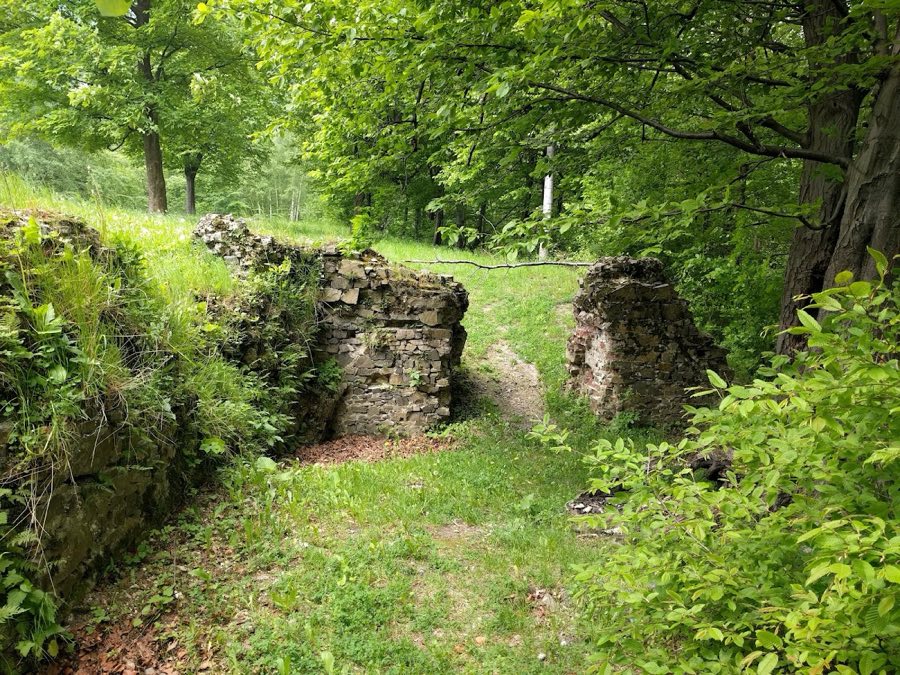
The castle occupied a flattened summit of Grojec Hill, characterized by a natural ridge of exposed rocks that formed the core of the defensive position. Around this rocky plateau lay a dry moat, which served as a barrier against attackers. Encircling the site was a substantial earthen rampart shaped roughly as an elongated oval, measuring about 100 meters in length and 40 meters in width. This fortification was built from a combination of clay and large sandstone boulders, creating a sturdy enclosure that defined the fortified area.
Within the boundaries protected by the rampart and moat, archaeologists found traces of wooden constructions. These timber buildings likely functioned as living quarters, storage, or support structures for inhabitants of the castle. The use of wood complements the defensive features and reflects typical building practices of medieval hilltop fortresses.
Excavations yielded various metal objects including nails, a knife, a horse bit used for controlling horses, and a crossbow bolt head. These finds point to a combination of domestic activity and military readiness on the site. Among the discovered artifacts was a silver coin known as a denarius bearing the image of King Władysław Jagiełło. This coin serves as a valuable chronological marker, indicating occupation or use of the stronghold during his reign in the late 14th to early 15th century.
Today, the physical remnants of these fortifications remain visible in the form of the earthworks and the dry moat, preserving the basic outline of the medieval stronghold on Grojec Hill.
No. 52153
No. 97212
No. 75862
No. 39739
Comments
Comments for Zamek na wzgórzu Grojec will require a verified account before posting.
We'll send a verification link before your first comment is published.