
No. 54592
Žebrák Castle
Czechia
CastleRuinFor events13th century
No. 49853
Castle · Czechia
No. 49853 · 49.858 N, 13.762 E
Quick summary
Zbiroh Castle is a castle in Czechia with origins associated with the 13th century.
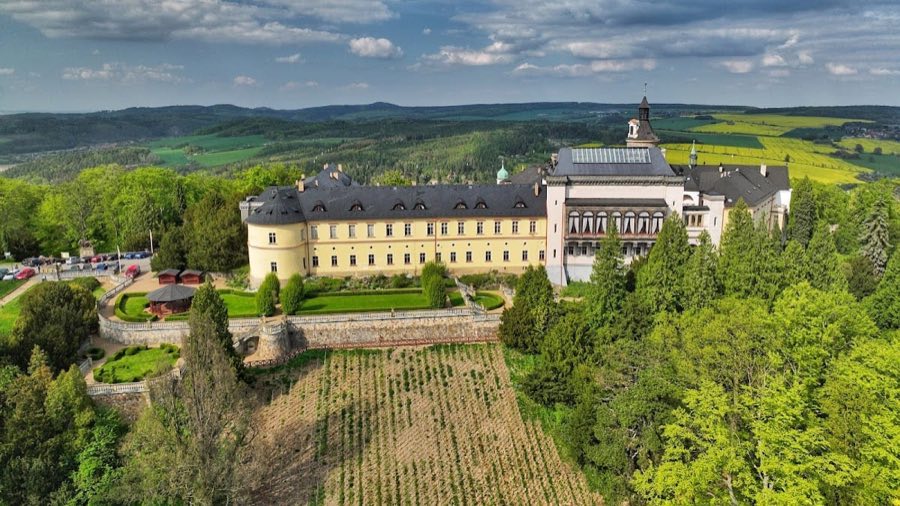
See all castles in CzechiaZbiroh Castle is located in the municipality of Zbiroh in the Czech Republic. It was established in the early 13th century by Bohemian nobility during the medieval period, making it one of the oldest noble castles in Bohemia.
The origins of the castle trace back to the second quarter of the 13th century, with the earliest indirect reference appearing around 1230, connected to the Sulislavic family. The castle’s founder is generally identified as Břetislav of Zbiroh, mentioned in records from 1247. Throughout the Middle Ages, the castle changed hands among several influential noble families and rulers. It was held by dukes such as the Drslavici, came briefly under King Přemysl Otakar II, and later became the property of the powerful Rožmberk family. In the early 15th century, the castle belonged to King Sigismund (known locally as Zikmund) before passing to the Kolovrat family.
During the turbulent 15th century, Zbiroh Castle was the site of a notable religious event in 1469, when Hanuš II of Kolovrat proclaimed a church curse against King George of Poděbrady within its chapel. This act underscored the castle’s role in the region’s religious and political conflicts during the Hussite Wars and the shifting balance of power in Bohemia.
The castle suffered significantly during the Thirty Years’ War in the 17th century when Swedish troops captured and burned it. Afterwards, it took on a new function as a royal prison. Six Czech nobles were detained here after the Battle of White Mountain (1620) and faced pressure to convert to Catholicism, reflecting the era’s intense religious struggles.
Later in the 16th century, Emperor Rudolf II acquired Zbiroh and transformed the medieval fortress into a Renaissance chateau. He added an extensive park and created one of the largest game reserves in the region. This renovation expanded the castle to include 224 rooms, marking it as one of the grandest residences in Bohemia.
In the late 19th century, the castle found a new owner in Baron Bethel Heinrich Strousberg, a German industrialist who purchased it in 1868. Between 1869 and 1870, architect August Orth carried out an extensive Neo-Renaissance reconstruction. However, following Strousberg’s bankruptcy, the castle was acquired in 1879 by the aristocratic Colloredo-Mansfeld family.
From 1912 to 1928, the famous Czech painter Alfons Mucha lived in the eastern wing of Zbiroh Castle. There he created the monumental Slav Epic series, painting in a spacious hall covered by a glass roof that provided abundant natural light. During this period, Mucha also hosted gatherings of Freemasons from various countries, using the castle as a meeting place.
World War II brought a militarized chapter to Zbiroh’s history. Between 1943 and 1945, the castle served as headquarters for the Nazi SS staff. Members of the SS conducted mystical rituals in the cellar beneath the so-called hermitage, drawn by legends of a mysterious earth energy emanating from a fissure in the rock.
After the war, ownership passed to the Czechoslovak state. The castle was repurposed for military use and became a secretive monitoring station. Its position atop silicified sandstone rock, which naturally amplified radio signals, made it an ideal location for radiotechnical detectors that observed NATO aircraft movements during the Cold War. Unfortunately, military occupation caused damage to the structure, including the room where Mucha had lived.
The army vacated the premises starting in 1997. In the early 21st century, the castle was acquired by a private company and opened to the public. It now serves multiple functions, integrating hospitality with cultural preservation. Exhibitions showcase history spanning from the Přemyslid dynasty through to the Art Nouveau period, including displays dedicated to Mucha’s artistic and Masonic involvement. The vast hall that hosted the creation of the Slav Epic now supports concerts and exhibitions.
The grounds include one of the highest vineyards in the Czech Republic, situated at 550 meters above sea level. This vineyard dates back to Emperor Rudolf II’s era and was restored in 2018 following destruction during military occupancy. Moreover, the castle today also acts as the seat of the Sovereign Order of the Temple of Jerusalem, linking it to contemporary chivalric traditions.
Zbiroh Castle exhibits a complex layout typical of medieval hilltop fortifications, originally designed as a bergfried-type fortress with a two-part construction. At its heart lies a pentagonal core, anchored by a free-standing, round bergfried tower erected during the initial building phase in the 13th century. This tower served as a last refuge and lookout point, characteristic of Central European castle architecture of the period.
Adjacent to the core, along its longest side, stood a palace whose first floor houses a chapel dating from the 14th century. This chapel features a notable eastern oriel—an overhanging window bay—vaulted with ribbed arches that were important medieval structural elements providing strength and decorative detail.
During the late Gothic period, defensive upgrades were made to the outer bailey, where several round artillery bastions reinforced the castle’s protection against emerging siege technologies. While most of these bastions were lost or altered, one bastion survives today in a rebuilt form, illustrating the castle’s adaptation to changing military needs.
The main entrance to the outer bailey was originally through a square gatehouse, which was removed in the 19th century during Baron Strousberg’s Neo-Renaissance remodeling. The extensive internal space includes 224 rooms, a number that reflects the castle’s Renaissance transformation into one of the largest chateaux in Bohemia.
One of Zbiroh’s most remarkable features is its deep, hand-dug well, carved into the silicified sandstone bedrock. At 163 meters (approximately 535 feet) deep, the well was created during the 12th century by miners from the nearby town of Příbram. Due to the hardness of the silicified sandstone, the well’s shaft spirals vertically rather than forming a straight tunnel. Excavating it took between seventy and eighty years, a testament to medieval engineering and perseverance.
The well’s condition today reveals layers of historical use and concealment. During military occupation, portions were filled with debris including weapons and archives from the Second World War. Below the waterline lies a sealed side tunnel, closed off by Nazi forces with kaolin clay and containing visible cables. This hidden passage is believed to have been used to store explosives, though it remains unexplored.
Within the castle courtyard stands the oldest freestanding tower in the Czech Republic, a notable landmark attesting to the site’s long defensive tradition. Several underground chambers exist beneath the castle, some of which remain unexplored or sealed by thick layers of concrete laid by the Nazis, preserving spaces hidden for decades.
Beneath the hermitage is a cellar that has been transformed into a wine cellar, currently used for wine tastings. This space links the castle’s storied past with ongoing cultural activities. Building materials across the site heavily feature silicified sandstone, known locally as buližník. This durable stone forms the bedrock beneath the castle and later served to amplify radio signals, a feature exploited during Cold War military uses.
Architectural details from various periods remain visible, including the rib-vaulted oriel of the chapel dating to the 14th century, and the Neo-Renaissance decorative elements introduced by August Orth during the extensive 19th-century reconstruction. The Renaissance park and game reserve added under Emperor Rudolf II survive as integral parts of the castle’s historic setting.
Together, these features illustrate Zbiroh Castle’s continuous development from a medieval fortress through Renaissance splendor to a site shaped by modern military history and cultural renewal.
No. 54592
No. 14618
No. 79029
No. 83978
Comments
Comments for Zbiroh Castle will require a verified account before posting.
We'll send a verification link before your first comment is published.