No. 48596
Krakovec Castle
Czechia
CastleRuin16th century
No. 83978
No. 83978 · 49.949 N, 13.588 E
Quick summary
Castle Krašov is a castle in Czechia with origins associated with the 13th century.
See all castles in CzechiaCastle Krašov is located in the municipality of Krašov in the modern Czech Republic. It was constructed by medieval European nobility, with origins tracing back to the early or mid-13th century.
The likely founder was Jetřich from the noble Hroznatovci family, first mentioned in records around 1232. Another theory credits Sezima of Krašov, referenced in documents from 1269 and 1284, suggesting the castle’s foundation occurred during the mid-13th century. Throughout the following centuries, the estate changed hands among several noble houses. The Hroznatovci initially held it, followed by the Švihovští of Rýzmberk during the 14th century. By the late 1370s, it was sold to the Kolovrat family, and in 1529 ownership passed to the Svitákové of Landštejn. Throughout these centuries, the castle remained a privately owned noble residence, with frequent transfers through sales or inheritance.
During the Hussite Wars of the early 15th century, Castle Krašov endured the turbulent regional conflicts but was never subjected to a direct siege, managing to avoid severe military damage. In contrast, the surrounding villages suffered more extensively. Later, during the Thirty Years’ War in the 17th century, the castle again escaped serious military assaults, despite widespread destruction in nearby areas.
Following the political changes after 1526, the fortress underwent significant transformation into a Renaissance-style chateau. Additional Baroque-style alterations were made in the 18th century, reflecting changing architectural tastes. Between 1755 and 1779, the castle served as a summer retreat for monks from the nearby Plasy monastery, highlighting its religious and residential function during that period. After the monastery’s dissolution in 1785, Castle Krašov was abandoned, leading to gradual decay and ruin over the subsequent decades. Interest in preserving the site resumed in the 20th century, starting in 1931, including controversial restoration efforts in the 1960s and archaeological investigations carried out in 1970 and 1971.
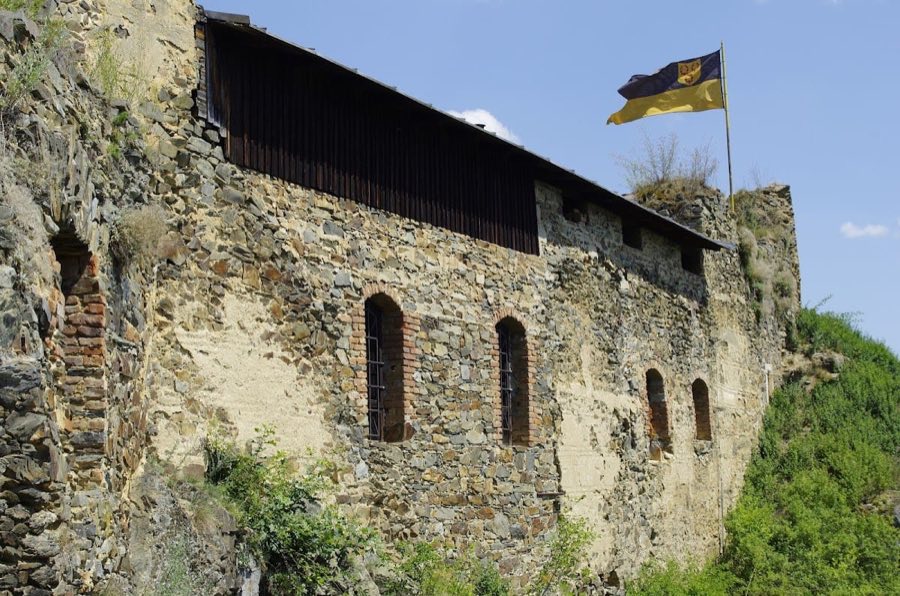
Castle Krašov is a ruin located on a rocky promontory approximately 310 meters above sea level, overseeing where the Brodeslavský stream meets the Berounka River. The fortress was originally built in the “bergfried” style, meaning its central stronghold was dominated by a tall defensive tower known as a bergfried. The earliest fortifications underwent several phases of redesign and expansion.
Initially, the main bergfried was replaced by a simpler tower, but during the latter half of the 13th century, a true bergfried was constructed at the front of the core castle area. This core was divided into two distinct sections: the front section included a water cistern essential for the castle’s water supply, while the rear section was strongly protected by a massive curtain wall, behind which stood a tower featuring battlements that replaced the earlier bergfried. A small palace stood on the core’s eastern side, placed advantageously within the defensive walls.
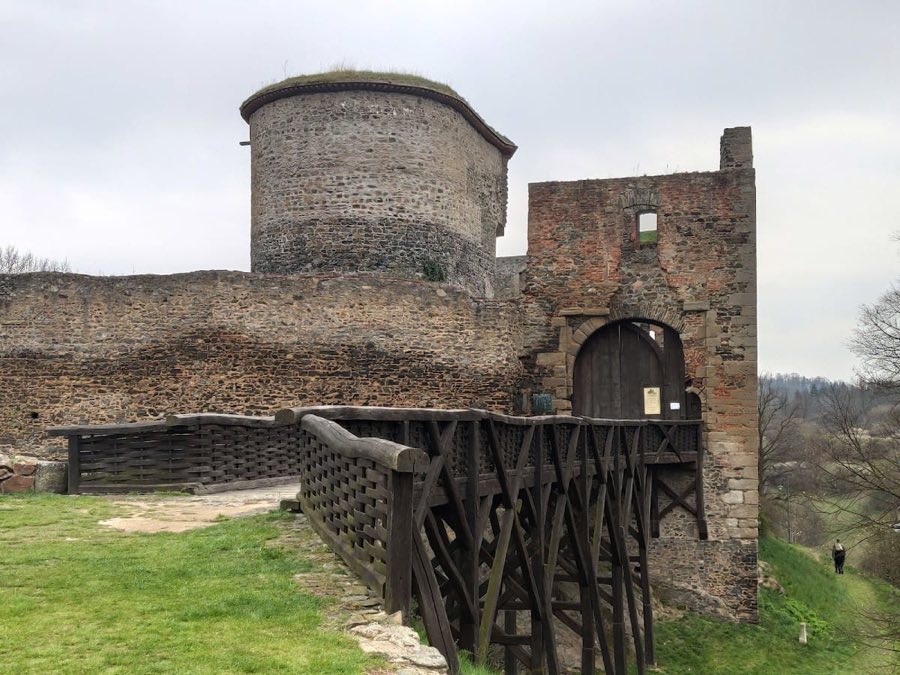
Expansions in the late 13th century added a strong outer wall and a round bergfried, further enhancing defense and residence. Additional palatial buildings were constructed, along with a tower-like structure situated between these palaces. By the second half of the 15th century, advances in warfare led to the building of fresh fortifications designed to resist firearms. Notably, a fortified outer bailey was created with a robust earthen rampart and included a battery tower that has since disappeared.
A noteworthy feature is a detached bastion positioned on a higher plateau north of the main castle above the left bank of the Brodeslavský stream. This bastion was separated from the castle by a semicircular ditch, partly carved into rock, and bordered by a low outer rampart. Its rampart rises up to four meters in height and is lined on the castle-facing side by a stone wall likely assembled without mortar, indicating medieval dry stone construction techniques.
The outer bailey contained several important buildings supporting the castle’s functioning. These included a brewery and malt house for producing beer, a smithy for metalwork, a tavern, a brickyard for construction materials, a bathhouse, and a mill located along the stream farther downstream. By the 18th century, the castle complex had grown to include two chapels, a dining hall (refectory), a kitchen, and as many as 27 residential rooms.
Today, Castle Krašov remains a ruin under cultural heritage protection since 1964. After its abandonment in the late 18th century, parts of the structure were dismantled so that the stone could be repurposed for local buildings. The surviving ruins reflect the complex building history and strategic position that once made the castle a notable stronghold in the region.
No. 48596

No. 79029
No. 49853
No. 70301
Comments
Comments for Castle Krašov will require a verified account before posting.
We'll send a verification link before your first comment is published.