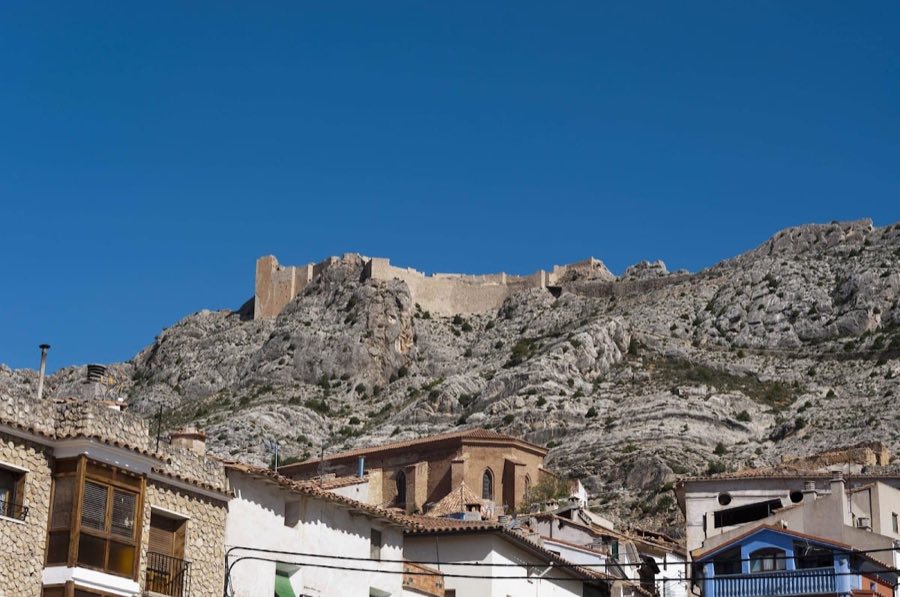
No. 87227
Castellote Castle
Spain
CastleRuin12th century
No. 75074
No. 75074 · 40.675 N, 0.705 W
Quick summary
Aliaga Castle is a castle in Spain with origins associated with the 12th century.
See all castles in SpainAliaga Castle in Aliaga, Spain, was built by Muslim builders in the twelfth century.
The castle began as a medieval fortress of Muslim origin. In 1118 King Alfonso I of Aragon captured the stronghold and granted it to Lope Johanes de Tarazona. After Alfonso I died in 1134, Aragonese forces withdrew and the castle reverted to Almoravid control that same year.
The castle entered lasting Christian hands under Alfonso II. In 1162 he donated the fortress to the Military Order of the Hospital of St John of Jerusalem, and by at least 1180 the site served as the seat of the order’s encomienda that administered the nearby castles of Pitarque, Fortanete, Villarroya de los Pinares and Sollavientos.
In 1462 the lord of Híjar occupied the fortress during the Navarre civil war as a supporter of Carlos de Viana against King Juan II. After reconciling with Juan II he received the county of Aliaga and Castellote, and in 1487 the family of Híjar acquired the title of dukes of Aliaga.
The castle saw renewed military use in the nineteenth century. During the First Carlist War the Maestrazgo region, including this fortress, was fortified under the regional command of Carlist general Ramón Cabrera. On 16 April 1840 General Leopoldo O’Donnell, leading liberal forces, besieged the town. The local commander Francisco Macarulla surrendered the plaza after heavy artillery fire; the complex was bombarded and suffered serious damage.
After the fighting the castle fell into progressive decay. In 1972 State Heritage auctioned the property and a private buyer acquired it for 120,000 pesetas. The site was declared a Bien de Interés Cultural in 2006. Descendants of the 1972 purchaser sold the property to the Town Council of Aliaga in 2022 for €50,000, and the castle is now publicly owned. The town council seeks support from the State and the Diputación General de Aragón to promote rehabilitation.
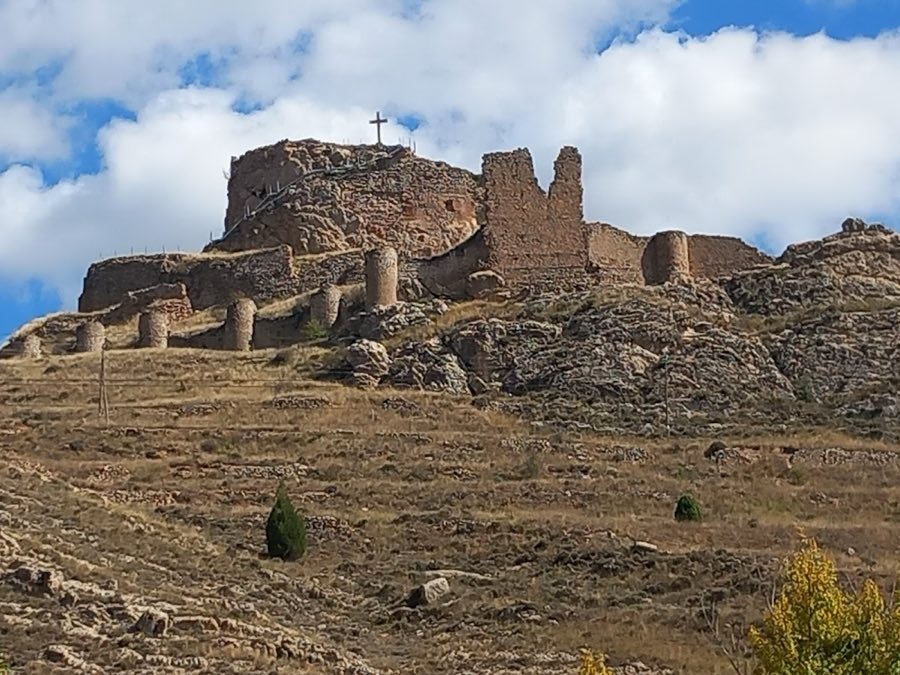
The castle occupies about 4,000 square metres and follows a complex, irregular plan that makes use of the hillside. Construction uses rammed earth for large wall sections and rubble masonry in other parts, producing a mixed technique typical of medieval hilltop fortifications. The ensemble consists of three staggered enclosures arranged down the slope so that each line of defence steps below the next.
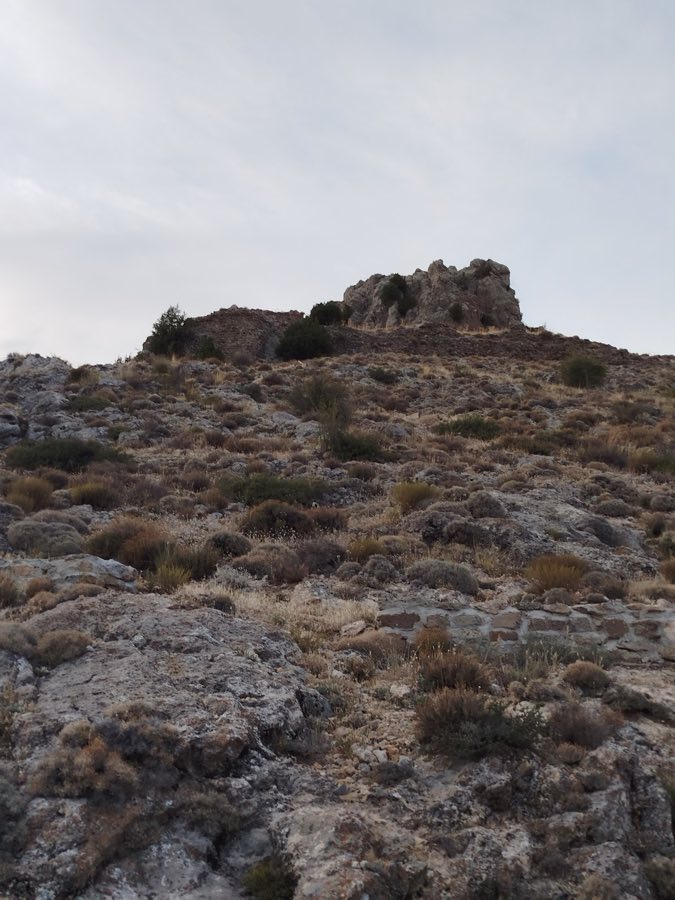
The original enclosure crowns the highest rock and contained the keep. Only the keep’s base survives there today, preserved as a substantial fragment of the main tower and reached now by a modern metal staircase that gives access to this ruined core. This part of the fortress dates to the medieval phase established in the twelfth century and represents the earliest defended position on the site.
Below the main stronghold a second walled curtain once extended across the slope. At present this middle enclosure survives only in two short stretches of wall, which remain as fragmentary reminders of the former intermediate line of defence. Those remnants retain their construction in rubble masonry and rammed earth and show the stepped arrangement that linked the upper and lower zones.
The outer enclosure is the most complete component and forms a low-height perimeter roughly one hundred by fifty metres in plan. Its wall is lined with a sequence of small semicircular defensive bulwarks, each about three metres across and set closely together. On the southeast side of this outer ring stand the remains of a large rectangular tower, roughly eight by seven metres in plan, built in rammed earth. Overall the complex is in partial ruin, with serious deterioration recorded after nineteenth-century bombardment and continuing decay that has left some towers at risk of collapse.
No. 87227
No. 75159

No. 68788
No. 85613
Comments
Comments for Aliaga Castle will require a verified account before posting.
We'll send a verification link before your first comment is published.