No. 93845
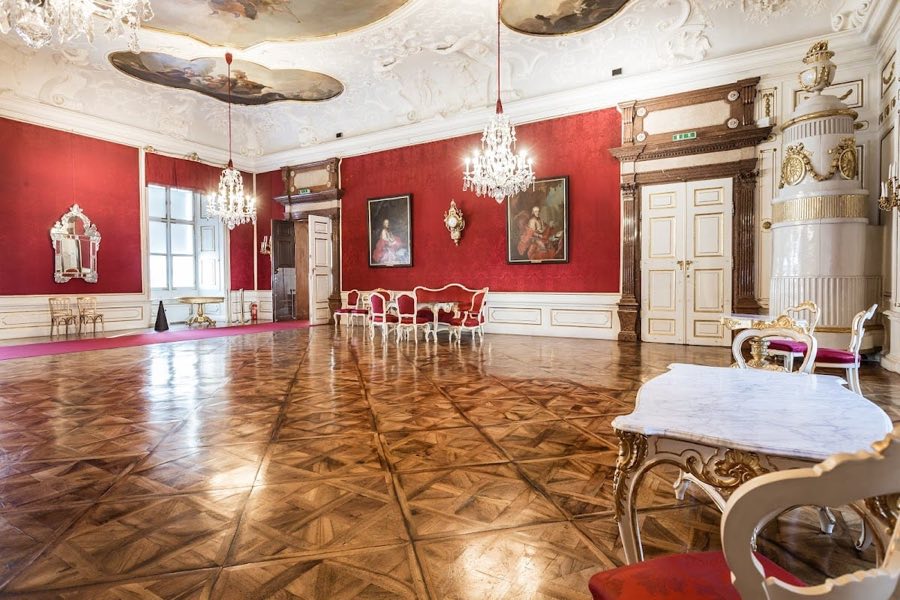
Salzburg Residenz
Austria
PalaceRestoredFor events18th century
No. 43886
Château · Austria
No. 43886 · 47.800 N, 13.058 E
For events
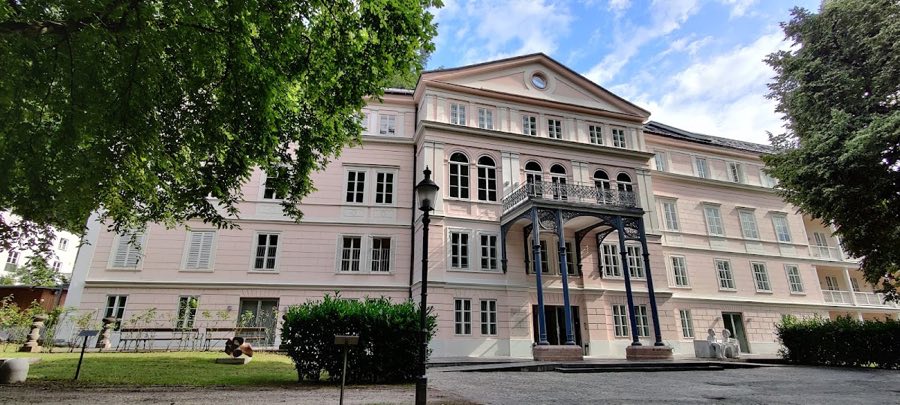
Arenberg Castle, Salzburg is marked as a château or castle venue lead. Capacity, indoor/outdoor spaces, catering rules, and accommodation options are published only after public verification.
Event types: Private events, Cultural gatherings, Filming and photography
Quick summary
Arenberg Castle, Salzburg is a château in Salzburg, Austria with origins associated with the 17th century.
See all castles in AustriaArenberg Castle, Salzburg, Austria, stands as an early 17th-century château later reshaped in the 19th-century Biedermeier manner, and its history links medieval church ownership, noble residence, religious education, and modern cultural use. The place appears in records from the 14th century under the cathedral chapter, and over the centuries it has changed hands and functions in ways that reflected shifting social and institutional needs in Salzburg. Its grounds yielded a substantial Roman burial ground during park works in the late 18th century, and the property today falls within the right-bank Old Town that is part of the city’s UNESCO-protected historic centre.
In the 16th century the site served as the seat of regional nobility, first held by the lords of Pirglstein and later by the lords of Rehlingen. In the 17th century the archbishop Johann Ernst von Thun acquired the estate and in 1695 transferred it to members of the Ursuline order to provide living quarters and a school for girls. The location proved unsuitable for their plans, and the nuns began building a new convent and school on Gstättengasse, with work starting in 1699 and finishing around 1720. After the Ursulines departed, the former castle accommodated teaching activities connected with the diocesan seminary.
At the end of the 18th century the estate entered private hands when Rosenegger purchased it in 1791 and laid out an extensive landscape park in the fashion of English gardens. Excavations made during those works in 1792 uncovered a large Roman cemetery along with movable treasures. A major fire in 1814 led to rebuilding in the Biedermeier idiom that shaped the castle’s present appearance. The geologist Eberhard Fugger was born there on 3 January 1842. In 1861 Princess Sophie of Arenberg, née Princess of Auersperg, acquired the property and enlarged the house by joining two three-storey wings with a new central section.
During the early 20th century the castle housed the writer and thinker Hermann Bahr and his wife Anna Bahr-Mildenburg, an opera singer and co-founder of the Salzburg Festival, from 1912 until 1922. Ownership passed in 1931 to the city and state of Salzburg together with the Salzburg Savings Bank. In January 2001 the Salzburg Stiftung of the American Austrian Foundation bought the property to establish an international conference centre for physicians, scientists and artists; after renovation the building reopened around 2005. On 20 April 2009 welding work sparked a fire that destroyed the roof truss; the roof was rebuilt and the centre resumed operations in April 2010. The castle and its grounds remain part of the historic core on the Salzach’s right bank.
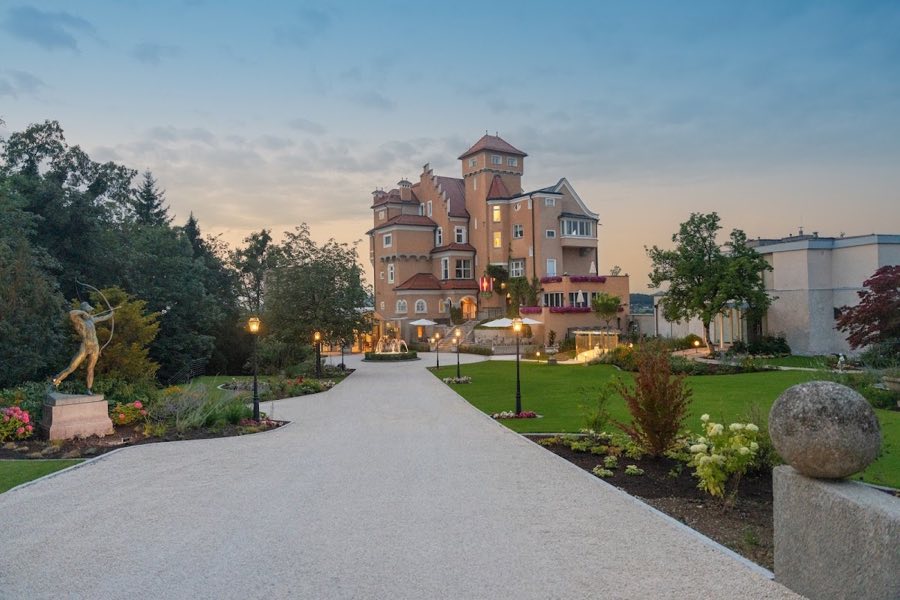
The manor presents as an originally early 17th-century château that was reconstructed in the 19th century in a late-Biedermeier appearance. The principal front is organized in six vertical sections and shows a central projecting section topped by a gable, with numerous windows emphasizing the elevation. The compound contains two three-storey blocks from the Rosenegger period that were linked by a central connecting wing during the 1861 enlargement. The site stands on the Salzach’s right bank, tucked between the lower slopes of the Kapuzinerberg and the northern face of the small Bürglstein rock.
Surrounding the house is a large English-style landscape park laid out around the turn of the 19th century. The grounds include the Bürglstein within their plan and are reachable from the street below; the park is open to the public and displays modern outdoor works from the Würth Foundation, among them Großer Phönix III (1966) by Bernhard Heiliger and an Untitled piece (2006) by Gertrude Reum. Remains of the late 18th-century layout survive in the form of pedestal bases that once supported a garden pavilion and two stone sculptures. A path rising from the park climbs the Bürglstein, though views from that ascent are limited by tree cover.
Archaeological activity tied to the park works of 1792 produced a large Roman cemetery and associated treasures discovered during ground disturbance at that time. In terms of building fabric, the roof truss was lost to a fire on 20 April 2009 but was subsequently reconstructed, allowing the complex to return to use. The main house, the linked three-storey wings, the surviving park pedestals and the modern sculpture installations together form the ensemble visible at the site today.
No. 93845
No. 55579
No. 68646
No. 35699
Comments
Comments for Arenberg Castle, Salzburg will require a verified account before posting.
We'll send a verification link before your first comment is published.