No. 34380
Castleknock Castle
Ireland
CastleRuin8th century
No. 10634
Tower house · Ireland
No. 10634 · 53.366 N, 6.331 W
Quick summary
Ashtown Castle is a tower house in Ireland with origins associated with the 15th century.
See all castles in IrelandAshtown Castle stands within Phoenix Park in Dublin, Ireland, and was built by the Anglo-Norman settlers who established tower houses throughout the country during the medieval period. Its origins can be traced back to the 15th century, most likely the 1430s, supported by its measurement aligning with a royal building grant policy issued under King Henry VI. This policy rewarded builders £10 for constructing castles of certain dimensions designed to provide personal security, indicating the castle’s initial purpose as a fortified residence.
By the early 1600s, the castle was well established and had undergone alterations to its roofline. In 1641, ownership passed to John Connell, known as John of Ashtown, who held an estate of 200 acres with an assessed value of about £200. This period reflects the castle functioning within a landed estate typical of the Irish countryside, bridging medieval and early modern eras in Ireland’s social landscape.
The surrounding property saw significant development from the mid-18th century, when Ashtown Lodge was built adjacent to the castle from 1751. This larger residence was subsequently expanded and modernized beginning in 1774. By 1782, Ashtown Lodge had become the official home of the Under Secretary for Ireland, marking its transition from purely residential or defensive use toward an administrative role within the British governance of Ireland.
In the 20th century, the site served diplomatic functions. Between 1922 and 1929, it housed the United States embassy, prior to the embassy’s relocation to a site known as Deerfield. Following the American tenure, the Apostolic Nuncio—the Vatican’s diplomatic office—occupied the property until 1978. During this time, the castle remained obscured within the walls of the Georgian-era Ashtown Lodge structure.
Following decades of neglect, Ashtown Lodge was demolished in 1989 after structural problems grew severe. This demolition uncovered the medieval tower house at the core of the estate for the first time in centuries. Restoration efforts that year removed later alterations and sought to reveal the castle’s original 15th-century appearance. Although the lodge complex had been proposed as a residence for the Irish prime minister, only the medieval tower house was preserved and returned to its historical form.
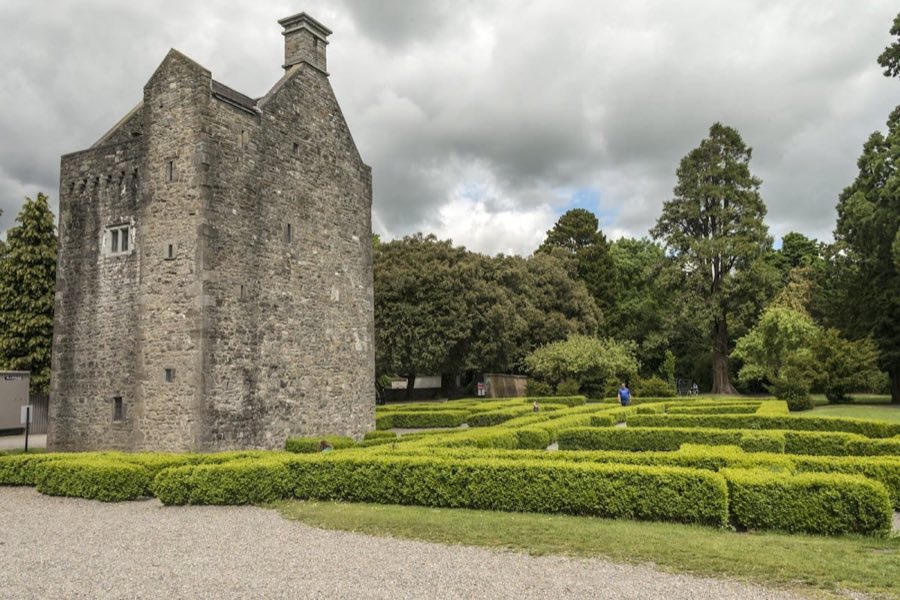
The site’s primary surviving feature is the original medieval tower house, a rectangular four-story stone structure measuring roughly 6 by 9 meters. Its design follows the typical style of Irish tower houses, compact and fortified residences built for defense and habitation. At the southeast corner, a projecting turret contains a spiral staircase, providing access to the upper floors while also serving a defensive purpose.
The ground floor’s precise original use remains uncertain, but it likely included a kitchen area, as in many similar tower houses where the lowest level was often devoted to service and storage. Above this, the first floor functioned as the lord’s living quarters, offering private domestic space. The second floor contained the great hall, a formal room for gatherings and important household activities. Defensive features were incorporated into the uppermost parts of the tower, notably within the roof section, which has been reconstructed with a pitched saddle roof following restoration work.
Surrounding the tower house, the layout of gardens now traces the footprint of the former Ashtown Lodge, the Georgian residence built in the 18th century and later extended to envelop the castle. The lodge’s more modern windows and modifications obscured the medieval tower for many years, but restoration efforts in 1989 removed these Georgian additions to return the structure to a medieval form closer to its original state.
Constructed primarily of stone, the tower house’s robust walls exemplify the defensive architecture typical of its time. Today, the restored castle stands as part of the Phoenix Park Visitor Centre complex, where its medieval character has been preserved, revealing the historical layers of the site and its evolution from a fortified dwelling into a diplomatic residence and, ultimately, a heritage landmark.
No. 34380
No. 75333
No. 16294
No. 89100
Comments
Comments for Ashtown Castle will require a verified account before posting.
We'll send a verification link before your first comment is published.