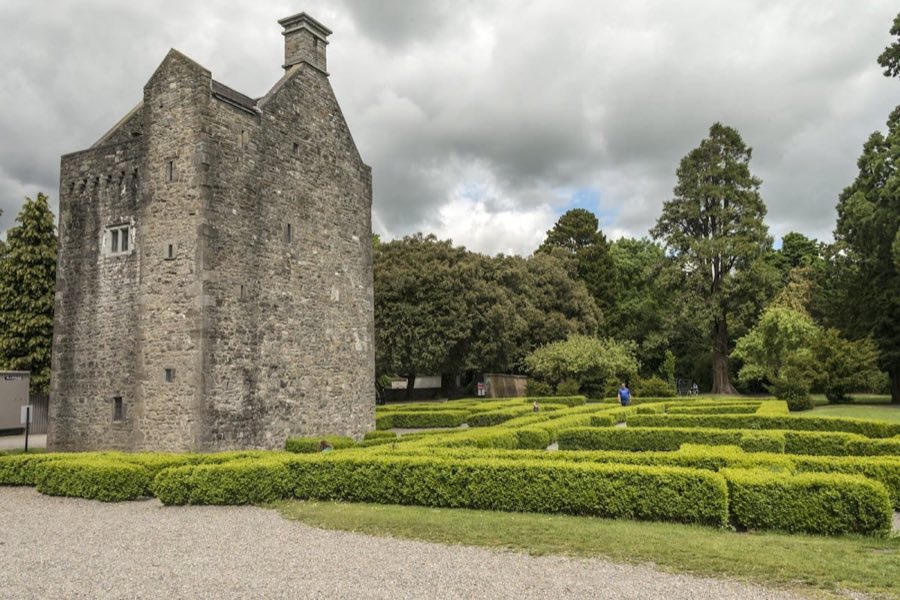
No. 10634
Ashtown Castle
Ireland
Tower houseRestored15th century
No. 34380
Castle · Ireland
No. 34380 · 53.368 N, 6.366 W
Quick summary
Castleknock Castle is a castle in Ireland with origins associated with the 8th century.
See all castles in IrelandCastleknock Castle is in Castleknock, Dublin, Ireland, and it was established by Norman settlers.
The place is recorded in early medieval Irish annals under the name Cnucha, and those records note the death of Congalach of Cnucha in 726 at his fort. In 1861 work on the grave of Reverend Thomas Plunket exposed a very large flat stone over a hollow chamber inside the castle interior, and this chamber contained a human skeleton; the feature discovered on that occasion was described as a druidic cromlech.
A Norman knight, Hugh Tyrrel, later styled Baron of Castleknock, founded the castle. He chose the summit of two esker mounds to command the route toward Dublin. Around 1171 the stronghold served as the final rallying point for Rory O’Connor during the Anglo‑Norman advance.
Richard Tyrrell, the second Baron of Castleknock, established an Abbey of St. Brigid at the site in 1184 on land where a Protestant church now stands. The monastery prospered until the dissolution of the monasteries, after which the abbey was demolished and a Protestant church replaced it.
During the Bruce campaign in Ireland, 1316 to 1317, forces under Edward Bruce captured Castleknock, took Hugh Tyrrell prisoner, and used the castle as a headquarters before releasing captives for ransom and withdrawing. In the 1640s the castle endured violent action during the wars of that decade. In 1642 it was besieged, with a contemporary account mentioning an attack by the Earl of Ormond and another describing an assault by General Monck; defenders burned valuables and suffered heavy casualties, and some survivors were executed in certain accounts. Monck left a garrison and the fortress suffered serious damage from artillery. Owen Roe O’Neill recaptured the site in 1647. After the conflict the Commonwealth government ordered the partial demolition of the battered castle and the estate was divided among private tenants.
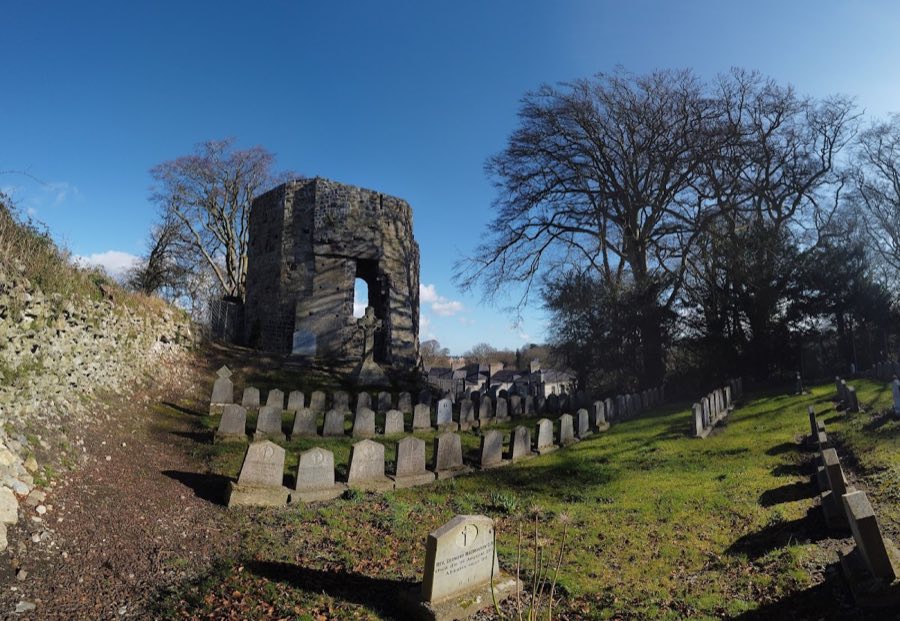
In 1834 forty acres that included the ruins were sold to John McCann, a Vincentian friar, who founded St. Vincent’s Ecclesiastical Seminary, now St. Vincent’s Castleknock College. The ground within the old walls later became a cemetery for priests of the Society of St. Vincent de Paul and other missioners.
The site crowns two mounds of an esker and occupies the top of a prominent hill, which originally gave the castle control over the western approach to Dublin. The surviving fabric presents as ruinous, much overgrown with trees and often cloaked in ivy, and the ruins were partly demolished after sustaining artillery damage in the 17th century. An early drawing by Francis Place shows the castle already in decay but less ruinous than it is today.
The principal element of the defences was a polygonal keep, described as the most notable tower on the site, with one account giving its height at about 24 metres. A large, squat building was attached to this main tower. The keep and its attached range formed the central strongpoint of the complex and remain as the most prominent remnants of the medieval fortress.
A circuit of curtain wall, punctuated by towers, enclosed the castle platform and the whole position was protected by two deep ditches that formed a double moat around the site. The curtain and towers once carried heavy battlements and deep embrasures adapted to the castle’s defensive needs; these features are recorded in descriptions of the fortification.
Within the interior, the 1861 discovery revealed a very large flat stone forming an altar‑like tomb over a hollow chamber that contained a human skeleton, a feature reported at the time as a druidic cromlech. This in situ subsurface monument was exposed during burial works and remains a noted element of the site’s long sequence of use.
A separate small mound west of the college, known locally as Windmill Hill, is topped by a later tower that was built as an observatory by a previous owner named Simon Quinn or Simon Guinn and has since served as a water tower. The land enclosed by the medieval walls was later reused for the Vincentian seminary and is now the burial ground for priests associated with that community.
No. 10634
No. 89100
No. 75333
No. 16294
Comments
Comments for Castleknock Castle will require a verified account before posting.
We'll send a verification link before your first comment is published.