No. 79488
Felix Romuliana
Serbia
PalaceRuinFor events3rd century
No. 26439
Castle · Bulgaria
No. 26439 · 43.993 N, 22.887 E
Quick summary
Baba Vida is a castle in Bulgaria with origins associated with the 14th century.
See all castles in BulgariaBaba Vida is a medieval fortress in Vidin municipality, Bulgaria, built by medieval Bulgarian rulers on the foundations of the Roman fortress Bononia.
The site began to take shape in the tenth century atop the earlier Roman fortifications. Local tradition links the name to a legend of three daughters of a Danubian Bulgarian ruler, Vida, Kula and Gamza, with Vida said to have raised the stronghold that later bore her name. Throughout the Middle Ages the castle served as Vidin’s principal defensive work and the main fortress of northwestern Bulgaria.
In the medieval era the fortress withstood an eight‑month siege led by Byzantine forces under Emperor Basil II. The structure was later destroyed and then rebuilt during the rule of Ivan Stratsimir, who in the mid fourteenth century used Baba Vida as his seat, principal residence and capital. Between 1365 and 1369 the fortress passed under Hungarian control after an attack by King Louis I, a campaign that required several months to effect a capture; in 1369 Ivan Stratsimir recovered the stronghold while remaining under Hungarian suzerainty. Ottoman forces invaded Stratsimir’s lands in 1388 and compelled him to accept vassalage. In 1396 Stratsimir took part in the anti‑Ottoman crusade under King Sigismund that ended at Nicopolis, and by 1397 Ottoman power had taken most of his domains.
Under Ottoman rule the fortress served as an arms depot and a prison, and much of the complex was damaged during that period. At a later date it was used as the residence of Osman Pazvantoğlu. From the late eighteenth century the site ceased to serve as an active defensive fortification. Military authorities restricted access in 1878 and it remained in use into the late nineteenth century as a prison and ammunition storage. Archaeological work was carried out in the 1950s and 1960s. The site opened to the public in 1958, a summer theatre was established within the enclosure in the 1960s, and in 1964 the fortress was declared a monument of national and cultural importance. The complex now functions as a museum.
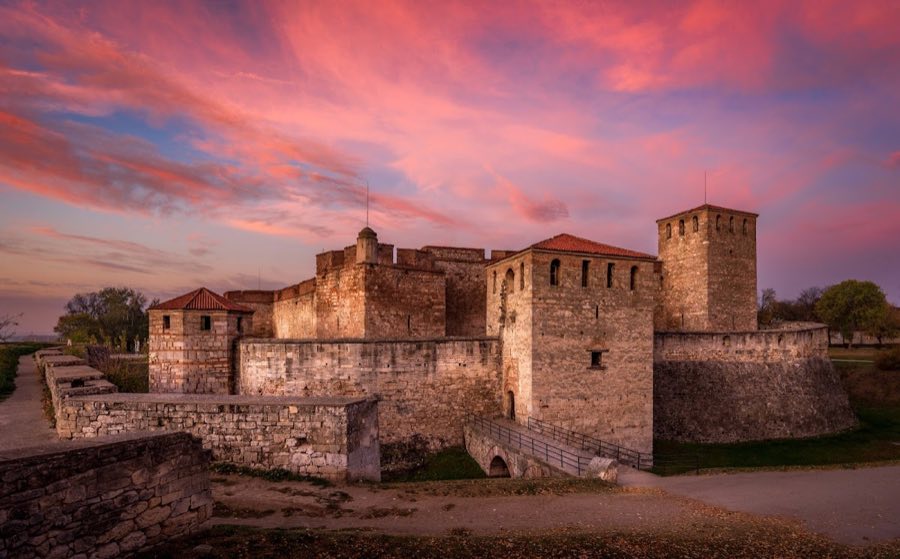
Baba Vida is laid out as a concentric fortification, with two rings of curtain walls built directly over the Roman footings of Bononia and sited on the bank of the Danube at an elevation of 39 metres above sea level. The defensive ensemble preserves the pattern of inner and outer walls that defined the castle’s layered protection.
The defensive circuit includes multiple towers. Descriptions record about nine towers in some references and elsewhere list eight defensive towers. One reconstruction of the tower plan places four towers at the corners, three along the curtain walls, and a heavily fortified tower directly above the gate, which served as the main entrance’s strongest point.
Three towers survive to their full medieval height and retain their original crenellated tops, standing as the best-preserved vertical elements of the fortress. The surrounding moat has been measured at roughly four metres deep and six metres wide, forming a clear water barrier between the riverbank and the fortifications.
Stone and masonry form the primary materials of the walls and towers, following the medieval building practice established on the Roman foundations. The complex saw later reuses: during Ottoman rule parts of the fortress were adapted for armament storage and for a prison, and one period of occupation converted portions into a residence for Osman Pazvantoğlu. In the twentieth century interior space was further altered when a summer theatre was constructed within the courtyard area, the performance space recorded as seating about 350 people.
Interior areas include the former prison, which is now presented with its instruments of torture on display, and spaces that have been conserved or restored as museum rooms. The overall condition combines high preservation with evidence of earlier destruction: the fortress is noted as the only medieval castle in Bulgaria described as entirely preserved, yet it bears clear traces of substantial damage sustained under Ottoman control. Archaeological investigations in the mid twentieth century informed the restoration and the later placement of the theatre and museum displays within the surviving fabric.
No. 79488
No. 24629
No. 86381
No. 84501
Comments
Comments for Baba Vida will require a verified account before posting.
We'll send a verification link before your first comment is published.