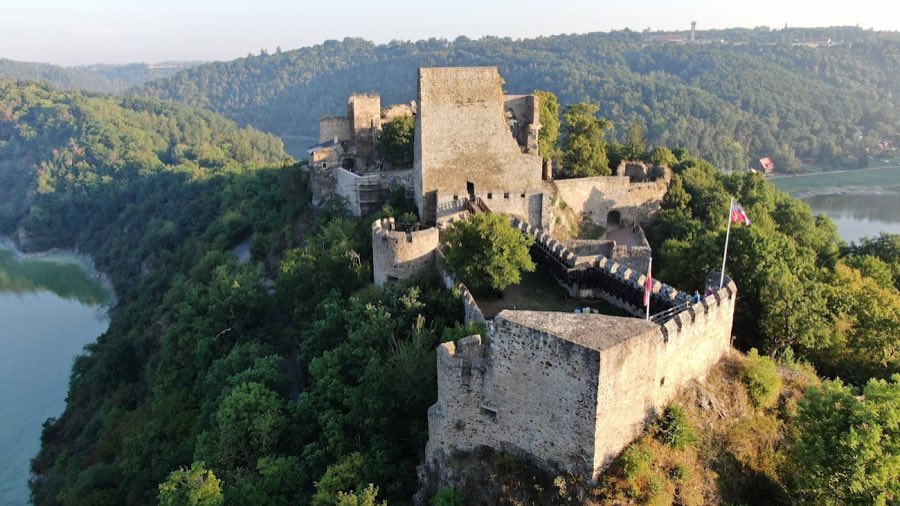
No. 86732
Cornštejn Castle
Czechia
CastleRuin14th century
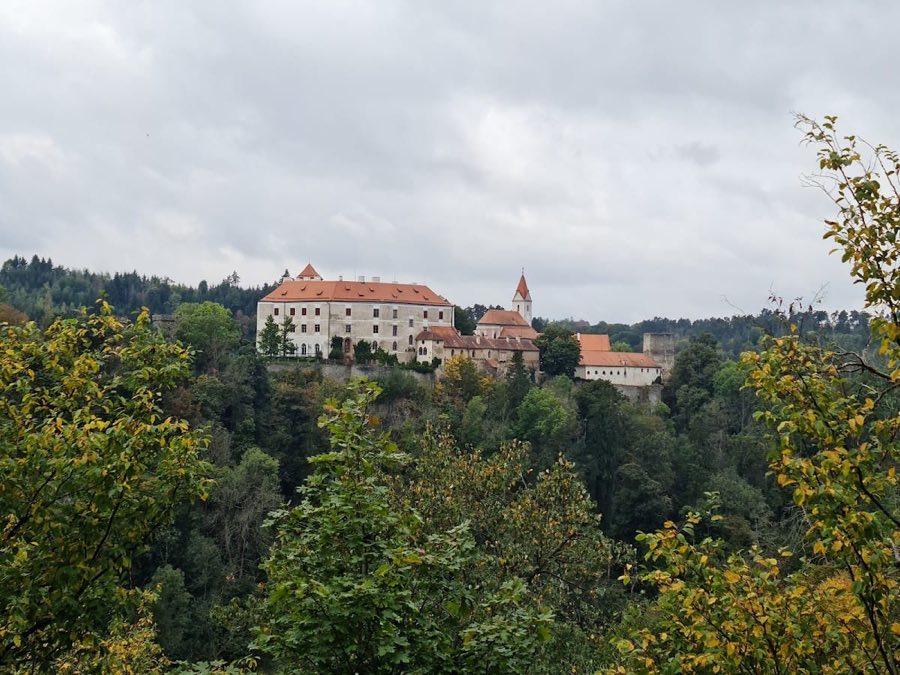
No. 26010
Castle · Czechia
No. 26010 · 48.944 N, 15.700 E
Quick summary
Bítov Castle is a castle in Czechia with origins associated with the 11th century.
See all castles in CzechiaBítov Castle is located in the municipality of Bítov in what is now the Czech Republic. It was originally established by early medieval settlers on the site of a prior Great Moravian settlement dating back to between the 8th and 10th centuries. The castle’s foundation occurred in the 11th century, likely as part of a defensive system created by the Přemyslid dynasty to secure the border between Bohemia-Moravia and Austria.
The earliest written references to Bítov Castle, between 1046 and 1067, connect it to ecclesiastical revenues, indicating its early importance. Through the 12th century, the castle became a key administrative center within the principalities of Brno and later Znojmo. It contributed significantly to the colonization and control of the Czech-Moravian Highlands. Its strategic location made it a stronghold in the recurring conflicts against Austrian forces, including the notable Babenberg family.
In the early 13th century, King Přemysl Otakar I designated Bítov as the heart of the Bítov province, which was one of six administrative units within the Moravian March. This elevated the castle’s regional status. However, in 1233, during a siege led by Austrian Duke Frederick II, the castle was compelled to surrender after enduring attacks with siege engines. Not long after, before 1240, construction of a stone bergfried tower featuring a distinctive wedge-shaped outer wall was completed, marking a key change from earlier wooden fortifications to more durable stone defenses. Later in the mid-13th century, King Přemysl Otakar II undertook a comprehensive reconstruction of the castle using stone.
Starting around the turn of the 14th century, Bítov Castle came into the possession of the Lichtenburg family, who first held it as collateral and then inherited it. They largely reshaped it into a Gothic fortress by adding three towers and building a new palace at the higher eastern section of the castle rock, replacing earlier structures located lower down. In 1334, the family also established a chapel dedicated to the Assumption of the Virgin Mary. Over the 14th and 15th centuries, the Lichtenburgs continued to strengthen the castle with several defensive additions, including prismatic towers with angled walls, moats, and strong curtain walls designed to protect against attacks from the surrounding hills and valleys.
In the late 15th and early 16th centuries, under Henry the Elder of Lichtenburg, the castle underwent further enhancements that made it one of the most secure border fortresses in the kingdom. These improvements included linking previously separate sections of fortification and moving the primary entrance. In the 17th century, ownership passed to the Jankovský of Vlašim family, who remodeled the castle with Baroque fortified chateau features. The 19th century saw the Daun family initiate romantic Gothic revival renovations, including an expanded and elevated chapel.
After 1945, the castle was nationalized and became managed by the Czech National Heritage Institute. Recognized for its historical value, Bítov Castle was protected as a cultural monument from 1958 and later designated as a national cultural monument in 2001.
Bítov Castle is perched on a rocky promontory approximately 70 meters above the Želetavka River near its meeting point with the Dyje River. This natural position offered significant defensive advantages. The original medieval complex was divided into three main sections separated by ramparts. Early fortifications consisted primarily of wooden and clay structures surrounded by moats on the eastern and western sides. Of these early works, only the castle chapel dedicated to the Virgin Mary was initially constructed in stone.
A prominent feature dating from the 13th century is the bergfried tower, a type of tall defensive tower. Its wedge-shaped outer wall faced the access road and was surrounded by a stone curtain wall. This design was innovative in the Czech lands and influenced the construction of other castles in the region, such as Zvíkov and Strakonice.
During the Gothic transformation carried out by the Lichtenburg family, the castle’s main components were relocated to the higher eastern part of the rock. Here, three formidable towers were built along with a new palace arranged around an irregularly shaped courtyard. The chapel was rebuilt and expanded within this palatial complex, creating a central religious space. Defensive improvements included additional prismatic towers—towers with a polygonal shape—featuring wedge-shaped outer walls protecting the primary access routes. A horseshoe-shaped moat and a powerful curtain wall guarded the outer rampart facing Trampelberk hill, which overlooked the river junction.
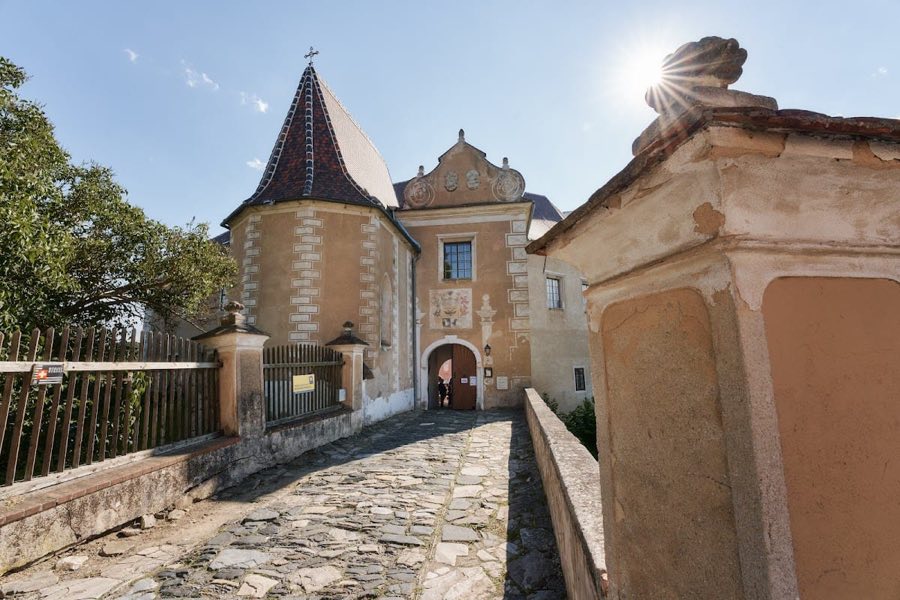
In the late medieval period, as the garrison grew, new fortifications were added down the slope closer to the valley. One of these was a wedge-shaped tower positioned to defend against potential attacker fire coming from opposite slopes. Later modifications in the late 15th century further connected previously isolated fortification segments and introduced a new main prismatic tower. These changes included relocating the castle’s entrance from the north to the southern end of the narrow isthmus. Today, the surviving entrance gate and a tall prismatic gate tower situated on the southwest corner of the palace complex stand out as significant remnants of these transformations.
Inside the chapel dedicated to the Assumption of the Virgin Mary, substantial remodeling occurred during the 19th century. The chapel was raised in height and extended, featuring a new main altar painting created by Anton Ziegler. Beneath the mosaic floor lies a family crypt. One of the chapel’s treasured items is a rare 14th-century Gothic statue of the Madonna holding a bird, originally from nearby Cornštejn Castle.
The castle’s interiors hold valuable collections assembled by its last private owner, Baron Georg Haas. These include German and Austrian Romantic paintings as well as zoological exhibits.
Surrounding the castle, grounds once included a large English-style romantic park adorned with small buildings and sculptures. Among these was a commemorative column topped with the “Swedish Madonna,” a statue honoring protection from Swedish troops during the Thirty Years’ War. Much of this park was lost in the 1930s with the construction of the Vranov reservoir.
No. 86732
No. 11214
No. 64104
No. 28179
Comments
Comments for Bítov Castle will require a verified account before posting.
We'll send a verification link before your first comment is published.