No. 99565
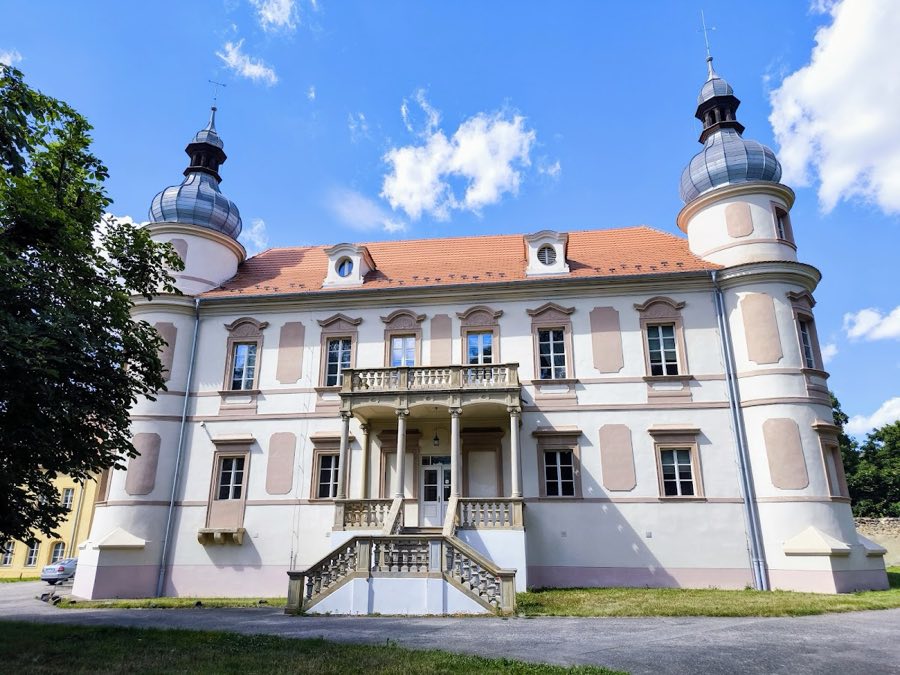
Krásné Březno Castle
Czechia
CastleRestored14th century
No. 78957
No. 78957 · 50.698 N, 14.099 E
Quick summary
Blansko Castle is a castle in Czechia with origins associated with the 19th century.
See all castles in CzechiaThe hill above Ryjice appears in surviving records from 1169, when King Vladislaus granted holdings in the Bílina area to the Hospitallers; a 1186 document refers to the district as Levín. Pottery shows habitation near the later residential range in the late 1200s, and settlement around the castle site is clear by the turn of the 13th and 14th centuries. The stone stronghold was established and fortified in the 1390s and is explicitly called a castle by 1401. It became the centre of a branch of the Wartenberg family. Václav Wartenberk, an ally of King Sigismund, held the place in the early 1400s; forces loyal to King Wenceslas IV seized it in 1402, and Václav recovered it later that year. In 1416 a royal army under Mikuláš Hud of Újezd captured the fortress. In 1421 the castle passed to Albrecht Schenk of Landsberg and was garrisoned by the Margraves of Meissen until 1426; after the 1426 battle at Ústí the fortress fell to Sigismund Wartenberk and Děčín, who had joined the Hussites.
From the mid-1430s until the mid-1450s Jan Wartenberk, known as Blankenstein, held Blansko and used it as a base for raids into Saxony. From 1454 the estate passed through a succession of noble families; in 1527 Heinrich (Heřman) von Bünau purchased it. By the mid-1500s the owners no longer lived there regularly, leaving a castellan and garrison in place. After 1585 the fortifications were remodelled in a Renaissance manner, and by the end of that century an additional bastion and an enlarged gate are recorded. In 1628 Günther von Bünau sold the castle to Christoph Simon von Thun and it was incorporated into the Krasné-Březno estate. The building was used for various purposes, including as a prison, but it was abandoned during the fighting of the Thirty Years’ War and thereafter declined; the last contemporary document dates from 1628.
At the end of the 19th century a local mountain club erected an observation tower within the palas ruins. Major alterations in the 1930s substantially changed the hall and the observation structure; one account records a tower built in 1931 with a cylindrical-vaulted ground floor serving as a shelter. Ownership passed from the state forest administration to the municipality of Ryjice at the start of the 21st century, and work has been undertaken to stabilise and conserve the surviving masonry. The site is protected as a cultural monument of the Czech Republic.
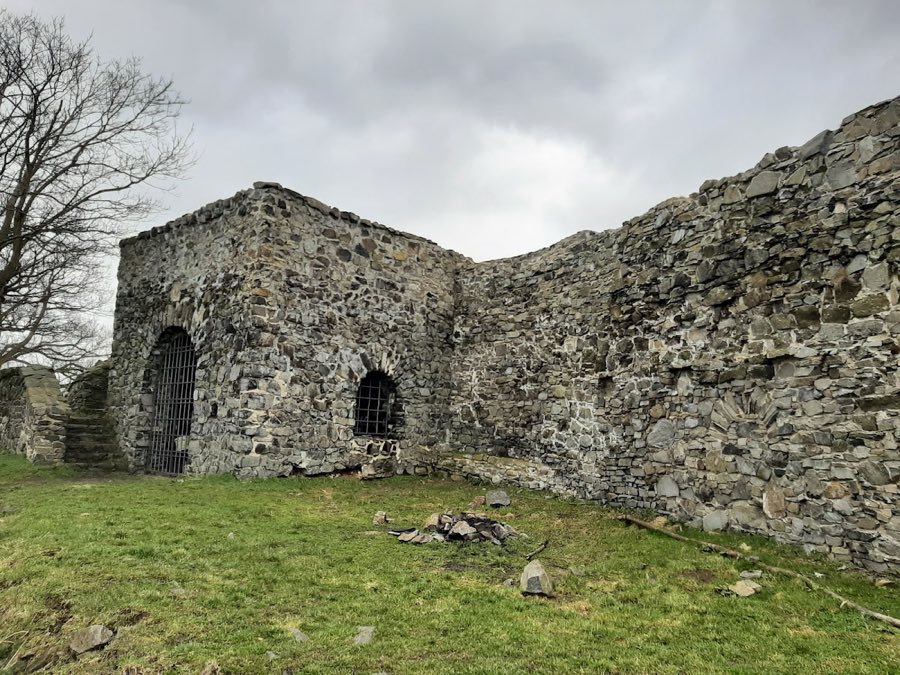
Blansko sits on a basalt summit at about 545 metres above sea level and survives as the ruin of a medieval hilltop castle. The enclosed area follows an irregular plan that can be read as four successive zones crossed by the former access road, which climbed the hill beside a rock outcrop on the right. The ensemble rests on solid volcanic rock and the surviving fabric is largely stone masonry that has been stabilised in recent conservation work.
A continuous defensive wall once encircled the site; from its line project two semicircular bastions and a small rectangular tower. These projecting elements provided some flanking coverage but did not form a complete system of mutual support. The main approach ran beneath the rocky summit, was dominated by the two bastions and then turned southwest toward a sequence of entrance arrangements whose form altered over time. The earliest approach crossed a substantial bridge to a gate tower set at an angle above the span; later access was reworked so that entrances were cut into a massive projecting wall above the bridge, allowing lateral fire onto the approach. Earlier commentators considered the bridge feature a remnant of the Renaissance alterations.
The inner stronghold was defended by a perimeter wall roughly two metres thick, along which a light covered wooden fighting walk once ran. The lower courtyard contained service buildings and rooms for the castellan or garrison steward, while the upper court housed a three-part palas providing accommodation on the north and east sides. Large sections of the outer circuit and major wall stretches remain visible, whereas the palas survived only in part until the 1930s, when much of the hall was lost to construction of the observation platform. Later additions reflect postmedieval reuse, notably the late 19th-century observation tower that was substantially altered in the 1930s. Conservation and reconstruction in the early 21st century have focused on stabilising the remaining masonry and preserving the extant walling. The site lies off the principal east–west routes of the region but was connected to local roads, including a westward track up the Neštěmice valley from a ford near Svadov and a more substantial line running from Děčín to Ústí north of the hill, both of which had branches leading to the castle.
No. 99565
No. 97944

No. 20565
No. 28534
Comments
Comments for Blansko Castle will require a verified account before posting.
We'll send a verification link before your first comment is published.