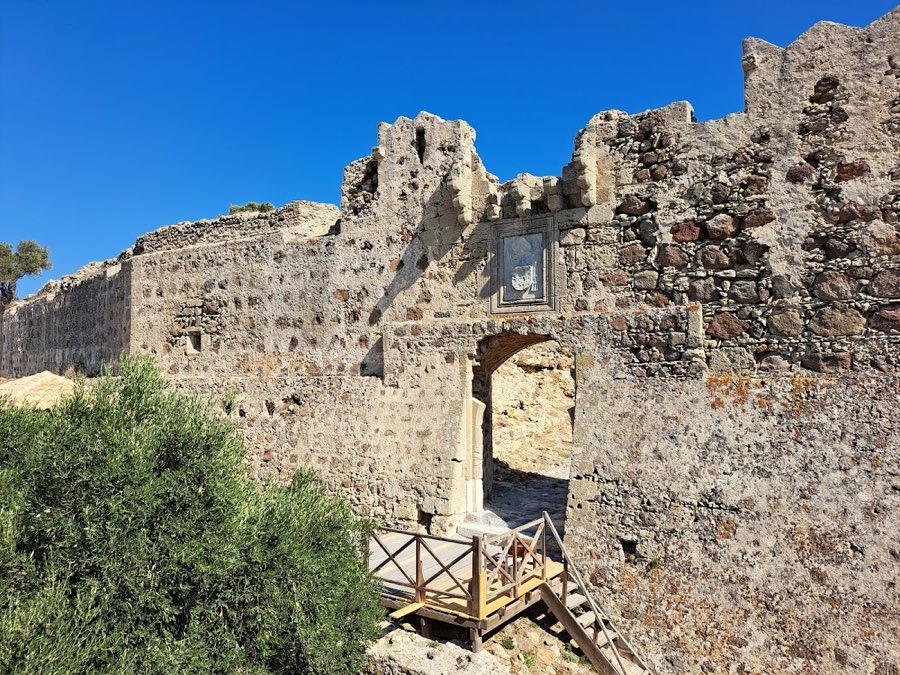
No. 13451
Antimachia Castle
Greece
CastleRuin14th century
No. 93416
Castle · Turkey
No. 93416 · 37.032 N, 27.429 E
Quick summary
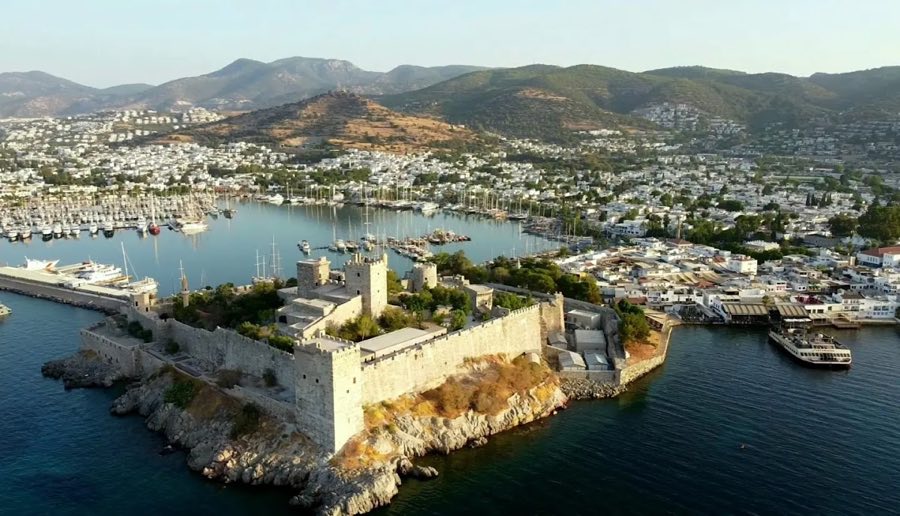
Bodrum Castle is a castle in Turkey with origins associated with the 15th century.
See all castles in TurkeyBodrum Castle in the municipality of Bodrum, Turkey, was constructed by the Knights of St John.
Work on the fortress began in the early 1400s, with building activity recorded from 1402 and a formal start of construction under the supervision of the German knight-architect Heinrich Schlegelholt around 1404. A chapel was in place by about 1406–1407, and the first circuit of walls was finished in 1437. Responsibility for the fabric of the fortress was divided among the Order’s national groups, or langues, and four towers came to be associated with particular communities, known later as the English, French, German and Italian towers.
The castle was strengthened in successive campaigns. In 1494 parts of the landward fortifications were thickened, using dressed stone taken from the nearby Mausoleum. A round bastion to reinforce the approach from the mainland was erected during the rule of Grand Master Fabrizio del Carretto between 1513 and 1521. The chapel received a Gothic rebuilding in 1519–1520 under the Spanish knights, whose names are carved on two cornerstones.
The fortress faced Ottoman pressure after the fall of Constantinople in 1453 and survived an attack in 1480. In 1482 Prince Cem Sultan sought refuge within its walls. Ottoman forces took the castle after campaigns in 1522–1523, with the fortress falling in 1523. Following the conquest the chapel was converted for Muslim worship and a minaret added; the site remained under Ottoman control for almost four centuries. The promontory on which the castle stands is also regarded as the probable location of the ancient Mausoleum of Halicarnassus, and the castle itself was long called the Castle of St. Peter or Petronium.
In the nineteenth and early twentieth centuries the castle saw varied military and civil uses. It served as a Turkish military base during the Greek Revolt of 1824. Reliefs and sculptural blocks were removed in 1846 under Lord Canning and in 1856 under Sir Charles Newton and taken to the British Museum. A minaret was added in the nineteenth century and the fortress was converted into a prison in 1895. On 26 May 1915 a French warship bombarded the castle, toppling the minaret and damaging several towers. After the First World War an Italian garrison was established and then withdrawn in 1921, leaving the castle unoccupied for decades.
State authorities converted the fortress in 1962 to the Bodrum Museum of Underwater Archaeology, a collection that largely reflects finds from underwater excavations carried out after 1960 by the Institute of Nautical Archaeology. The minaret that fell in 1915 was rebuilt in its earlier form in 1997. The castle was added to Turkey’s UNESCO Tentative List of World Heritage Sites in 2016.
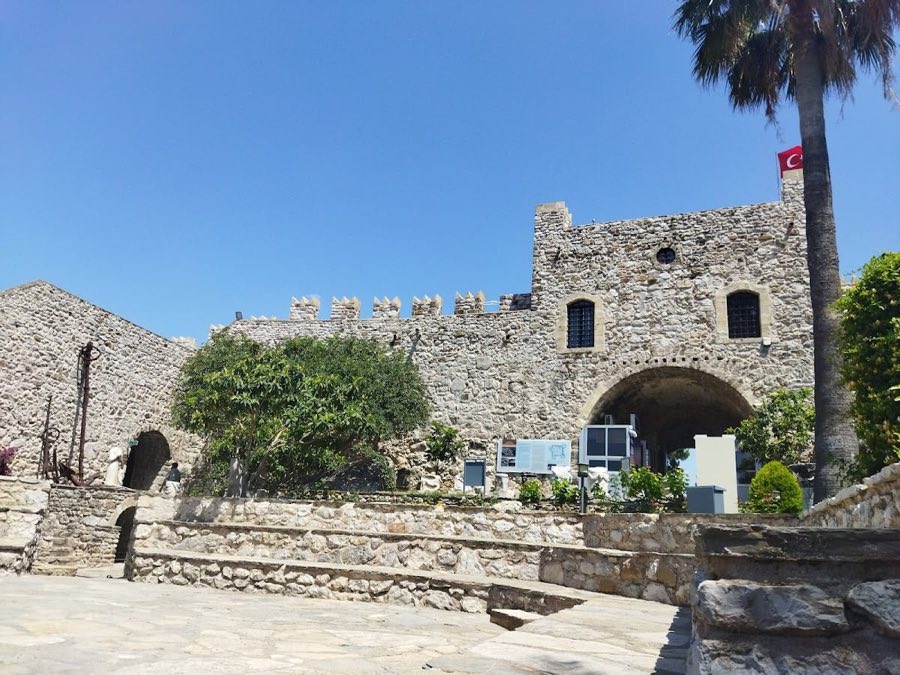
The castle occupies a rocky promontory at Bodrum harbour, built chiefly of squared green volcanic stone and finished with reused marble columns and sculptural blocks taken from the nearby Mausoleum. The plan combines multiple towers and a defended inner ward, approached by a series of gates and twisting passageways that lengthen and complicate any approach. Seven gates lead into the inner fortress, and the landward side was reinforced with a round bastion added in the early sixteenth century to meet the threat of gunpowder artillery.
A group of towers forms a prominent feature. Four are traditionally identified with the Order’s national groups and are named the English, French, German and Italian towers. The English, or Lion, Tower is three storeys high and was completed in 1413. It opened to the castle interior on its northern side and to the western rampart on its other side, and it was reached originally by a drawbridge. A carved lion relief decorates the western face and above it appears the coat of arms of King Henry IV of England.
The chapel presents a vaulted nave and an apse. Built soon after construction began, it was rebuilt in a Gothic manner in 1519–1520 by Spanish members of the Order, their names marked on two cornerstones. After Ottoman conquest it was adapted for use as a mosque and a minaret was attached; that minaret fell during the 1915 bombardment and was reconstructed in 1997. In its present museum role the former chapel houses collections of Mycenaean and Bronze Age vases and amphoras.
Water supply was organised beneath the fortress, where fourteen cisterns were cut into the rock to collect rainwater. Defensive adjustments are visible in the fabric: sections of the walls facing inland were thickened in the late fifteenth century with stone taken from the Mausoleum to resist cannon, while the sea-facing walls are noticeably thinner. Passages and approaches retain deliberately indirect lines that complicate access.
The castle’s decorative programme used a rich array of heraldry and sculptural relief. Hundreds of painted coats of arms and carved reliefs were placed on walls and above gates, and 249 distinct heraldic or relief designs are counted among the surviving examples. Between 1505 and 1507 several large sculptural blocks from the Mausoleum were incorporated into the fortress for decoration, including twelve slabs showing Amazonomachy scenes, a block with a Centauromachy, several sculpted lions and a figure of a running leopard. Some of these elements were later removed and dispersed to other collections.
Later changes altered the internal layout and functions. Spaces within the walls were used as a bathhouse and a prison before the twentieth century museum conversion. The Italian Tower contains the Coin and Jewelry Hall and an exhibition devoted to the tomb of a Carian princess who died between 360 and 325 BC. Two reconstructed ancient shipwrecks are displayed under the ramparts: the Fatimi vessel, which sank in 1077 AD, and the Uluburun shipwreck, dated to the fourteenth century BC. A garden inside the castle supports Mediterranean plants and trees, and the towers afford views across the town and neighbouring bays.
No. 13451
No. 66324
No. 93133
No. 60902
Comments
Comments for Bodrum Castle will require a verified account before posting.
We'll send a verification link before your first comment is published.