No. 91291
Castels Castle
Switzerland
CastleRuin13th century
No. 73056
Castle · Switzerland
No. 73056 · 46.922 N, 9.776 E
Quick summary
Burg Kapfenstein is a castle in Switzerland with origins associated with the 13th century.
See all castles in SwitzerlandBurg Kapfenstein in the municipality of Küblis, Switzerland, was built in the medieval period by local noble families.
The earliest personal names connected to the place appear in the 13th century. A Ulricus de Kaphinstain is recorded in 1249, and a Heinrich von Kapfenstein is mentioned as dead in 1275. The site itself first enters surviving documents in 1275, when a transaction between Walter von Vaz and the bishopric of Chur explicitly names the castle as castro de Kaphenstain. The fortress also appears under the alternative name Ober-Sansch, and its name is linked to the Middle High German verb kapfen, meaning to look, giving the sense of a castle from which one looks out.
In later medieval decades the castle changed hands within the regional feudal network. The estate passed to the Straiff family through enfeoffment. In 1351 the heirs of Simon Straiff formally renounced their claims to the place in favor of Count Friedrich of Toggenburg and Ursula von Vaz, receiving payment of 40 Marks. On 1 April 1351 further transfers involving Andreas von Marmels and Ulrich Manus von Castelmur are recorded in an account by Anton von Castelmur. In 1352 Johannes, son of Simon Straiff, acknowledged compensation from the Toggenburgs that covered costs and damages associated with the castle.
When the Toggenburg inheritance was divided in 1394, Kapfenstein was allotted to Count Friedrich VII of Toggenburg. The site was probably abandoned during the 15th century. Later descriptions and investigations note the surviving traces: an 18th-century report from 1740 described a nearby round tower as having habitable rooms at the top and very thick walls, and excavations in 1952 revealed substantial masonry of that tower. In the modern era securing work was carried out by the canton between 1982 and 1984, and maintenance together with measured plan recording was undertaken by the regional castle association in 1998.
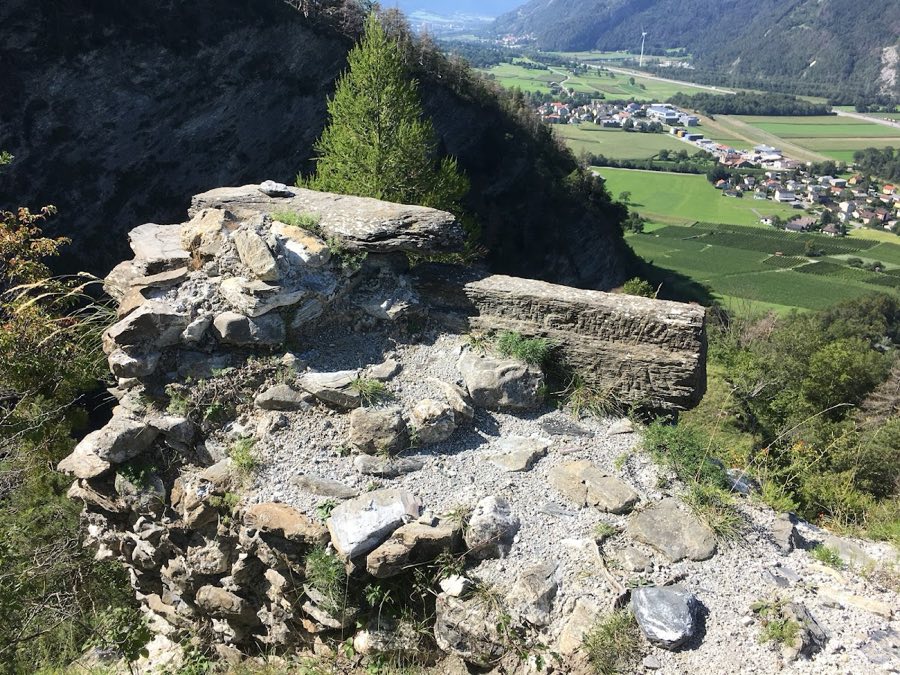
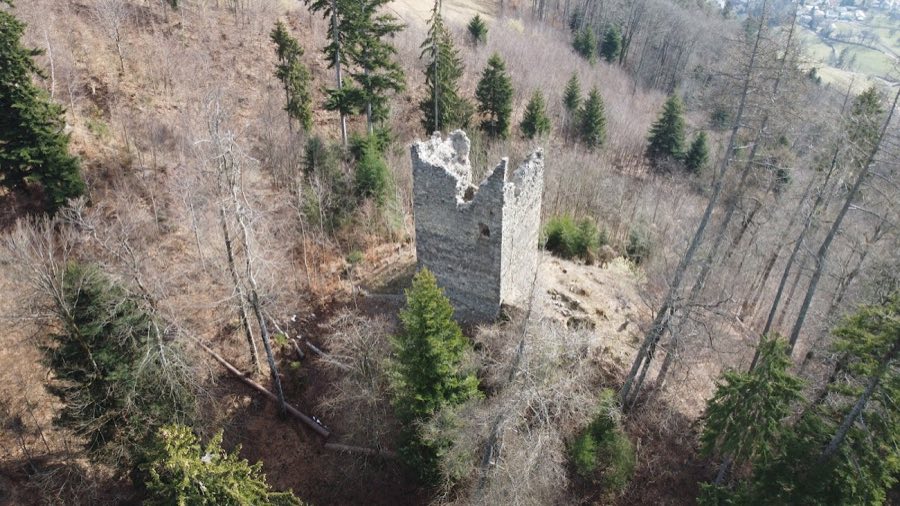
The ruin occupies a rocky plateau at about 1,060 meters above sea level above the hamlet of Tälfsch. The defensive enclosure follows the natural edge of that plateau and was built as a hill castle, with a primary enclosing wall that adapted to the site’s topography. The surviving circuit is dominated by its perimeter wall rather than by clearly defined internal buildings.
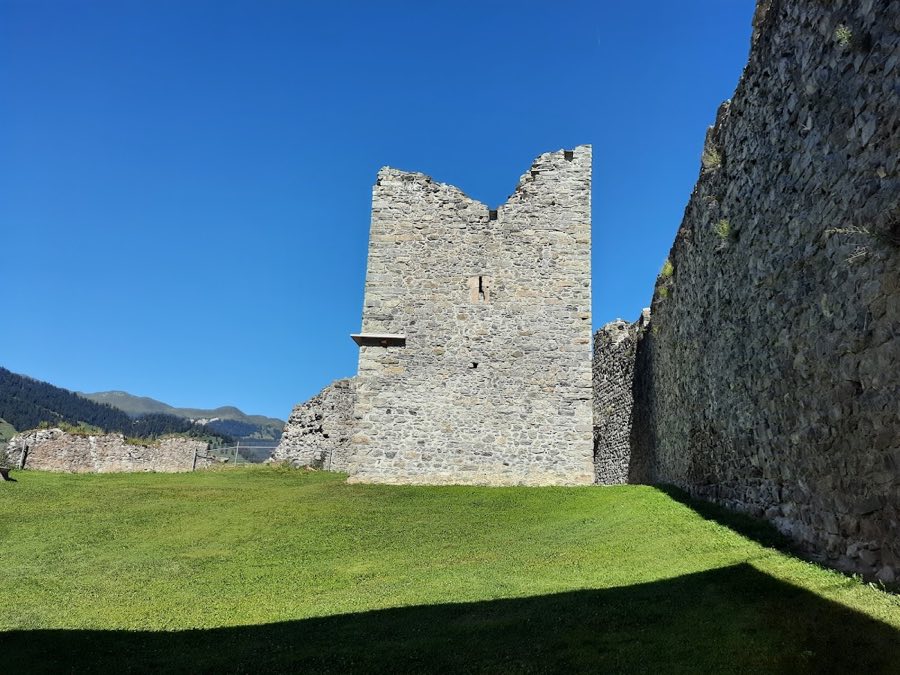
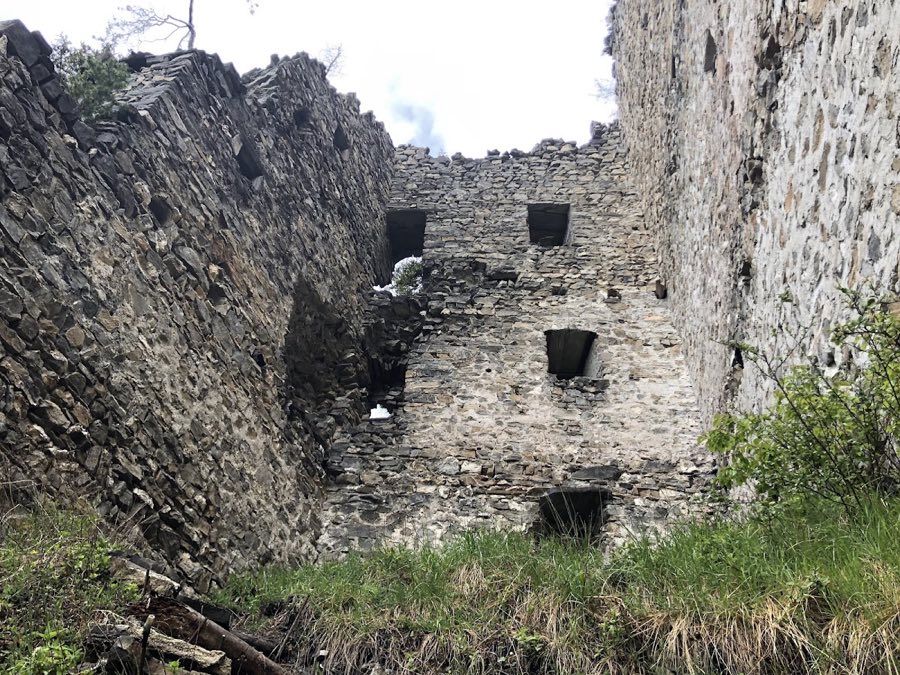
The main surviving feature is the ring wall. The southern stretch of this wall still stands to a height of several meters and preserves visible construction. The original masonry of the wall measured roughly 1.4 meters in thickness; at a later building phase approximately another 1.5 meters of stonework were added against the older wall. Narrow defensive windows in the earlier wall were retained but given a funnel-shaped widening in the later facing, adapting those openings to the newer outer masonry. Inside the enclosure the ground is covered by fallen wall material and rubble, and only faint traces of former internal wall lines remain.
About one hundred meters west of the Küblis church excavations carried out in 1952 exposed the substantial walls of a round tower, known in the tradition as the lower Sansch. An 18th-century description reports that the tower once contained living rooms at its upper level and that its walls were of very great thickness. The tower’s masonry was revealed in situ during the mid-20th-century work and remains as a fragmentary but robust element of the site. Later interventions to stabilise and conserve the ruin were carried out by the Canton in 1982–84, and further maintenance and measured recording were completed by the local castle association in 1998.
No. 91291
No. 16338
No. 35130
No. 51041
Comments
Comments for Burg Kapfenstein will require a verified account before posting.
We'll send a verification link before your first comment is published.