No. 46515
Burg Meistersel
Germany
CastleRuin11th century
No. 22362
Castle · Germany
No. 22362 · 49.189 N, 8.015 E
Quick summary
Burg Neukastel is a castle in Germany with origins associated with the 12th century.
See all castles in GermanyBurg Neukastel stands in Leinsweiler, Germany; it was probably constructed by the Salian dynasty. The castle first appears in a document of 1123 and is recorded in connection with Heinrich von Neukastel. Its name, meaning “new castle,” likely reflects that it was erected as a replacement for or addition to an older fortified site.
In 1246 Isengard, the wife of the imperial seneschal Philipp I von Falkenstein, handed Neukastel together with the imperial regalia kept at nearby Trifels to King Conrad IV. After that transfer Neukastel served as an imperial castle charged with helping to protect Trifels. By 1252 and 1253 Ludwig von Schüpf, who had been bailiff of the Speyergau since 1232, took his title from the castle, indicating its local administrative importance.
In 1307 Nikolaus von Speyer received Neukastel as a fief. Two years later, in 1309, King Henry VII granted the castle and the bailiwick in the Speyergau to Count Georg I of Veldenz, obliging him to invest 1,200 Pfund Heller drawn from the Jewish tax in Landau and from the toll in Germersheim into the castles Trifels and Neukastel. In 1330 Emperor Louis the Bavarian pawned Neukastel, among other holdings, for 6,000 marks of silver to the Palatine counts Rudolf II and Ruprecht I. By 1353 the castle was divided as an imperial fief within the Palatine family and was further sub-pledged.
The 1410 division of the Palatine comital seat assigned Neukastel to Duke Stephan, the founder of the Palatinate-Zweibrücken line. The castle suffered significant damage during the Peasants’ War in 1525; the Dukes of Palatinate-Zweibrücken carried out partial rebuilding afterward, although a proposed new circular artillery platform was never completed. In 1555 the administrative seat (Oberamt) was transferred from Neukastel to Burgschloss Bergzabern. Neukastel sustained further severe damage during the Thirty Years’ War, 1618–1648. French troops delivered the final destruction in 1689 during the War of the Palatine Succession; since that year the site has remained a ruin. At the foot of the hill the former manor farm was reconstructed in 1828 on the castle’s older foundations and survives today as the Slevogthof Neukastel.
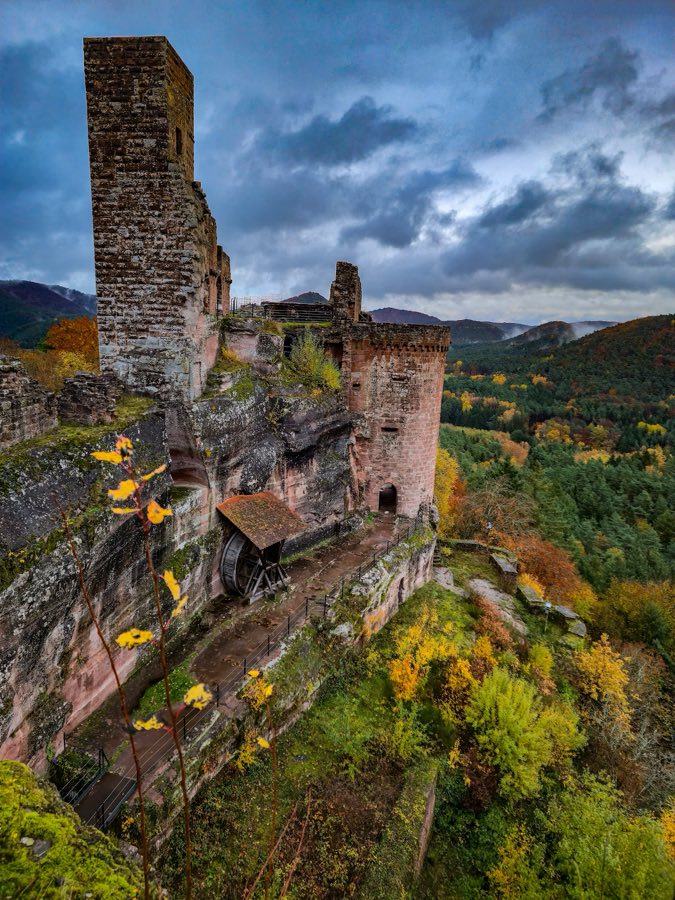
The castle occupies an elevated spur of sandstone at about 459 metres above the village, arranged as an upper ward and a lower ward set along the rock spur. The overall layout reflects a hilltop castle adapted to a sandstone ridge, with building and defensive elements worked into the natural rock. The structure dates to the 12th century and was established using the outcrop as a foundation for its highest elements.
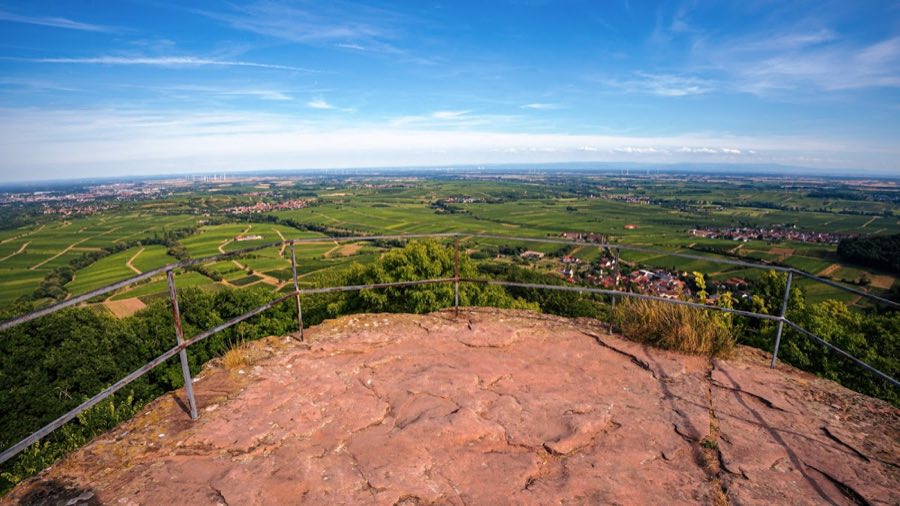
On the highest rock is the upper ward, where a viewing platform or terrace survives on the sandstone. This sector functioned as the castle’s upper stronghold from the medieval period. Construction relied on the natural rock with masonry built against and above it. The upper ward shows evidence of alteration after the Peasants’ War when the ruling dukes undertook partial repairs; a planned circular artillery work was recorded in that phase but was not completed. Today the rock-mounted platform and a few masonry fragments remain in situ.
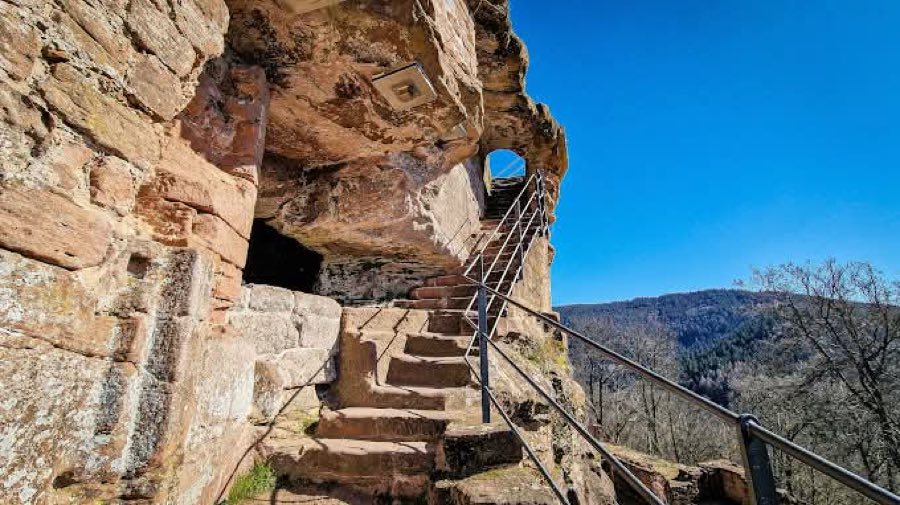
The lower ward sits below the upper rock and includes a carved rock cavity and a defensive neck ditch cut across the spur. These features served the lower castle’s defensive and functional needs during the medieval occupation. The rock cave is hewn into the sandstone, and the neck ditch was formed to control access along the approach; both survive as tangible earthwork and rock-cut elements. Only limited wall masonry remains at the site, preserved in fragments that attest to the castle’s former built extent.
At the hill’s base the medieval manor farm, identified as the castle’s former economic yard, was rebuilt on the existing foundations in 1828. That rebuilt estate occupies the earlier footprint and continues to exist today as the Slevogthof Neukastel, representing the later reuse of the castle’s foundational fabric.
No. 46515
No. 36361
No. 30147
No. 96128
Comments
Comments for Burg Neukastel will require a verified account before posting.
We'll send a verification link before your first comment is published.