No. 77514
Burg Hatzfeld
Germany
CastleRuin13th century
No. 87849
Castle · Germany
No. 87849 · 51.175 N, 8.425 E
Quick summary
Burg Rappelstein is a castle in Germany with origins associated with the 14th century.
See all castles in GermanyBurg Rappelstein stands in Schmallenberg, Germany, and it was established by the medieval German noble family known as the Edelherren von Grafschaft.
Local tradition reports that the von Grascap family may have held an older fortified site on the Wilzenberg around the year 1000. The stronghold that would become Burg Rappelstein was recorded under the name Burg Norderna and is conventionally dated to about 1200, when the Edelherren von Grafschaft moved their seat to Nordenau. As lords of the area they exercised the vogtei, serving as hereditary protectors of the nearby monastery at Grafschaft. Dendrochronological study of timber from the tower shows that the principal tower was erected between 1085 and 1110, a construction date documented by analysis of the surviving wood.
On 14 February 1298 the brothers Kraft and Widekind von Grafschaft transferred ownership of the castle to Count Otto von Waldeck, who then enfeoffed it back to them. That transaction inaugurated a period in which Waldeck shared lordship over the castle and its estates. Efforts by Waldeck to remove Kraft’s widow, Agnes, from her rights prompted intervention by Archbishop Walram of Cologne. From 1343 prolonged conflicts between Cologne and Waldeck followed, including pitched fights and temporary sieges around the castle. In 1364 the two parties reached an agreement that made the fortress jointly owned by the archbishop and the Count of Waldeck.
In 1471 the von Grascap family acquired another residence at Ober-Ense, and Burg Norderna thereafter fell into disuse and decay. The line of the von Grascap family ended in 1572.
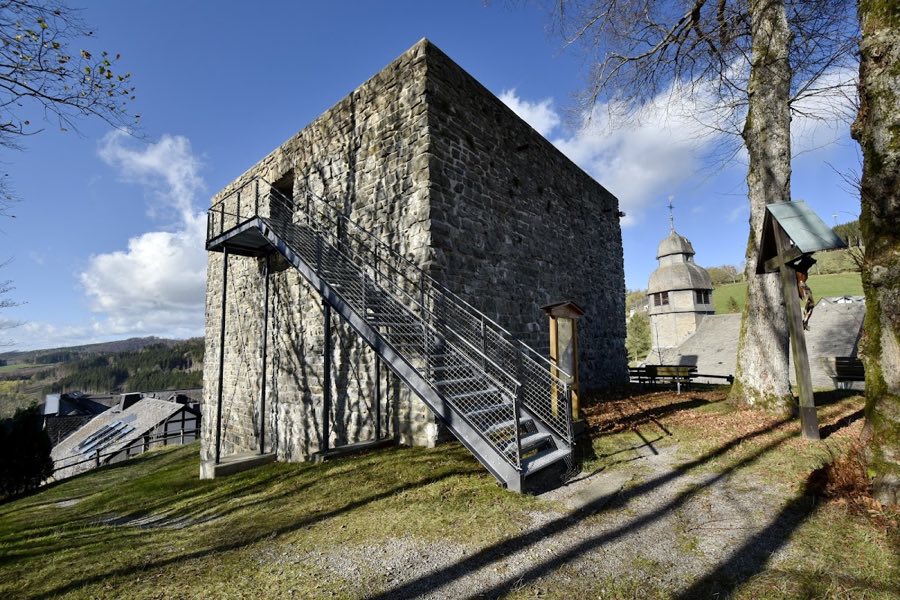
Archaeological interest in the ruin began after World War I, with excavations starting in 1919. A bronze bowl of about 25 centimeters, inscribed SUR ERBIA and bearing the image of a crowned woman, was recovered by a local amateur excavator and entered the LWL-Landesmuseum für Kunst und Kulturgeschichte in Münster in 1927. In 1967–68 the municipality and the regional monument authority undertook conservation and partial reconstruction of the surviving tower, and archaeological investigations at that time produced pottery fragments, a crossbow, and a 14th-century coin from the Duchy of Westphalia. The rebuilt upper part of the tower now serves as a viewing platform with wide views over Nordenau, the Nesselbachtal valley, and the surrounding Sauerland hills.
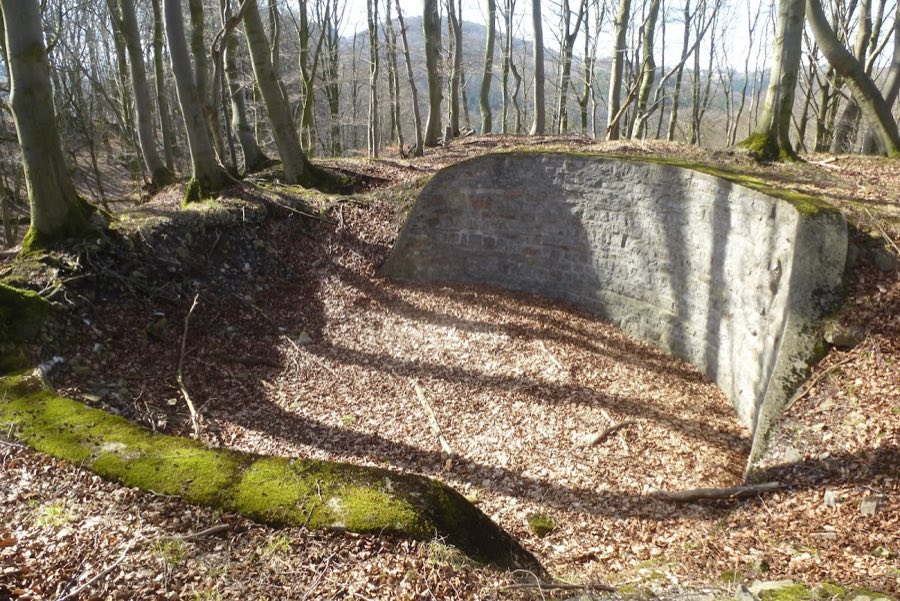
The castle occupies a prominent rock known as Rappelstein in the center of Nordenau, placed as a high hilltop stronghold. The site is classified as a hill castle sited directly on the exposed rock, a position recorded as tactically important and at one time described as the highest such fortress in Westphalia. The surviving fabric consists primarily of the castle’s main defensive tower and associated ruined masonry clustered on the rock outcrop.
The principal surviving element is the bergfried, a defensive tower whose preserved timbers were dated to the years 1085–1110. That dating documents an early construction phase for the tower and indicates the presence of substantial wooden structural elements in its build. The bergfried was partially rebuilt and secured in 1967–68 by municipal authorities and the monument agency, and the repaired tower now functions as an observation platform. Its masonry and timber components remain visible in fragmentary form, and the reconstructed upper sections sit above earlier medieval fabric.
Excavations and investigations at the ruin have produced a small but informative group of finds. Pottery sherds recovered in the 1967–68 work reflect medieval occupation. A crossbow recovered during those investigations provides evidence of military equipment on site. A 14th-century coin from the Duchy of Westphalia was also found, attesting to activity in that century. Earlier, a flat bronze bowl of roughly 25 centimeters with the inscription SUR ERBIA and the depiction of a crowned woman was discovered in 1919 and is now housed in the museum in Münster. The ruin today presents as a preserved fragment of the medieval complex, with the partially restored bergfried the most prominent, in situ feature and the other finds held as documentary traces of the castle’s medieval phases.
No. 77514
No. 24467
No. 28483
No. 42355
Comments
Comments for Burg Rappelstein will require a verified account before posting.
We'll send a verification link before your first comment is published.