No. 71995
Bukovina Castle
Czechia
CastleRuin14th century

No. 53963
No. 53963 · 48.931 N, 15.910 E
Quick summary
Burg Šenkenberk is a castle in Czechia with origins associated with the 13th century.
See all castles in CzechiaBurg Šenkenberk is a medieval castle ruin located in the village of Šumná in the Czech Republic. It was constructed in the 13th century, likely by the Austrian noble family known as the Pincern or Schenk family, who settled in this border region during that period.
The earliest probable record of the castle dates back to 1247, though the first confirmed mention appears in 1325. At that time, King John of Luxembourg granted permission to Hrut of Rukštejn to sell the village of Chlupice to Jindřich of Šenkenberk. Jindřich belonged to the Jíkva family and is thought to have acquired the castle through marriage, marking the beginning of the Jíkva family’s association with the site. Ownership was later transferred to Jindřich’s sons, Markvart and Protiva, who in 1353 sold shares of the castle to other local nobles, including Jindřich Přibík of Jíkva.
By the early 15th century, Burg Šenkenberk came under the authority of the Moravian margrave. In 1406, Jobst of Luxembourg sold the castle to Přech of Kojetice, who subsequently gave it as a dowry to his wife, Kateřina. Ownership continued to change hands, with Osvald of Eitzing documented as the holder in 1436, when King Sigismund confirmed his possession. However, by 1517 the castle had fallen into ruin, and Michal of Eitzing sold the damaged property to Adam of Bačkovice.
Archaeological research suggests the fortress likely suffered destruction during the mid-15th century, possibly as a result of the Hussite Wars or related feudal conflicts in the region. The nearby village of Šenkenberk had been abandoned by 1549. Since May 3, 1958, the ruins have been legally protected as a cultural monument, preserving their historical legacy.
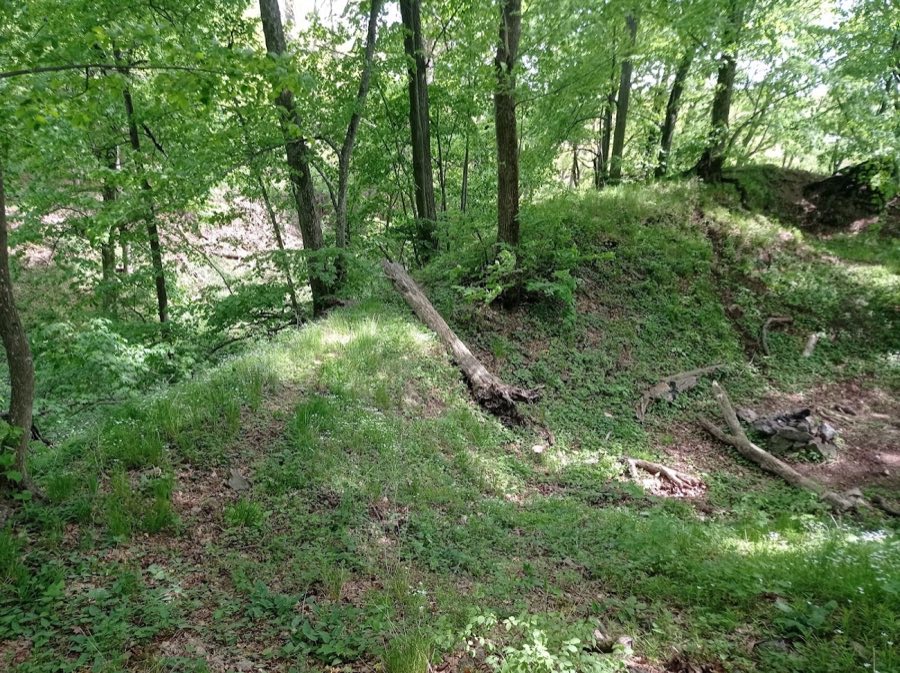
Burg Šenkenberk occupies a rocky spur elevated at 412 meters above sea level, with natural defenses provided by the Plenkovický potok stream curving around three sides and the Vlkov pond lying to the south. The site reveals a two-part design, linking a trapezoidal main castle core to an outer courtyard known as a bailey, itself shaped trapezoidally. These two sections were separated by a deep, wide trench—a neck ditch—measuring about nine meters across and one and a half meters deep, serving as a defensive barrier.
The main castle enclosure extends 32 meters along its front, with sides measuring roughly 29.5 meters to the south and 18.5 meters on the western façade, which rests atop a rocky outcrop. A connecting wall crosses diagonally between the areas of the castle, stretching some 31 meters. Among the surviving structures, the northern corner stands out with wall remains reaching up to 3.6 meters in height. Traces of the outer walls still mark the perimeter, along with remnants of the palace building, or palas, which would have served as the residential and representative quarters.
On the east side, a deep defensive ditch separated the castle from the adjacent ridge, while natural valleys formed by the Plenkovický potok provided protection along the north, south, and west. These landscape features enhanced the castle’s defendability by limiting access routes. Today, the ruins remain on site and are preserved as part of the nation’s protected cultural heritage, reflecting the castle’s historical importance and medieval construction techniques.
No. 71995
No. 64104
No. 64128
No. 19710
Comments
Comments for Burg Šenkenberk will require a verified account before posting.
We'll send a verification link before your first comment is published.