No. 77476
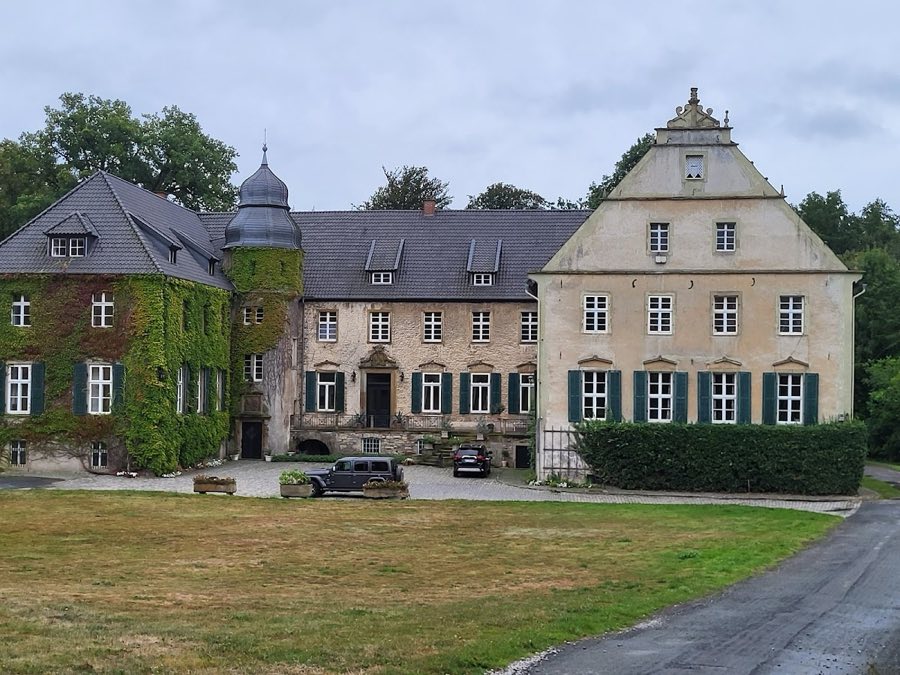
Gut Ostenwalde
Germany
Manor houseRestored18th century
No. 32734
No. 32734 · 52.321 N, 8.374 E
Quick summary
Burg Wittlage is a castle in Germany with origins associated with the 15th century.
See all castles in GermanyBurg Wittlage is located in the municipality of Bad Essen, Germany. It was built by the medieval ecclesiastical authorities of the Bishopric of Osnabrück as a fortified residence and administrative center.
The castle was erected in 1309 under Bishop Engelbert II of Osnabrück to protect the bishopric’s eastern border against neighboring territories such as Ravensberg, Minden, and Diepholz. Not long after, its structure was enhanced through fortifications and expansions by subsequent bishops including Gottfried Graf von Arnsberg and Otto Graf von Hoya, who added defensive walls and constructed the manor house, known as the Aula, during the 15th century. The outer bailey, a fortified enclosure outside the main castle, was established later by Bishop Konrad IV Graf von Rietberg. Indications of an earlier fortification on this site come from reports of ancient earthworks and ditches nearby, suggesting that the location had long been of strategic importance.
By the mid-14th century, starting around 1353, Burg Wittlage became the administrative heart of the Amt Wittlage, a regional jurisdiction overseen by an official called the Amtmann, later referred to as the Drost. From 1556, the Drost also managed the adjacent Amt Hunteburg, expanding the castle’s administrative significance.
In 1553, the castle suffered an assault by mercenary troops working for Duke Philipp Magnus of Brunswick-Wolfenbüttel, who plundered its defenses. When the Thirty Years’ War began in the early 17th century, the castle was in a weakened state without permanent troops or robust fortifications. This situation allowed Danish forces to occupy it from 1626 to 1628 with little resistance or enhancement to its defenses. In 1633, Swedish troops took control and undertook some reinforcement efforts, successfully defending the castle in three separate sieges up to 1642. Swedish presence at Burg Wittlage ended with their withdrawal in 1650, after which the bishopric of Osnabrück stationed an infantry company in the castle until 1652.
Later in the 18th century, from 1726 to 1728, Prince-Bishop Ernst August II commissioned the construction of a new administrative building called the Amtshaus. This marked a shift in the castle’s purpose toward civil governance under the Drost’s administration. Around 1750, an economic timber-framed building was added within the outer bailey to support functional needs, and in 1860 a prison was annexed to the castle’s tower. Following Prussia’s annexation of the Kingdom of Hanover and the Principality of Osnabrück in the 19th century, the castle’s former military buildings were repurposed to serve the administration of the newly formed district known as Kreis Wittlage.
Today, several of the preserved structures have been adapted for social services, operated by the Verbund Sozialer Dienste. These include an inclusion café, a kitchen, residential groups for children and youth, as well as offices serving community needs.
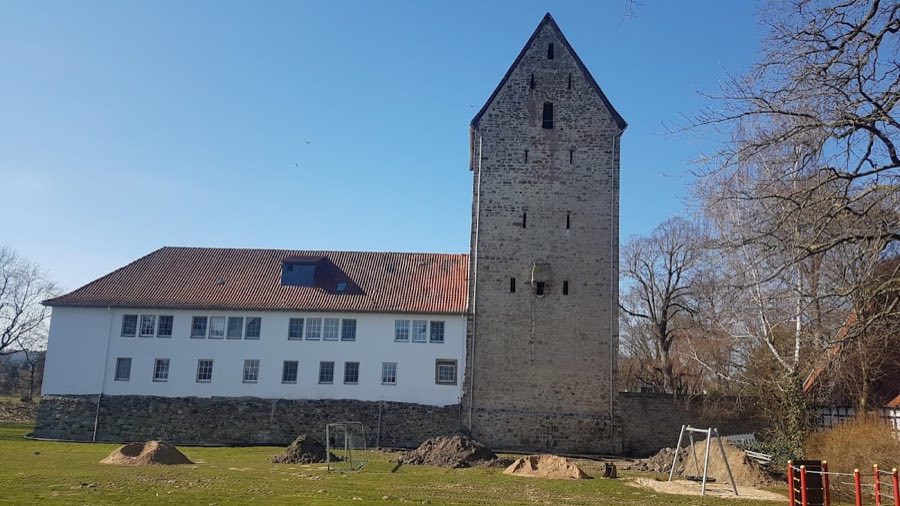
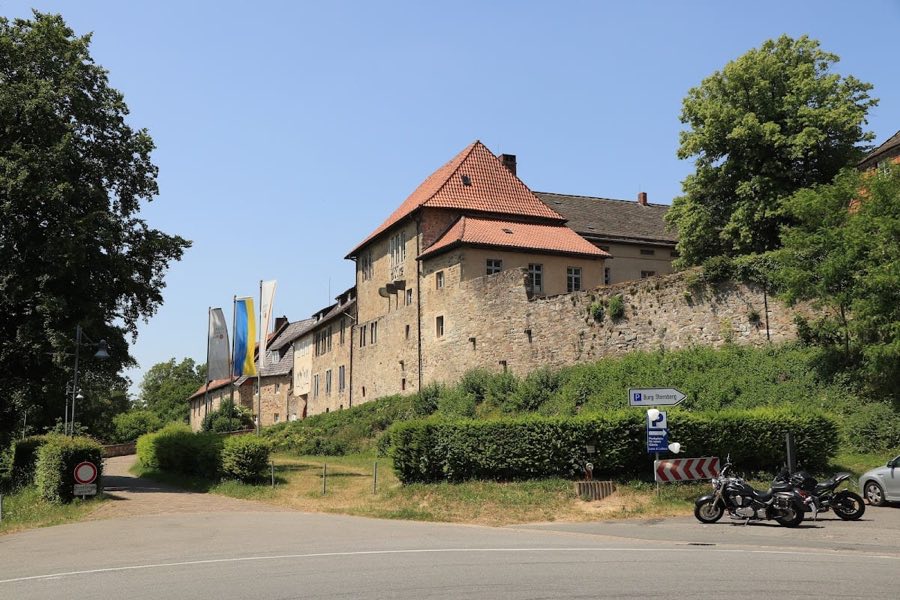
Burg Wittlage’s main compound occupies a rectangular space approximately 40 by 58 meters, surrounded by an earthen embankment with a deep outer ditch. This form of earthwork defense was typical of medieval castles, combining soil ramparts with water-filled ditches to hinder attackers. Within this enclosure stands a massive stone keep, called a bergfried, positioned at the northeastern corner. This tower measures about 10 meters on each side, with walls 3.5 meters thick, rising to nearly 29 meters in height over seven stories. The bergfried functioned as a strong defensive tower, a place of refuge during attacks, and a symbol of seigneurial power.
Adjoining the keep’s south side is the residential building that originally housed the castle’s rent office, or Rentei, where financial matters and property management were conducted. This structure is built directly onto the eastern section of the ring wall encircling the core castle. On the western side lies the Amtshaus, the administrative building largely rebuilt between 1716 and 1728 under Prince-Bishop Ernst August II. Stretching some 40 meters in length, this building retains cellar rooms from an earlier predecessor, notable for their defensive loopholes—narrow slits designed for firing weapons while offering protection to those inside.
The main entrance to the castle is situated in the northern section of the enclosing ring wall. Beyond this lies the outer bailey, a larger fortified courtyard extending northwards from the main castle. It was protected by a substantial rampart and ditch termed the Amtsgraben, a defensive trench surrounding both the outer bailey and the core castle. Access to this area came from the west through what was once a gatehouse guarding the approach.
Early 19th-century records describe the outer bailey containing a large barn and a building known as the “old pleasure house,” indicating a mixed use of the space for agricultural and leisure purposes. Today, while much of the rampart around the outer bailey survives only in fragmented form, the ditch remains nearly intact. Historical fortifications also included bastions—projecting defensive structures—at the northeastern corner of the outer bailey and the southwestern corner of the main castle, though only their remains survive.
Overall, the preserved elements at Burg Wittlage include the sturdy bergfried and the Amtshaus with its historically significant cellar defenses, along with the earthworks marking the defensive boundary of the outer bailey, offering a vivid glimpse into the castle’s evolving military and administrative roles through the centuries.
No. 77476
No. 98261
No. 17972
No. 99686
Comments
Comments for Burg Wittlage will require a verified account before posting.
We'll send a verification link before your first comment is published.