No. 98643
Castello di Roccavaldina
Italy
CastleIntact13th century
No. 40413
No. 40413 · 38.232 N, 15.434 E
Quick summary
Castello di Bauso is a palace in Italy with origins associated with the 13th century.
See all castles in ItalyThe Castello di Bauso is situated in Villafranca Tirrena, Italy, along the northern Sicilian coast. Its origins trace back to the medieval period, emerging as a noble residence amid Sicily’s complex feudal landscape. The earliest record of the fief associated with the site appears in 1271, when King Charles of Anjou granted the land, then known as Bauso, to Pierre Gruyer. Prior to this, the fief had belonged to a noble named Enrico de Dissinto. This initial phase places the castle’s roots within the Angevin rule, reflecting the region’s shifting allegiances during the late 13th century.
Throughout the 14th and 15th centuries, the fief passed through several prominent families as Sicily came under Aragonese influence. In 1397, King Frederick the Simple awarded the domain to the Gioeni family, marking a significant shift in ownership by royal concession. Through marriage and inheritance, the Bauso estate later came under the control of the Bonifacio, La Grua, and Pollicino families between the 15th and 16th centuries. These transfers reflect the feudal dynamics of the time, with alliances cemented through noble lineages.
A notable transformation occurred in the late 16th century when the Cottone family acquired the barony. Around 1590, they undertook extensive reconstruction of the castle, adapting it into a residential stronghold rather than a purely military fortress. Shortly thereafter, in 1591, King Philip II of Spain elevated Bauso from a barony to a county. Further recognition followed in 1623 when King Philip IV conferred the title of Prince of Castelnuovo—another designation for the Bauso territory—upon Girolamo Cottone. This ennoblement underscored the importance of the estate within the Spanish-ruled Kingdom of Sicily.
During the Cottone tenure, the castle served primarily as a secondary residence but also provided sanctuary for local residents during frequent maritime raids by pirates and corsairs targeting Sicily’s coastline. In the early 19th century, ownership shifted again when the Pettini family purchased the castle and fief in 1819. The Pettinis enriched the interior decoration with busts and sculptures, adding cultural and artistic layers to the residence.
By the 18th century, descriptions of the surrounding land note cultivated orchards and mulberry trees, though the area was also said to have unhealthy air. Over subsequent decades, the castle passed through various noble custodians until the 20th century. In 1926, Pietro Saija acquired the property and later gifted it to the Italian state. A significant restoration effort completed in 2003 repaired decades of neglect, preserving the site’s historical fabric. Since then, the castle remains in public hands, valued for its cultural and historical significance.
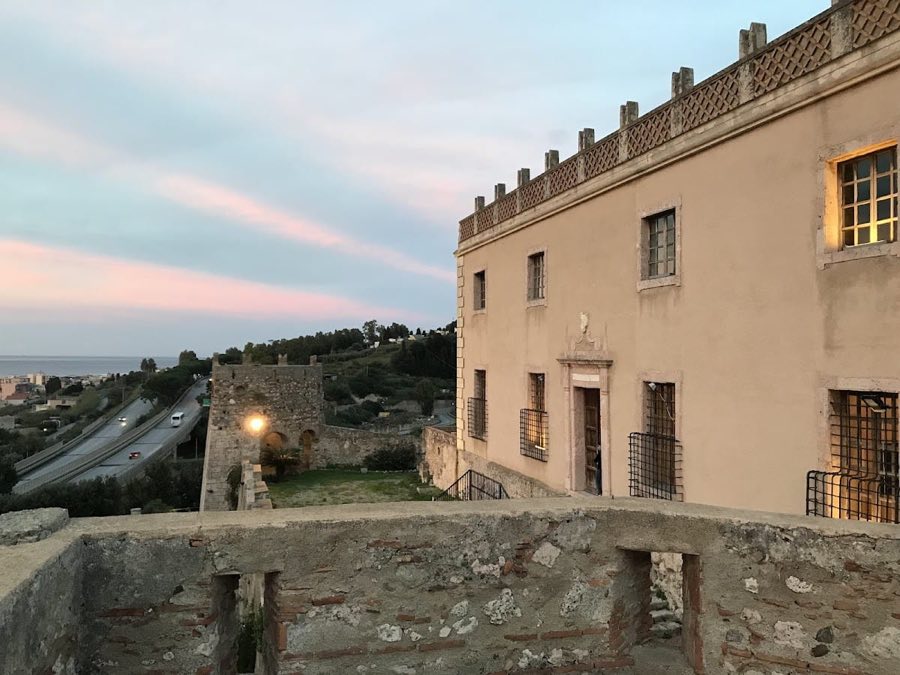
The Castello di Bauso is a fortified noble residence characterized by features typical of a manor designed for defense, though it was not intended for serious military use. It occupies the summit of a hill overlooking the Gulf of Milazzo, commanding scenic views toward the sea. The castle’s footprint is an irregular trapezoid enclosed by low surrounding walls, which open onto a large garden area on the northwest side.
Three bastions punctuate the perimeter walls on the west, north, and east sides. The eastern bastion includes the primary entrance gate, which faces southwest. The main building within these walls rises two stories high, accessed through a modest central portal reached by stairways shaped like isosceles triangles. Each wing contains two openings per floor: the ground-level openings are balconies with wrought-iron grilles, while the upper floor features regular windows. Along the roofline, the parapets display swallowtail-shaped merlons, also known as Ghibelline merlons, a distinctive style repeated in the terrace railings, tying the castle’s silhouette to this medieval decorative tradition.
Inside, the castle houses a large hall notable for its massive stone lintels and arches supporting the ceiling. A monumental fireplace designed in Renaissance style dominates one area, while heraldic emblems celebrating the Cottone and Pettini families decorate the interior walls, emphasizing the lineage and prestige of its owners. Part of the chapel and a section of the terrace retain fragments of richly decorated maiolica tiles, a form of tin-glazed pottery typical of Italian decorative arts.
Artistic busts of significant family members occupy niches accompanied by inscribed cartouches, adding a personal and commemorative aspect to the décor. Sculptural representations inspired by literary figures such as Dante Alighieri, Virgil, and Torquato Tasso are present, alongside allegorical statues of the Four Seasons. Over time, war damage and long periods of neglect resulted in the loss of many original ornamental details.
Surrounding the castle, an Italian-style garden extends as an integral part of the estate’s design. A central walkway connects the main building to a villa pond, itself adorned with fountains and artificial grottoes themed after the three canticles of Dante’s Divine Comedy: Paradiso (Heaven), Purgatorio (Purgatory), and Inferno (Hell). Decorative elements include multicolored stones and glass embedded within the garden’s features. Historically, the garden also contained the Fountain of the Four Lions, which is attributed to the workshop of Giovanni Angelo Montorsoli, a notable Florentine sculptor. Near the front terrace, columns and pillars remain as evidence of a former pergola gallery, suggesting a once lush and shaded outdoor space adjacent to the residence.
No. 98643
No. 35729
No. 19073
No. 66188
Comments
Comments for Castello di Bauso will require a verified account before posting.
We'll send a verification link before your first comment is published.