No. 27861
Castle of Carrazeda
Portugal
CastleRuin11th century
No. 21381
Castle · Portugal
No. 21381 · 41.100 N, 7.290 W
Quick summary
Castle of Numão is a castle in Portugal with origins associated with the 18th century.
See all castles in PortugalThe Castle of Numão stands in the municipality of Vila Nova de Foz Côa, Portugal, on a site first occupied during prehistoric times. The earliest known builders were the Lusitanians, an ancient Iberian people who established a fortified settlement here, which was later adapted and Romanized during the Roman occupation of the peninsula.
In the early medieval period, the site underwent several changes in control. During the Christian Reconquest, the castle belonged to D. Chamoa Rodrigues and was donated to the Monastery of Guimarães in 960 by his aunt, Countess Mumadona Dias. This early medieval phase saw the castle as a monastic possession. Around the year 1000, Muslim forces retook the fortress, holding it until it was destroyed in 1030 by the brothers Tedom and Rausendo Ramires. Subsequently, the castle returned to Christian rule under Fernando Magno in 1055 or 1056, at which point it was again listed among the property of the monastery by 1059.
Following the independence of Portugal, King Afonso Henriques (1112-1185) granted the castle and surrounding lands to his brother Fernão Mendes de Bragança. Fernão Mendes issued a formal charter to the town, at that time called Civitate Noman, on July 8, 1130, initiating the castle’s reconstruction. Later, under King Sancho I (1185-1211), the castle’s defensive walls were restored and a keep tower constructed, an effort commemorated by an inscription dated to 1189, which was recorded in the 18th century but no longer exists.
During King Sancho II’s reign (1223-1248), the castle and its lands were temporarily given to Abril Peres de Lumiares. The town’s privileges were confirmed again in 1265 by King Afonso III, who also oversaw further fortification work. King Dinis reconfirmed the charter in 1285 and continued strengthening the castle’s defenses.
The castle played a role in the 1383-1385 Portuguese succession crisis when Numão was one of the strongholds that supported Beatriz’s claim to the throne. In 1436, during King Duarte’s rule (1433-1438), a legal status known as a couto de homiziados was established at Numão, indicating the area had difficulties maintaining stable settlements. Later, King Manuel I granted a new charter on August 25, 1512, by which time the castle fell under the administration of the Order of Christ as a commandery. Records from 1527 show that the town contained 15 households, with 41 additional residences in the nearby lands.
From the 14th century until 1534, the strategic defense of the castle was in the hands of the Coutinho family, whose extinction hastened the decline of the site. By the late 18th century, the original village was relocated away from the hilltop to the surrounding lowlands, and the castle had largely fallen into ruin. Nevertheless, an inscription confirming the keep tower’s construction date in 1189 was still legible on the west gate at that time, as noted by Frei Joaquim de Santa Rosa de Viterbo around 1798-1799.
In recognition of its historical value, the Castle of Numão was officially classified as a National Monument in 1910. Efforts to stabilize and restore the fortifications began in the 1940s. These included repairs and cleaning, rebuilding sections of wall, clearing the cistern, and restoring the keep tower. Further restoration took place in the 1970s and again in the 1980s following the collapse of part of the northern wall. In the 21st century, the municipality added lighting to highlight the monument’s presence.
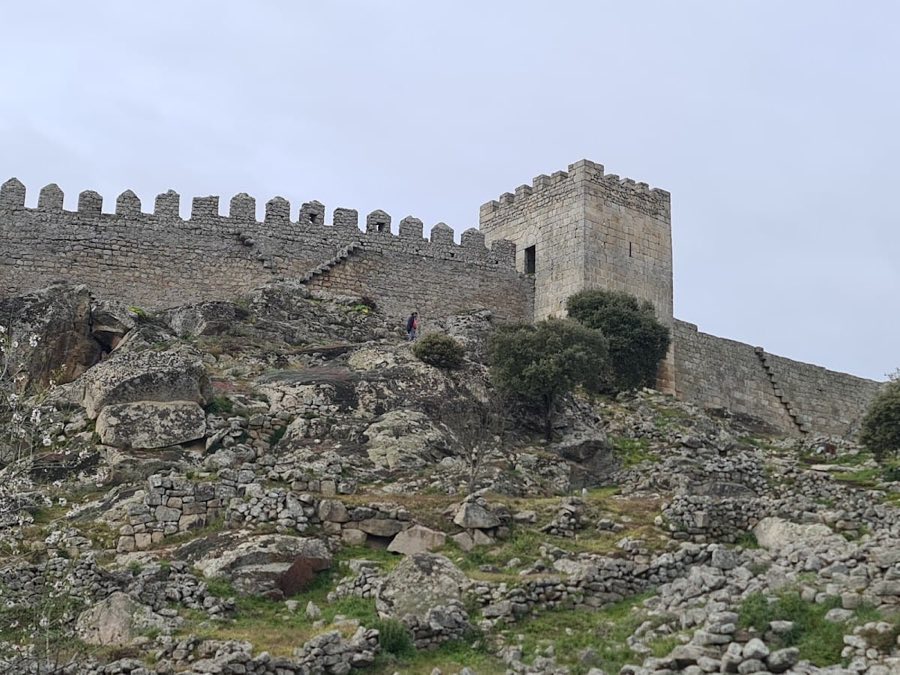
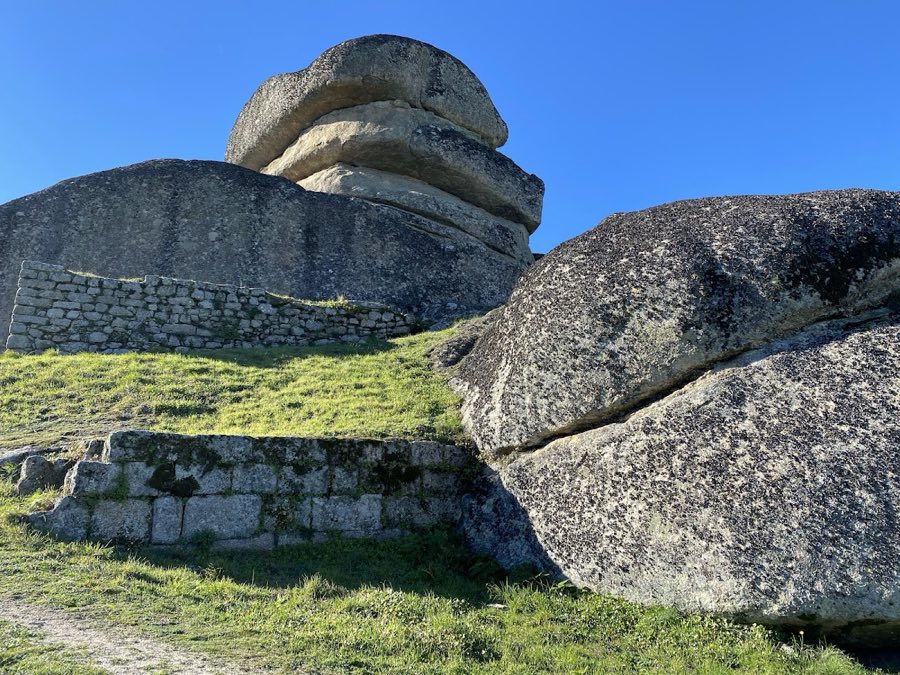
The Castle of Numão occupies a roughly oval area of about two hectares atop a rocky hill 677 meters above sea level, using the natural terrain to enhance its defenses. Its walls, constructed in the Romanesque and Gothic styles, define an organic shape that conforms to the hill’s contours. Originally, the enclosure was protected by fifteen towers, of which six remain; some of these towers are positioned on the exterior side of the curtain walls, enhancing defensive coverage.
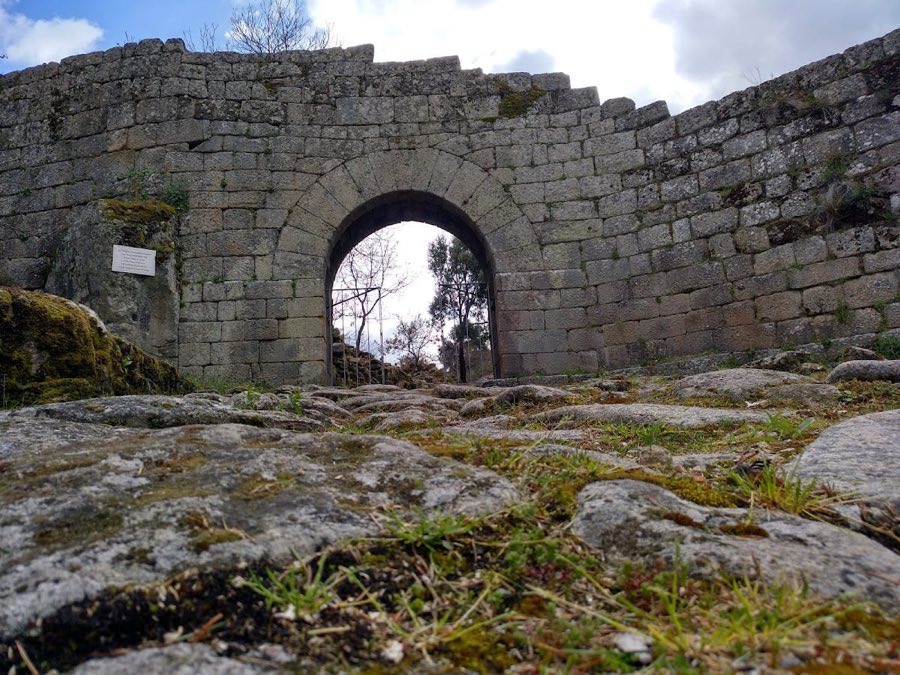
The castle features four gates carved into the walls, each with distinct characteristics. To the east lies the Porta de São Pedro, which is guarded by a tower. This gate is marked by a pointed arch and covered by a barrel vault ceiling that also has a slight pointed profile. On the west side, the Porta do Poente shares a similar design. A smaller, false gate or postern on the southeast side is defined by a broken arch, serving as a discreet access point. The main gate, located on the southern wall, survives partially, consisting currently only of the springing arches where the doorway once opened.
Within the castle’s main courtyard, a large circular cistern measures about seven meters in diameter. This open cistern would have been crucial for collecting and storing water, essential for the site’s long-term habitation and defense during sieges. Near the main entrance are the ruins of the Church of Santa Maria do Castelo, built in the Romanesque style. Although only fragments remain, this church once formed an important spiritual center for the community that lived within the castle walls. Adjacent to these remains lies the cemetery used by the medieval inhabitants.
The keep tower stands out in the northeastern section of the fortress. It has a square layout and features two narrow vertical slits, or arrow loops, which provided vantage points for archers. Its upper part is supported by corbels, stones that project from the wall to carry weight, decorated with geometric patterns that reflect the architectural styles of the period.
On the eastern slope, close to the Porta de São Pedro, there once stood a small chapel dedicated by the same name. Nearby is a rock-cut necropolis containing approximately ten anthropomorphic tombs, carved in the shape of human figures. This burial site is popularly known as the Cemetery of the Moors, reflecting local traditions that associate these ancient graves with early Muslim inhabitants or other historic populations. The necropolis offers valuable insight into the funerary customs practiced in the area around the castle.
Together, these elements demonstrate a complex fortress adapting through various phases of occupation, combining military, religious, and settlement functions shaped by centuries of use and modification.
No. 27861
No. 30021
No. 40104
No. 86650
Comments
Comments for Castle of Numão will require a verified account before posting.
We'll send a verification link before your first comment is published.