
No. 43898
Château de Beauville
France
ChâteauRestored16th century

No. 87587
Château · France
No. 87587 · 44.219 N, 0.710 E
Quick summary
Château de Castelnoubel is a château in France with origins associated with the 13th century.
See all castles in FranceChâteau de Castelnoubel in Bon-Encontre, France, is a medieval fortified castle erected by local feudal lords at the end of the 13th century. Its core construction belongs to the later Middle Ages, with major building phases in the 13th and 14th centuries and later remodelling in the 15th and 16th centuries. The site played a local administrative and military role, appearing in a 1270 oath that set the boundary between neighbouring bailiwicks, and it figured repeatedly in the shifting loyalties and armed contests between English and French authorities in the Agenais region.
The hilltop was occupied from at least the 10th or 11th century, and work on the medieval stone castle began at the close of the 1200s. The earliest named lord is Arnaud de Marmande, active at the turn of the 14th century; he compounded his local power by invoking a custom that allowed townspeople to build towered houses on his land, an action that initiated construction at Castelnoubel. Members of the Marmande family later aligned with the English crown during the Anglo‑French struggles over the Agenais, drawing intervention by the English king in 1311 and 1315 and leading one family member, Pierre de Marmande, to serve as seneschal of Agenais for the English between 1316 and 1323. In the mid-1320s Arnaud de Marmande obtained a royal remission from King Charles IV of France for offences committed in rebellion against the French crown.
Because the Marmandes kept their allegiance to England, their castles were lost and Castelnoubel passed into the Durfort family. On 29 August 1351 Charles the Bad, king of Navarre acting as the French king’s lieutenant in Gascony, granted high and low jurisdiction at Bajamont and Castelnoubel to Arnaud de Durfort, while excluding full sovereignty. The Agenais itself changed hands in the 14th century: a royal decision in 1352 sought to fold the Agenais into the French royal domain, but the English recovered it under the Treaty of Brétigny in 1360. Following that treaty, local lords and parishes were required to swear allegiance to the English king at Bordeaux cathedral in 1363.
Durfort family members held and extended the seigneury from the 14th through the 16th centuries, sometimes switching sides between England and France and repeatedly litigating and fighting with the consuls of Agen and other regional magnates. Royal troops were stationed in the Agenais in 1472 during operations against Lectoure, and the castle appears to have been ruined about that year, leaving only a surviving north round tower from the earlier works. In 1476 King Louis XI authorised Arnaud de Durfort to rebuild the fortress and local mills. François de Durfort restored and raised the castle after the damage of 1472, carrying out the work with the participation of local inhabitants; disputes over compulsory labour for the rebuilding were eventually decided in favour of the municipal consuls by the Parlement of Bordeaux in the early 1500s.
In the mid‑16th century Alain de Durfort undertook recorded works at Castelnoubel, including two superposed galleries and a monumental staircase attached to the late 15th‑century structure, dated to about 1535–c.1554. Family litigation over succession and rights continued through the 1500s; one notable judicial decision appears in the Grand Conseil in 1554. During the Wars of Religion François de Durfort, who was seneschal of Agenais in 1572, supported the Catholic side in the region and around 1570–1573 conducted transactions that included selling and redeeming the seigneury. On 10 August 1589 troops of the Catholic League under the Marquis de Villars occupied, plundered, and sacked Castelnoubel. Possession was later confirmed to Jeanne d’Antin by a late 16th‑century arrêt, and she sold Castelnoubel and the land of Mérens on 9 October 1608 to Arnaud de Gasq.
Jacob de Secondat assumed the title seigneur of Castelnoubel in 1619 and the estate remained with the Secondat family through the 17th century. Around 1700 Jean‑Baptiste de Secondat sold the property to Louis Pascault de Poléon, who died at the château in 1711. Ownership later fragmented and the land passed through auction before Louis‑Auguste Pascault de Poléon re‑acquired parts of it; he stayed in France during the Revolution and thus avoided confiscation, dying in 1811. The château was sold in 1817 to Pierre Loubat and then to Joseph‑Marie‑Étienne Giraud (des Écherolles). In the 19th century Hélène des Écherolles lived at Castelnoubel and hosted the writer Félicie d’Ayzac from 1868 until d’Ayzac’s death there in 1881. The building received 19th‑century neo‑Gothic alterations and was placed on the national list of historic monuments on 8 August 1966.
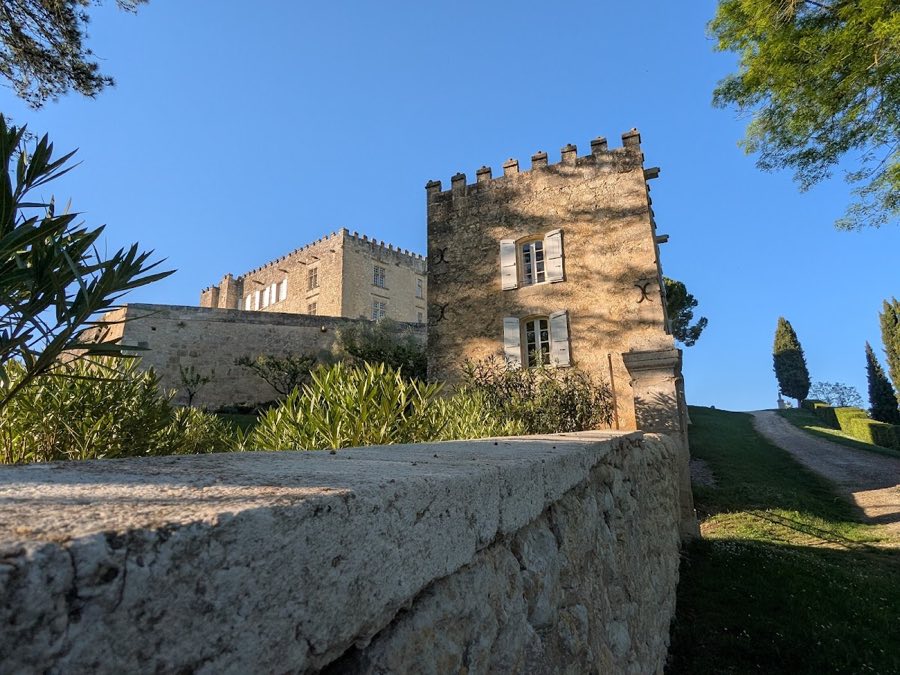
The castle occupies a steep promontory above the Mondot valley at Saint‑Denis de Lasgourgues near Bon‑Encontre, a defensive position that may have succeeded an earlier castrum with wooden palisades along the cliffs. The medieval complex developed as a château fort, a fortified castle of the later Middle Ages, with its earliest stone phases begun at the end of the 13th century and substantial rebuilding in the 14th century.
From the 13th and 14th centuries a north round tower survives in the documentary record as the element that remained after the destruction around 1472; this tower is the principal remnant directly linked to the earliest stone phase. The late 15th‑century rebuilding raised and reworked the castle’s fabric, and accounts record that François de Durfort carried out those repairs with local participation, so parts of the standing masonry reflect post‑1472 reconstruction rather than the original plan.
In or after 1535 Alain de Durfort added two superposed galleries, which are described as being served by a monumental staircase attached to the late 15th‑century structure. These galleries and the stairway represent a documented 16th‑century enlargement that altered circulation inside the château. The building’s fabric was further altered by a violent event on 10 August 1589, when League troops under the Marquis de Villars sacked and looted the site; that assault affected the castle’s structure.
Nineteenth‑century owners introduced neo‑Gothic fittings and other stylistic alterations to the château, integrating historic and revival elements into the older masonry. The property’s status as a listed monument since 8 August 1966 recognises the surviving medieval tower, the later galleries and staircase, and the successive layers of rebuilding that can be read in the standing fabric.
No. 43898
No. 96484
No. 12983
No. 92804
Comments
Comments for Château de Castelnoubel will require a verified account before posting.
We'll send a verification link before your first comment is published.