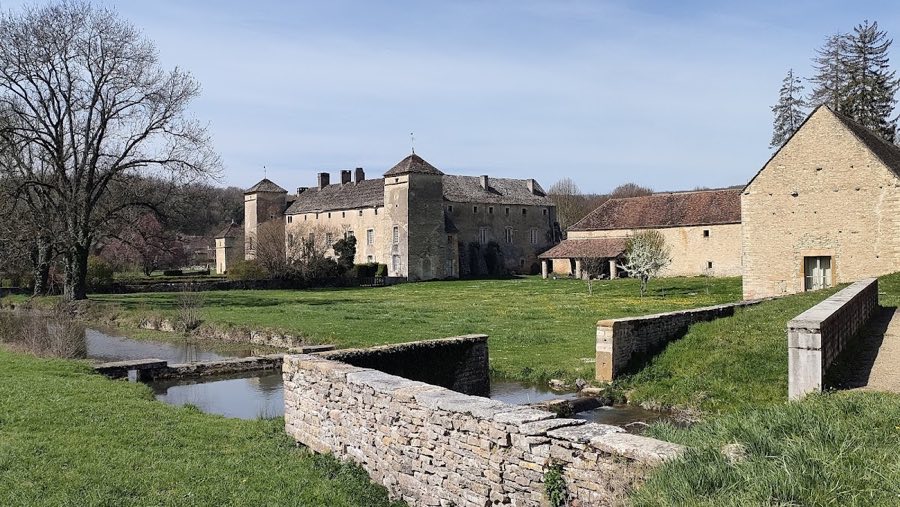
No. 13147
Château d'Ozenay
France
ChâteauIntact15th century

No. 16444
Château · France
No. 16444 · 46.572 N, 5.248 E
Quick summary
Château de Sainte-Croix-en-Bresse is a château in France with origins associated with the 12th century.
See all castles in FranceThe château de Sainte-Croix-en-Bresse, in Sainte-Croix-en-Bresse, France, is a medieval seigneurial residence erected by feudal lords associated with the counties of Burgundy and Mâcon. Its origins lie in the Middle Ages, and the site remained a local seat of noble authority for centuries, passing through several important regional families and reflecting changing patterns of inheritance and marriage among Burgundian and Savoyard nobility. The château mattered as the centre of a seigneury whose ownership linked it to the dukes of Burgundy and later to families celebrated in French history and literature.
In the early medieval period the estate belonged to the counts tied to the Burgundy–Mâcon lineage; Scholastique of Champagne, wife of Count Guillaume IV of Vienne‑Mâcon and living around 1170–1219, appears as lady of Sainte‑Croix, likely in right of dower. Control then moved into a cadet branch that took the name d’Antigny. Henri I d’Antigny, who died around 1250 or after 1256, and his heirs kept the lordship through the later Middle Ages.
By the fourteenth century the seigneurial rights passed through marriage into the House of Vienne, when Marie d’Antigny and her son Hugues (also called Huguenin) transmitted the estate. In 1390 Guillaume II de Vienne, known as le Sage and born about 1360–1362, held Sainte‑Croix among his fiefs. Guillaume de Vienne received the distinction of being made the first knight of the Order of the Golden Fleece on 10 January 1430 and maintained close ties with Burgundy’s ducal court.
After the middle of the fifteenth century the property entered the Hochberg family by marriage. Marguerite de Vienne, who married in 1447, brought Sainte‑Croix to her husband Rodolphe of Hochberg, count of Neuchâtel. Their son Philippe of Hochberg, born in 1453 and deceased in 1503, acquired Pontarlier during the period when Louis XI made donations there, and Philippe married Marie of Savoy in 1476. In 1504 Jeanne of Hochberg, who died in 1543, wed Louis I d’Orléans‑Longueville, and Sainte‑Croix passed into the Orléans‑Longueville succession; François, Léonor, Henri I and Henri II appear in turn as holders through the sixteenth century.
In the early seventeenth century Henri II d’Orléans‑Longueville sold the estate, in either 1623 or 1626, to Charles de Champlécy. His granddaughter Anne‑Charlotte de Champlécy inherited the barony of Sainte‑Croix and in 1659 married Charles de Batz de Castelmore d’Artagnan, the historical figure who inspired Alexandre Dumas’s fictional hero. Their son Louis II de Batz held the barony and his line continued through the eighteenth century. In 1741 Louis‑Gabriel de Batz sold the property to Jean‑François‑Joseph de Venant, lord of Iverny, who carried out a restoration of the house; shortly afterward, in 1744, the seigneury was raised to the rank of marquisate. A later sale in 1759 transferred the château and its contents to Claude‑François de Renouard de Fleury, confirmed as marquis in May 1764, and his descendants retained ownership thereafter. In the twentieth century the estate entered the possession of the comte de Varax through the Mazenod family.
The château presents a compact, rectangular principal residential block with pavilions at its four corners, linked on the east side by a low, one‑storey wing. That east wing supports a raised terrace protected by a wrought‑iron railing. The overall arrangement gives the building a balanced, axial composition typical of a country noble residence that evolved from medieval origins and received later alterations.
Small balconies project where the corner pavilions meet the main block, set at the level of the half‑storey and supported on corbels (projecting supports). These modest platforms occupy the angled junctions of the façades and form a recurring decorative and functional motif. The single‑storey eastern link and its terrace reflect later, non-medieval additions and the mid‑eighteenth‑century campaign of repair undertaken after the 1741 change of ownership.
The principal entrance faces west and is marked by an ogival doorway (pointed arch) constructed with alternating horizontal bands of ochre and dark stone. Above this door sits a small window beneath an accolade lintel (decorative curved stone), while the remaining windows and openings throughout the building are set beneath segmental‑arched lintels (curved spans shallower than a full semicircle). These materials and details — the banded masonry, the carved lintel above the entrance, and the wrought iron of the terrace — give a clear sense of the château’s layered building history.
Work carried out after 1741 repaired and updated the house, and the property was thereafter styled as a marquisate in 1744. The château remains private property and is not open to public access.
No. 13147
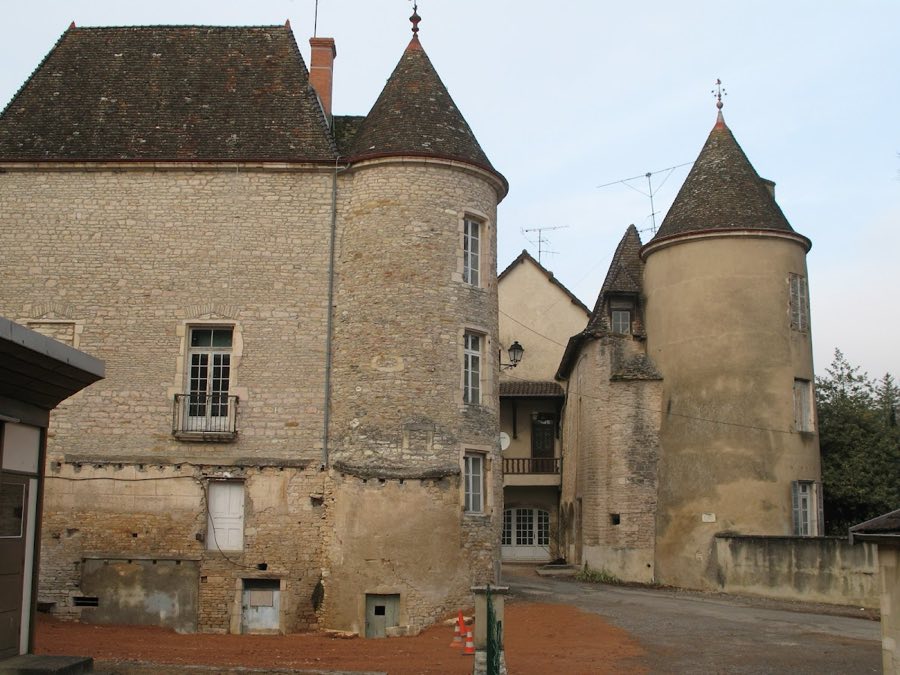
No. 87567
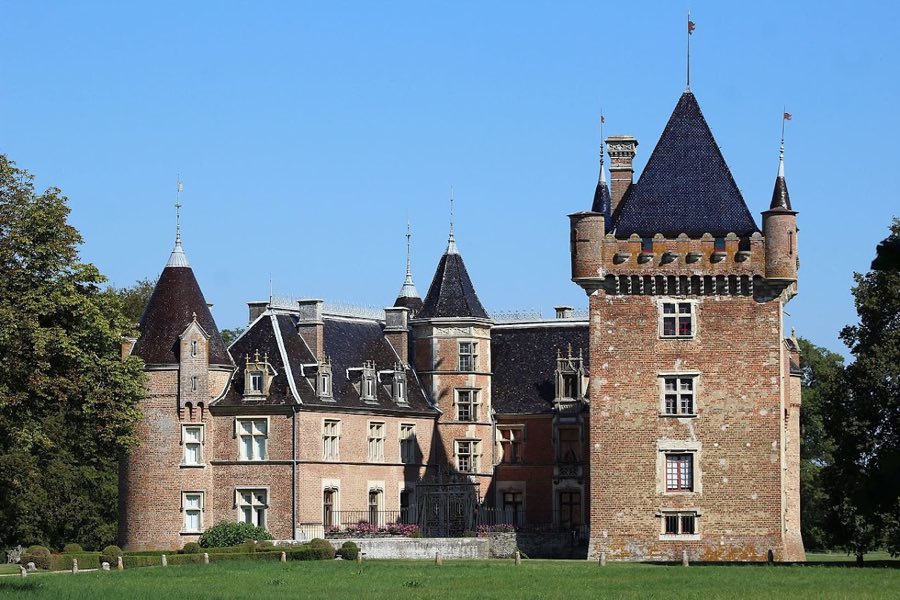
No. 10482
No. 33948
Comments
Comments for Château de Sainte-Croix-en-Bresse will require a verified account before posting.
We'll send a verification link before your first comment is published.