
No. 41191
Château de Hauteville
France
ChâteauRuin18th century
No. 39261
Château · France
No. 39261 · 48.448 N, 0.503 W
Quick summary
Château du Bois Thibault is a château in France with origins associated with the 11th century.
See all castles in FranceChâteau du Bois Thibault in Lassay-les-Châteaux, France, is a medieval castle first raised in the 11th century by Geoffrey II, Count of Anjou, as part of the regional defenses of the Angevin lords during the age of Norman expansion. Its origins lie in the high Middle Ages, and the site gained repeated military and local importance through successive centuries of conflict, reconstruction, and noble ownership. The castle’s story illustrates continuity from feudal frontier defense to a fortified noble residence involved in national religious and political struggles.
In the 12th century the estate passed into the hands of the Logé (Lougé) family, with Herbert de Logé recorded as an early lord and founder of a chapel before 1232. The medieval stronghold continued under local seigneurs until the turmoil of the 15th century, when the English invasion of the region around 1425 forced the owners to abandon the place. A company of Scottish soldiers serving King Charles VII then occupied the site and strengthened its defenses before Jean II, Duke of Alençon expelled them.
Marriage transferred the lands in 1429 to the du Bellay family, which retained control for almost three centuries. Reconstruction of the ruined medieval castle took place in the mid-15th century; work attributed to Jean du Bellay occurred from about 1450 into the 1460s, and a later record mentions rebuilding in 1467 that gave the new structure towers resembling those at the nearby Château de Lassay. The du Bellay household continued to alter and enrich the residence into the early 16th century, creating new domestic quarters, stair arrangements, and courtyard ornamentation.
The 16th century brought religious violence. During the French Wars of Religion Huguenot forces attacked the chapel, breaking statues and desecrating monuments, and in 1590 an assault on the castle was repulsed after artillery failed and the attacker withdrew on 20 October. In 1616 local parishes placed precious church ornaments in the castle cellars during regional unrest to protect them. The castle remained a lived-in dwelling until about 1830.
From the 18th through the 20th century the property passed through various private hands. In 1925 the site belonged to the de Broglie family and later to the Soubrier antique dealers. The ruined remains received legal protection as a historic monument on 22 October 1925 and were placed on the state list on 25 October 1943. Local civic action began in the late 20th century, with an Association Bois‑Thibault formed in 1984 and the town acquiring the property in 1988; the town later opened the site for seasonal visits beginning in 2013.
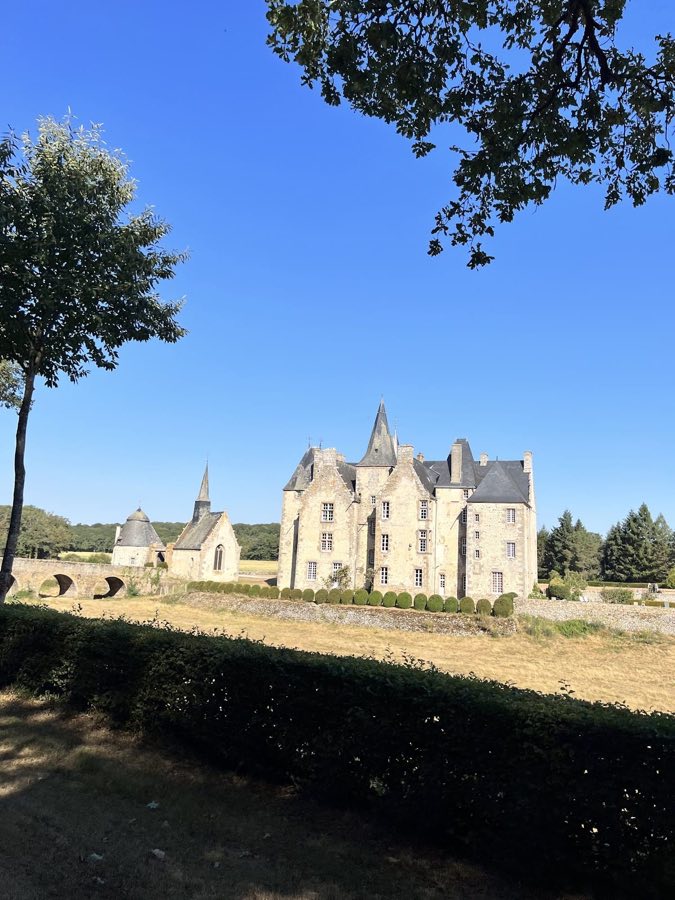
The site survives today as a group of stone ruins within a fortified enclosure, showing work from medieval rebuilding phases and later alterations. The principal domestic range stands as two wings arranged at right angles, forming an L-shaped plan that is flanked by round towers and served by an octagonal stair tower, while other descriptions emphasize a rectangular walled courtyard pierced by four towers, with the southwest and northwest ranges joined by an entrance porch. The fabric preserves two main building episodes, one belonging to the fifteenth-century rebuilding and another to the early sixteenth century when taller towers were added.
A porch framed by a pointed arch links two principal blocks, and the ensemble retains defensive features including machicolations (overhanging openings to drop missiles). The southern range contained the service quarters, where a very large fireplace and a bread oven once stood beneath a monumental chimney, underlining the house’s function as a noble residence combining comfort with defense. Early-sixteenth-century changes include vertical breaches cut through the walls to create larger window openings, reflecting a shift toward brighter domestic interiors.
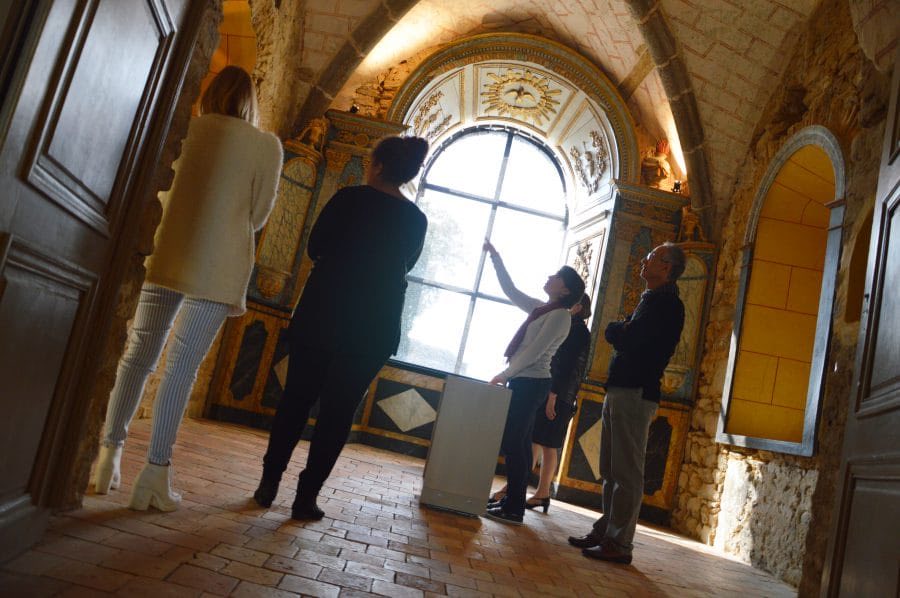
Beneath the wings extensive vaulted cellars survive, with a double row of arches and stout pillars that carry intersecting ribbed vaults, a layout compared to Romanesque crypts. These cellars were used for secure storage and, in times of local trouble, received church plate and ornaments for safekeeping. The chapel, founded before 1232 and dedicated to Saint Catherine, was later rebuilt and endowed in the sixteenth century by Louis du Bellay; painted inscriptions of indulgences and an approval by the cardinal of Bourbon were recorded on its walls, while a mausoleum bore an inscription reading “Here lies the heart of … Louis du Bellay,” its statue reported broken. The chapel’s nave contained eight tombs marked with Maltese crosses, busts, and swords.
Later domestic additions attributed to Louis du Bellay include a northwestern lodging block, a new stair in an adjacent tower, and an ornamental armrest overlooking the inner courtyard. The surviving fabric remains fragmentary but coherent enough to show defensive masonry, fitted living spaces, ceremonial monuments, and service areas.
The ruins have been officially protected since their classification as a historic monument in 1925.
No. 41191
No. 94151
No. 54143
No. 29638
Comments
Comments for Château du Bois Thibault will require a verified account before posting.
We'll send a verification link before your first comment is published.