No. 23527
Huntington Castle
United Kingdom
CastleRuin13th century

No. 39515
Castle · United Kingdom
No. 39515 · 52.177 N, 3.307 W
Quick summary
Colwyn Castle is a castle in United Kingdom with origins associated with the 11th century.
See all castles in United KingdomColwyn Castle is located near the settlement of Hundred House within the municipality of Llandrindod Wells, Wales. It was originally established by the Normans around the late 11th century on the grounds of an earlier Roman military fortification.
The earliest phase of the castle’s history begins around 1093 when Raoul II of Tosny constructed a motte-and-bailey fortress on this site to consolidate Norman control in the region of Radnorshire. This strategic position, lying within the manor of Glascwm, allowed its occupants to oversee surrounding lands and defend against Welsh resistance. By the early 12th century, the castle had become a contested stronghold, changing hands between Welsh and Norman forces. Around 1135, Madog ab Idnerth, a Welsh ruler, is reported to have taken control of the castle. The Normans reasserted their presence when Ranulf, Earl of Chester, undertook repairs in 1143.
In the later 12th century, Rhys ap Gruffydd, a leading Welsh prince, gained influence in the region. In 1175, he transferred ownership of the castle to his son-in-law, Einion Clyd, marking a period of Welsh administration. Initially, Rhys maintained an alliance with King Henry II of England, but this relationship deteriorated under King Richard I. Around 1196, during renewed hostilities, Rhys recaptured the castle from the Normans and had it destroyed, reflecting the turbulent struggle for control along the Welsh-English borderlands.
The early 13th century saw significant rebuilding efforts. King Henry III ordered the reconstruction of Colwyn Castle in 1215, and historical records show that he spent much of 1231 there supervising its defenses and restoration. This renewed fortification was further enhanced in 1242 under Ralph de Mortimer, who sought to secure his claim over the lordship of Maelienydd. During this period, the castle became associated with Maud de Braose, wife of William de Braose, and came to be known colloquially as Maud’s Castle.
Despite the return of the Tosny family in the late 1290s, the castle’s importance declined over the following century. By the 14th century, it was largely abandoned, falling out of use as political and military dynamics shifted in the region.
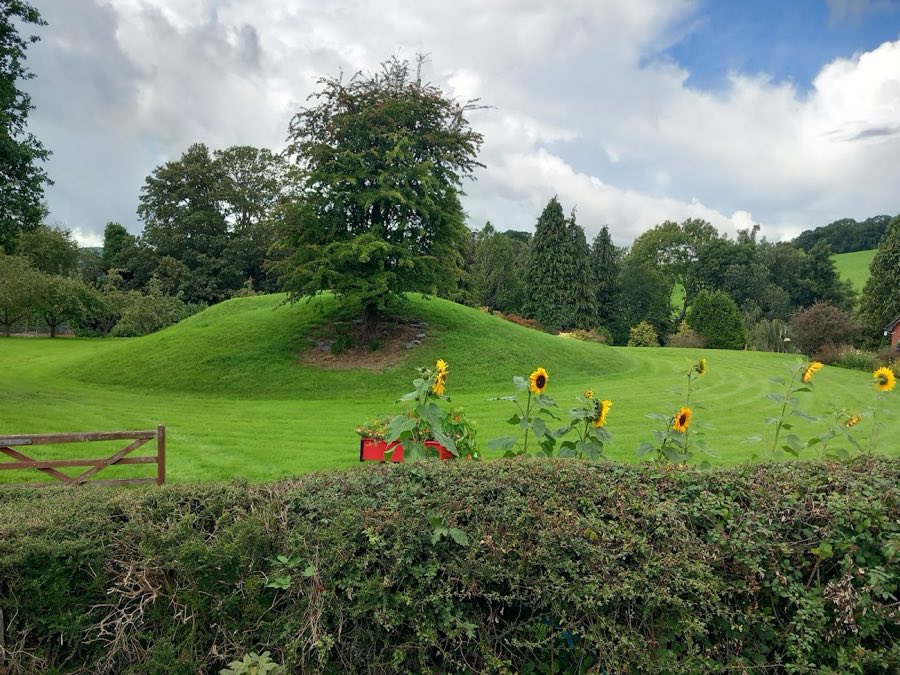
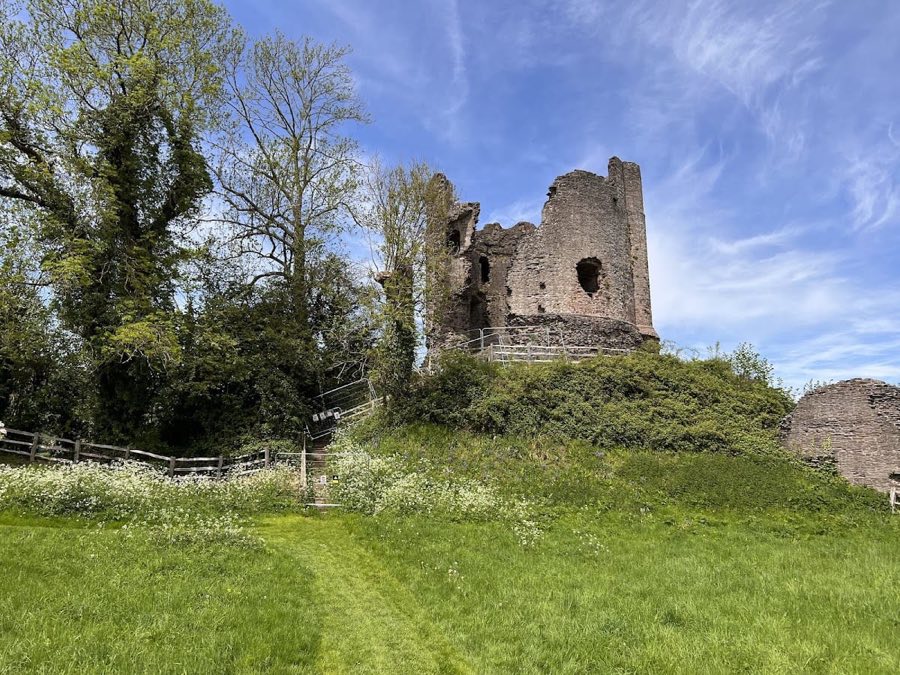
Colwyn Castle was originally constructed as a motte-and-bailey, a common medieval fortification style featuring a raised earth mound (the motte) accompanied by an enclosed courtyard (the bailey). This design was superimposed on the site of a former Roman fort, integrating the strategic advantage of the earlier imperial military installation. The location rests roughly 238 meters above sea level on rolling hills, granting commanding views toward the River Edw to the north and nearby mountain ranges to the south.
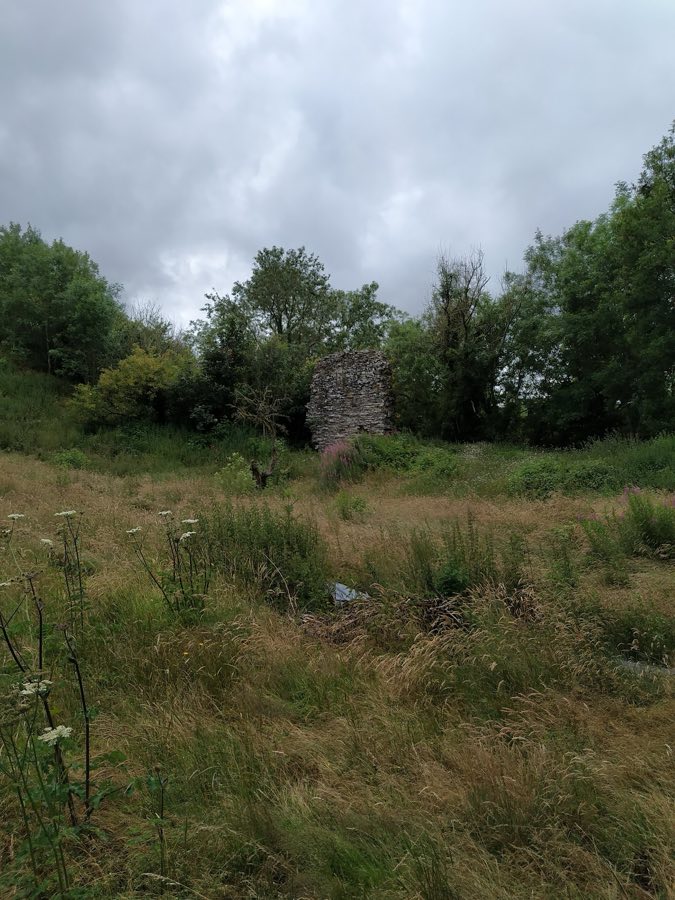
Today, only the outer defensive earthworks of the castle have survived. These consist primarily of raised banks and ditches that once formed the perimeter defenses, visibly tracing the boundaries of the former fortifications. No constructed stone walls or internal buildings remain in standing form. Over time, the site was adapted for agricultural use, with a farmhouse now occupying the area within the former castle grounds.
The earthworks retain their shape well enough to reveal the castle’s layout, reflecting the arrangement typical of motte-and-bailey castles on the medieval frontier. Although no detailed dimensions or construction materials have been recorded, the presence of significant mounding and enclosure ditches attest to the castle’s original defensive purpose. The site’s close proximity to a main road and its spatial relation to nearby settlements confirm its role as a regional stronghold during the Norman and medieval Welsh periods.
No. 23527
No. 63741
No. 58512
No. 18198
Comments
Comments for Colwyn Castle will require a verified account before posting.
We'll send a verification link before your first comment is published.