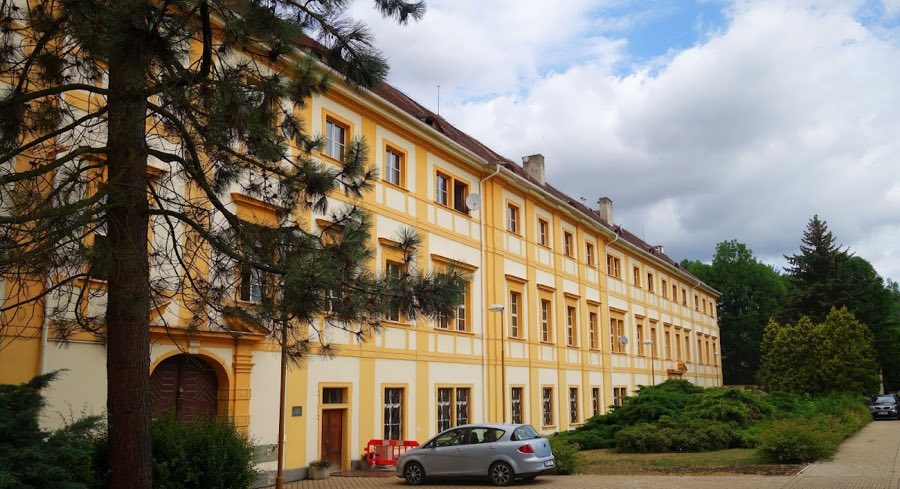
No. 79396
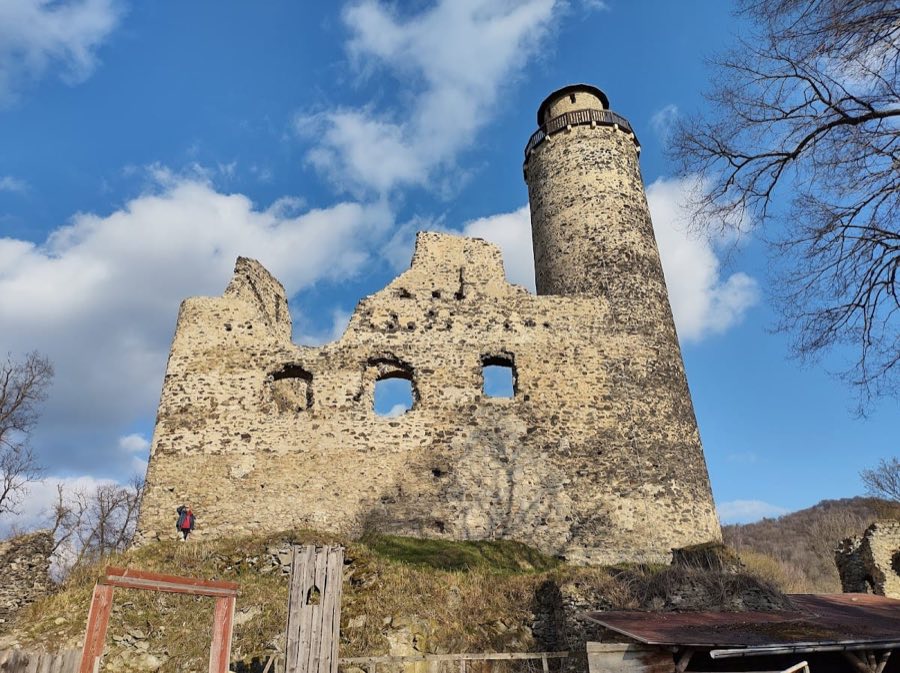
Světec Castle
Czechia
CastleIntact13th century
No. 75900
Château · Czechia
No. 75900 · 50.602 N, 13.744 E
Quick summary
Duchcov Chateau is a château in Czechia with origins associated with the 13th century.
See all castles in CzechiaDuchcov Chateau in Duchcov, Czechia began as a fortified stronghold built in the 13th century by the lords of Hrabischitz, a medieval Bohemian noble line. The site first served as a local seat of power in the later Middle Ages and later passed into the hands of related noble houses of the region. Its long development links medieval lordship with later Renaissance and Baroque rebuilding phases that made the building an important regional residence.
In the late 16th century, around 1570, the medieval stronghold was replaced by a Renaissance chateau under the patronage of Wenzel Popel von Lobkowitz. This rebuilding transformed the defensive fortress into a residential complex suited to noble life of the Renaissance era, marking a shift from military to representational and domestic architecture.
The estate changed ownership in 1642 when the counts of Waldstein acquired it. From the 1670s into the early 18th century the château was rebuilt and enlarged in the Baroque manner. Work during this period gave the house its formal, court-facing composition and added side wings up to 1707; further alterations took place after 1720. In 1680 the Waldstein family converted the holding into a fideicommiss, an entailed estate, and the chateau became the seat of the manorial economic office administering the lordship of Dux together with Ober‑Leitensdorf and the family’s allodial estate at Maltheuer.
Philanthropic and religious uses followed the Baroque reconstruction. In 1694 an institutional hospital was founded on the chateau domain by Archbishop Johann Friedrich von Waldstein and endowed with 27,780 gulden plus in-kind assets from the family’s Maltheuer estate. The hospital was enlarged in 1716 under Johann Josef von Waldstein and included a church consecrated to the Holy Cross. In 1775 Emanuel Philibert von Waldstein-Wartenberg relocated twelve orphan places to a new orphanage at a cloth factory in Ober‑Leitensdorf; by the early 1800s financial adjustments reduced that number to eight pensioners.
The château played a notable cultural role in the late 18th and early 19th centuries. Giacomo Casanova lived at Duchcov as librarian from 1785 until his death in 1798 and wrote his memoirs there. Ludwig van Beethoven performed at the house in 1812 and dedicated the piano sonata known as the “Waldstein” to Count Ferdinand Ernst von Waldstein. In 1813 the residence was the setting for political talks attended by Tsar Alexander I of Russia, King Frederick William III of Prussia and Emperor Francis I of Austria.
In the 20th century the estate passed out of family hands when the castle was sold to the state in 1921. Wartime damage in 1945 destroyed much of the church’s sculptural ornamentation. During the 1950s brown‑coal surface mining removed large parts of the surrounding park and led to the destruction of a hospital building located about 400 metres west of the main house. A ceiling painting by Wenzel Lorenz Reiner rescued from the former hospital church was installed in a garden pavilion opened in 1983. Duchcov Chateau is recorded as a protected cultural monument of the Czech Republic under catalogue number 1000154850.
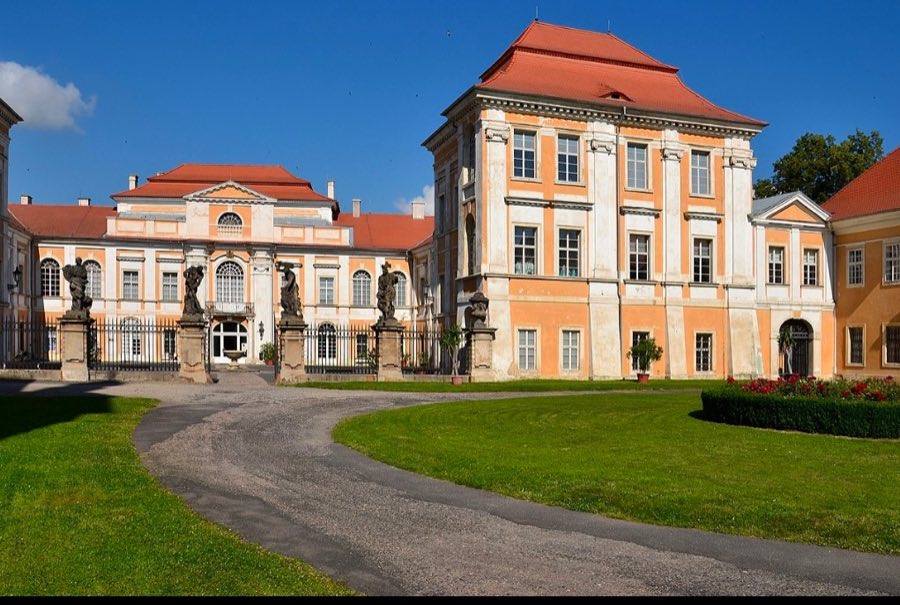
The château stands as a formal two-part complex arranged around two courtyards. A central main block is flanked by two side wings, producing a P-shaped ground plan that frames a court of honor (formal entrance courtyard). The courts sit in a two‑section layout, with an inner courtyard set back from the front court and historically separated by a fence adorned with Baroque sculptures mounted on pillars. The building sits on a small hill so the garden-facing rear elevation appears more imposing.
Construction is predominantly brick with plastered façades. The principal front is two storeys high and features a large entrance portal set between pilaster strips. Roof forms include hipped slopes and mansard roofs. In the mid-19th century the interior contained three large halls and about sixty rooms, arranged to support residential life, collections and administrative functions.
One distinctive object survives in the inner courtyard, a large metal basin cast in 1630 from captured Swedish cannon by Albrecht von Waldstein. That basin originally stood in the Prague Waldstein Garden before being re‑installed at Duchcov. The château also housed an extensive assembly of cultural material: painting and sculpture collections, a cabinet of naturalia and art objects, an armory and a library of over twelve thousand volumes.
Religious architecture formed part of the ensemble. A church dedicated to the Annunciation with two towers was built beside the main house to serve household and local spiritual needs; the twin towers were prominent in the silhouette of the neighbouring settlement. Sculptural ornament and park statuary included works and vases by Matthias Bernhard Braun, with additional interior sculptures attributed to Braun together with Ferdinand Maximilian Brokoff. Ceiling and mural decoration by Wenzel Lorenz Reiner survives in part in relocated settings, and the large hall once bore a ceiling painting showing Heinrich Waldstein presenting his twenty‑four sons and their twenty‑four squires to King Přemysl Ottokar II in 1254. Much of the church’s sculptural work was destroyed in 1945.
The château’s hospital complex lay roughly 400 metres west of the main house at the park edge. That hospital building was lost during brown‑coal mining operations, but one important mural from the hospital church was moved into a garden pavilion that opened in 1983. The surrounding grounds were originally laid out as a Baroque garden between 1716 and 1728, with parterres, pools, fountains and allegorical sculpture. In the early 19th century the park was reshaped in the English landscape manner. Large areas of the historic garden were removed by surface mining in the 1950s; parts of the layout were reconstructed in the 1960s using earlier plans.
No. 79396
No. 51324
No. 16953
No. 69872
Comments
Comments for Duchcov Chateau will require a verified account before posting.
We'll send a verification link before your first comment is published.