No. 32307
Palazzo Corboli Aquilini
Italy
PalaceRestored18th century
No. 49234
Palace · Italy
No. 49234 · 43.724 N, 12.636 E
Quick summary
Galleria Nazionale delle Marche is a palace in Italy with origins associated with the 15th century.
See all castles in ItalyThe Galleria Nazionale delle Marche in Urbino, Italy, occupies the Renaissance Ducal Palace built by the dukes of Urbino in the 15th century. Its fabric and decoration grew under the ducal court of the Italian Renaissance and the palace housed an important ducal collection of paintings, tapestries, library volumes and interior furnishings that made it a cultural center for the duchy.
Construction and decoration reached a high point in the mid to late 1400s when Federico da Montefeltro commissioned richly appointed private rooms. A small wooden alcove was created around 1459–1460 and the small study known as the studiolo was finished in 1476, fitted with a stuccoed vaulted ceiling and a band of elaborate marquetry (wood inlay work). At that time the palace contained a large library and cycles of painted portraits and panels that reflected the intellectual ambitions of the ducal household.
The palace and its collections suffered repeated removals of art and furnishings. In 1502 Cesare Borgia, after taking control of the duchy, dispersed part of the ducal holdings, including a sculptural work by Michelangelo that was later lost. After the duchy’s transfer to the Papal States in 1631, the movable goods of the house were treated as the dowry of Vittoria della Rovere on her marriage to Ferdinando II de’ Medici; jewels, sculptures, gems and numerous paintings were moved to Florence or sold, among them works by Raphael, a ducal diptych by Piero della Francesca and a group of Titian paintings such as the Venus of Urbino.
Following the 1631 change in rule, Cardinal Antonio Barberini removed parts of the studiolo decoration and several chapel paintings; many of those pieces remained in the Barberini collection before passing to other private collections in the 19th and early 20th centuries, with some works later acquired by the Italian state and returned to Urbino. In 1657 Pope Alexander VII transferred hundreds of illuminated books from the ducal library to the Vatican Library and the palace’s decorative leather wall coverings were destroyed. During the Napoleonic era a group of fourteen portraits from the studiolo cycle went to France and are today in the Louvre; this formed the largest single group taken from Urbino in that period.
The modern museum institution was established in 1912. Nineteenth- and twentieth-century processes of suppression and redistribution also shaped the gallery’s holdings: after Italian unification in 1861 many works from churches and convents in the surrounding region entered public collections, and named bequests and deposits continued to augment the gallery. The Mauruzi gift of 1865 brought Castelli ceramics, and later legacies and purchases — including the Volponi deposits in the 1990s and 2000s, a collection of Roman coins in 2000, and acquisitions from foundations — expanded the displays. In 1975 two masterpieces were stolen, the Madonna of Senigallia and The Flagellation by Piero della Francesca; both were recovered in Locarno in March 1976. Exhibition spaces were reorganized in 1982 and paintings that had been held in Barberini collections were bought by the State and reinstalled in the studiolo in 1983. The institution gained special autonomous museum status in 2014, and in 2022 a new arrangement of the second-floor galleries opened, made possible by a deposit from the local savings bank foundation.
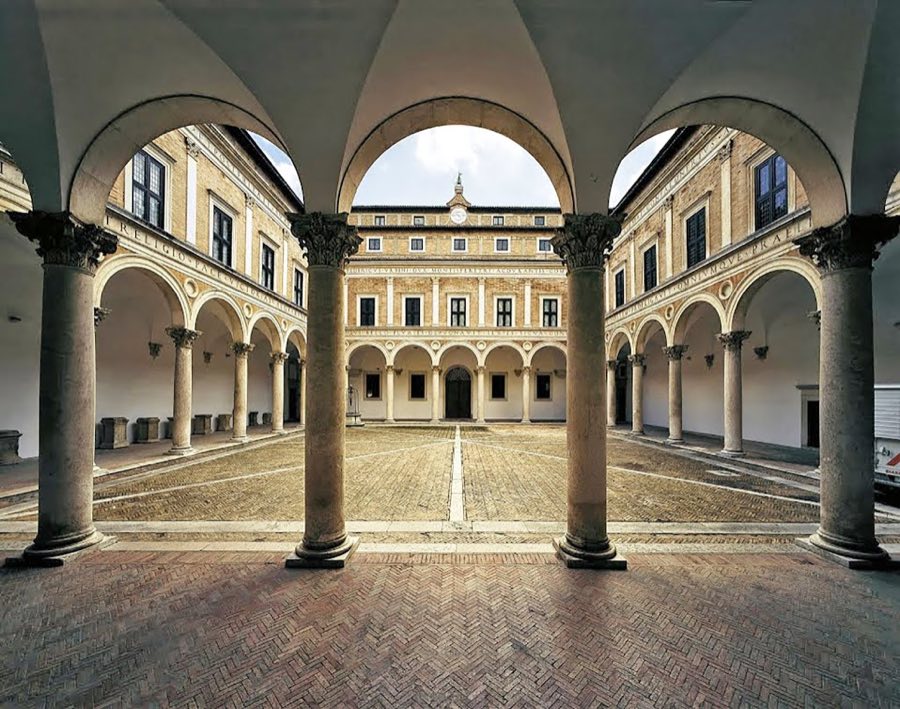
The gallery occupies the palace around a rectangular courtyard whose facades form the heart of the complex. The courtyard features five arches on its north and south sides and six arches on each of the other sides. A dedicatory Latin inscription runs along the two lintels on every side of the courtyard; the southeast corner contains a well dated to the 17th century.
The palace’s main first-floor apartment is arranged as named suites with numbered rooms. In the east wing the Jole apartment comprises seven rooms (rooms 1–7). The Melaranci suite covers rooms 8–11. A Guests apartment occupies rooms 12–15. The Duke’s apartment, often called the Realissimo, is formed by rooms 16–20. Representative reception rooms are grouped as rooms 21–23, while the Duchess’s apartment comprises rooms 24–28. These suites form the principal sequence of public and private interiors on the main floor.
The ducal alcove is a cubic wooden chamber measuring 340 by 340 by 340 centimeters, attributed to Giovanni da Camerino around 1459–1460. Its structure is built of paneling, pilasters and roof boarding, the surfaces painted in tempera and covered with gilding. The outer facing was painted in imitation of multi-colored marble by Fra’ Carnevale in a scheme that echoes contemporary Florentine façade decoration. The alcove was rediscovered among palace deposits and has been reconstructed for display.
The studiolo of Federico (a small private study) occupies room 18 and was completed in 1476. It has a vaulted ceiling coated with stucco (plaster finish) and on the lower wall band contains intricately executed marquetry (wood inlay work) carried out by Baccio Pontelli after designs by Sandro Botticelli, Francesco di Giorgio Martini and Donato Bramante. The band between the vault and the marquetry once held twenty-eight portraits of learned men painted by Justus of Ghent and Pedro Berruguete; fourteen of those portraits were recovered and returned to the palace in the 20th century, and the panel showing Federico da Montefeltro with his son Guidobaldo by Pedro Berruguete is preserved among the surviving pieces. The studiolo’s wood inlay panels and many carved wooden doors remain intact and visually coherent.
Stone decorative elements throughout the palace and many of the original marquetry doors survive in place and in good condition. The basement levels contain the service areas that supported court life, including stables, kitchens, baths and wine cellars. The second floor contains the Rovere apartment, built under Guidobaldo della Rovere, laid out as a suite of rooms and housing a large collection of Renaissance and later maiolica (tin-glazed ceramics). In 1983 paintings purchased by the State were reinstalled in the studiolo, restoring aspects of the original pictorial cycle within the preserved architectural shell.
No. 32307
No. 50188
No. 14749
No. 11784
Comments
Comments for Galleria Nazionale delle Marche will require a verified account before posting.
We'll send a verification link before your first comment is published.