No. 14433
Övedskloster Castle
Sweden
Manor houseRuin12th century
No. 25791
Castle · Sweden
No. 25791 · 55.735 N, 13.559 E
Quick summary
Hjularöd Castle is a castle in Sweden with origins associated with the 19th century.
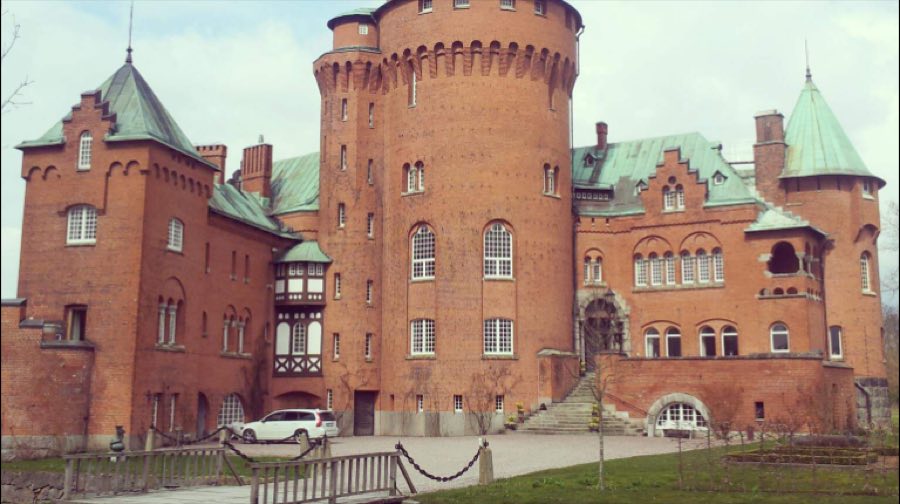
See all castles in SwedenHjularöd Castle in Harlösa, Sweden, is a late 19th-century manor built in a medieval revival style on a site whose origins reach back to the Danish Middle Ages. The estate first appears in records from 1391, when Christina Konstantinsdotter of Kirningsetten gave her farm there to the Bosone nunnery. That early association with a religious house, and the estate’s later passage through royal and noble hands, made the place important as both a landed property and a local administrative unit over several centuries.
Throughout the late medieval and early modern period the estate remained tied to church and crown. It stayed under the nunnery’s control until secularization, after which church lands were taken into royal hands and the former monastery together with its surrounding holdings were reorganised as an administrative district. In 1579 the king granted the property to members of the Danish noble Dresselberg family. In 1589 Wilhelm Nielsen Dresselberg erected a manor and likely laid out defensive moats; those late 16th-century works were probably lost during the fighting between Denmark and Sweden in the following decades.
The Dresselberg male line ended in 1620, and Mette Dresselberg and her husband Frederik Parsberg sold the estate to district judge Knud Gabrielsen Akelee. Akelee owned the property for about thirty years and put up a new main house that stood until the later 1600s. In 1658 the estate reverted to the crown and was let to Admiral Henrik Gerritsen, who served as a squadron commander in Carl Gustaf Wrangel’s fleet at the naval action known as the Battle of Öresund. The property then returned into private circulation and in 1662 passed to Colonel Fredrik von Buchwald of a German noble family.
Fredrik von Buchwald expanded the holding by purchasing neighbouring farms, began styling himself Baron Hjularöd from 1675, and served as governor of Wismar until his death in 1693. Two of his sons fell in the Great Northern War, the large-scale conflict between Sweden and a northern coalition, and the youngest son, Georg von Buchwald, died at the Battle of Poltava in 1709, a decisive encounter that marked a turning point in that war. The estate descended through Georg’s daughter Emerentia, who married Colonel Baron Reinhold von Lewen, and later passed into the hands of Charlotte von Lewen and her husband Colonel Bernt Wilhelm von Dellvig. Their son Christian Georg von Dellwig held Hjularöd for more than forty years and provided a new residential building in his time.
In 1805 Christian Georg von Dellwig sold the property to chamberlain Baron Karl Gustav von Schwerin. The estate then passed by inheritance to his daughter Brita Katarina and through her family to their grandson, chamberlain Hans Gustaf Toll. At the end of the 19th century Hans Gustaf Toll commissioned a new residence, seeking a building that recalled French medieval castles and probably taking the Château de Pierrefonds as a model. The current castle was raised between 1894 and 1897 for him. In 1917 Toll sold the house and surrounding lands to a group of private investors who divided the estate. Members of the Bergengren family have owned the property since 1926 and it has remained private. The house has appeared on film and television: exterior scenes for a 1924 motion picture were made there, and outdoor filming for the 1996 Swedish television production Mysteriet på Greveholm and its 2012 follow-up used the manor’s grounds.
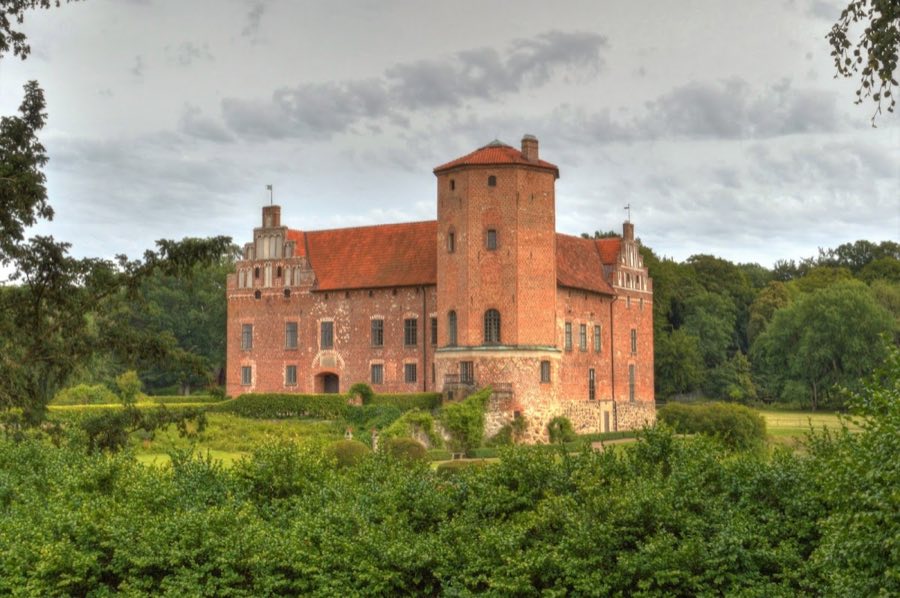
The present complex is arranged as a fortified manor built to evoke medieval strongholds, with the surviving building dating from the 1894–1897 reconstruction. The plan centres on a circular donjon (keep), a central fortified tower, placed within an enclosure that follows the principles of older fortress layouts. Massive battlemented walls partly surround the core, and the whole complex sits within a protective water-filled moat, underlining the castle’s deliberate medieval appearance while belonging to a late 19th-century phase of construction.
A series of three bridges provide entry to the island-like enclosure; two of these are for foot traffic. The exterior shows deliberately historicist motifs carried out in the late 19th century: tall chimney stacks rise above the roofs, facades display stepped gables, and door and window openings include high pointed arches, a form borrowed from medieval architecture. These decorative and structural elements belong to the building campaign of 1894–1897 and remain visible on the surviving house, which continues in private residential use.
During work for the modern manor builders uncovered older stone foundations beneath and around the new construction, indicating earlier buildings on the site. A gatehouse on the south side, formerly part of the entrance sequence, was removed during later rebuilding, while the remaining walls, bridges, moat and the central keep survive as the main visible features. The stone bases that were exposed during the 19th-century work attest to the site’s long sequence of occupation and repair, and the current ensemble preserves the late 1800s reimagining of a water-surrounded fortress.
No. 14433
No. 56812
No. 63703
No. 75351
Comments
Comments for Hjularöd Castle will require a verified account before posting.
We'll send a verification link before your first comment is published.