
No. 49664
Wallburg Sieben Gräben
Germany
CastleIntact13th century
No. 66577
Castle · Germany
No. 66577 · 51.345 N, 7.571 E
Quick summary
Hohenlimburg Castle is a castle in Germany with origins associated with the 15th century.
See all castles in GermanyHohenlimburg Castle in Hagen, Germany, was raised by the German comital family of Altena-Isenberg under Count Dietrich I around 1240 and first appears in a document dated 1242. During the 1200s the site grew into the principal residence of that comital line and is recorded as the originating core of the county that became known as Limburg; a peace agreement involving the counts of von der Mark is dated 1 May 1243.
In 1288 the castle fell into the hands of Count Eberhard I of von der Mark. Around 1300 the knight Sobbo de Svirte seized the stronghold and later returned it to the von der Mark counts; by 1304 the castle had been restored to Count Dietrich III of Limburg.
Fighting returned in the mid-15th century. Troops of the Limburg family branch seated at Broich and their allies besieged and captured the castle in 1459, and from 1460 ownership was shared between the houses of Limburg-Broich and Neuenahr. Over the following decades the Limburg-Broich share passed to Count Wirich V of Daun-Falkenstein between 1509 and 1542. From 1542 until 1589 the counts of Neuenahr ruled alone, and from 1592 until about 1807–08 the counts of Bentheim-Tecklenburg held the castle and its county.
In 1584 forces of the Electorate of Cologne took Hohenlimburg and occupied it until 1610. Imperial troops under Generalwachtmeister Lothar Dietrich von Bönninghausen besieged and captured the castle in 1633 and used it as their quarters until 1636. When these troops withdrew in 1636 the outer ward and its buildings, including a medieval half-tower, burned down.
During the 1600s the site was adapted increasingly as a residential palace. Between 1729 and 1756 the Bentheim family moved their residence from Rheda to Hohenlimburg. Under Count Moritz Casimir I von Bentheim-Tecklenburg the castle was expanded for residential use and formal late-baroque gardens were laid out on the slope below the hilltop. In 1762, while French units occupied the castle, forces of the Duke of Brunswick‑Hanover shelled the position.
A tower was struck by lightning and destroyed in 1811; later, from about 1816 or 1817 until 1830 the palace served the princes as their principal home before the princely seat returned to Rheda. Ownership remained with the Bentheim-Tecklenburg family; the site is recorded as presently owned by Maximilian, Prince of Bentheim-Tecklenburg.
Local interest in the castle led to the establishment of the Hohenlimburg local history association on 20 October 1920 and the opening of a museum in 1927. A decision in 1947 moved the collection into the castle and a museum opened there in 1949; responsibility passed to the municipal authorities after six years and Dr. Wilhelm Bleicher became museum director in 1975. The castle museum recorded over 23,000 visitors in 1986. A period of decline began in the 1980s, and revival efforts resumed from 2006 under Maximilian, Prince of Bentheim-Tecklenburg, working with Albrecht Wrede; public funding from a Rhine-Westphalia foundation was recorded in 2004. The charitable company Schloss Hohenlimburg gemeinnützige GmbH was founded on 27 January 2005.
Recent management measures include installation of a turnstile in 2022 that controls paid entry to the cannon platform, the inner courtyard, the wall-walk and the garden; the initial price on opening was four euros and admission hours were set daily. The cultural recovery programme “Neustart Kultur” funded much of that work. The exhibition titled “Schwarze Hand” was placed in the keep in 2024 and the admission fee was reported as raised to six euros.
The industrial rolling-mill museum opened on the site in 1988. In 2004 the castle charitable company was established with several shareholders. In 2016 the supporting association terminated its contract and a regional court upheld that termination, requiring reversal of a €200,000 grant. The museum displays were moved in 2017 to an open-air museum in Hagen with reported restart funding, and a new industrial exhibition opened in April 2024 in Haus Letmathe with reported state and foundation grants.
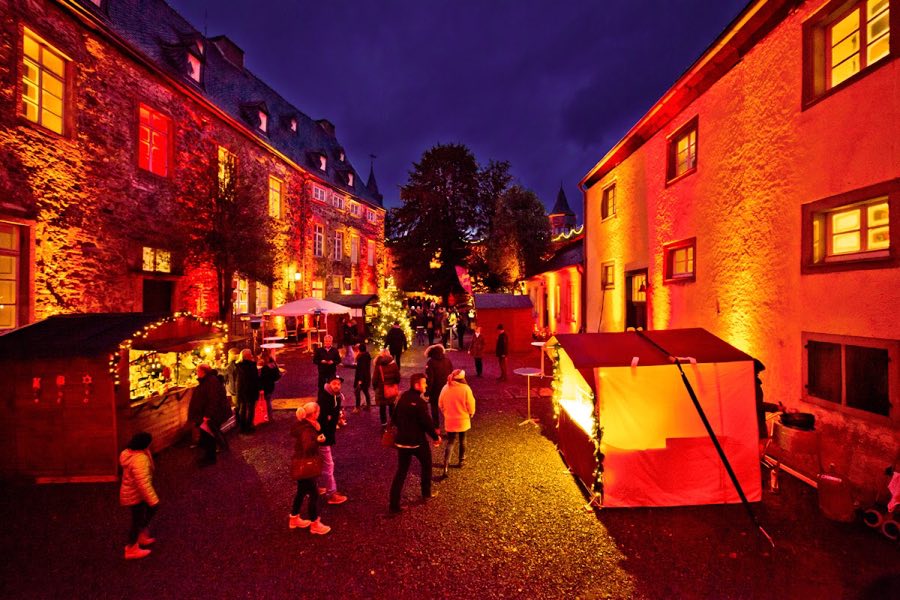
The castle occupies a hilltop spur above the Lenne valley and presents a two-part hill fortress with an outer ward below a main ward. The ensemble is recognised as one of the relatively intact medieval hilltop castles in the region, combining surviving fortified elements from the 1200s and 1300s with later residential buildings and a designed garden on the slope beneath the castle.
The main residential block, or great hall, together with the principal gatehouses, the surrounding curtain walls and the tall stone keep date to the 13th and 14th centuries and remain part of the visible complex. These components represent the medieval core of the site and are preserved as structural elements standing in their original positions. Gate routes and the keep continued to be used and adapted in later centuries as the castle changed function from strictly defensive stronghold to a noble residence.
A number of domestic and service buildings added between the 1500s and 1700s survive within the castle grounds. These later structures reflect the site’s conversion into a representative residence; they were incorporated into the castle ensemble and remained in place through subsequent repairs and modifications associated with changes in ownership and use.
The lower outer ward suffered a destructive fire in 1636 when Imperial troops withdrew, and that event consumed buildings there including a medieval half-tower. The outer ward nonetheless forms part of the present ensemble and the cannon platform located on this lower enclosure displays restored artillery pieces. The artillery were conserved and remounted between 1996 and 2000, identified as shipboard guns produced in France and Sweden, two from the French Revolutionary era and one likely from 17th-century Sweden, and these were fitted to modern carriages following a rearmament pattern based on an early 19th-century system.
The keep now houses the exhibition known as the “Schwarze Hand.” For this display the interior walls of the keep were painted deep black and new display cases, interpretive panels and QR-code information points were installed. The exhibited object is an intentionally mummified human hand recovered from the archive of a tower that was destroyed by lightning in 1811. Radiocarbon measurement gave a central date of 1546 with a margin of ±60 years. Analysts determined the object is a right hand, probably from an adult male, lacking all distal finger bones and some carpal bones, with a remnant cord at the thumb and no signs of cutting or hacking. The hand has been on display in the keep since July 2024 and is included in the visitor route without a guided tour.
A continuous wall-walk runs along parts of the curtain wall and was recognised as a notable monument in August 2005. This defensive passage is accessible to visitors through the controlled entrance installed in 2022, providing circulation around the battlements while leaving the interior rooms closed to general access.
Below the castle on the western slope, the high baroque garden laid out from 1730 survives as a designed landscape element. Laid out under Count Moritz Casimir I after the pattern of a French formal garden, it includes ornamental and kitchen plots, a small vineyard and an orchard meadow. Restoration work began around 2000 and the garden has been reopened to visitors since 2007, preserving the late-baroque arrangement and supporting elements of historic planting.
Controlled visitor infrastructure now complements the historic fabric. The turnstile installed in 2022 manages paid entry to the cannon platform, the inner courtyard, the wall-walk and the garden while the castle interiors remain excluded from that admission circuit.
No. 49664
No. 78875
No. 26096
No. 63280
Comments
Comments for Hohenlimburg Castle will require a verified account before posting.
We'll send a verification link before your first comment is published.