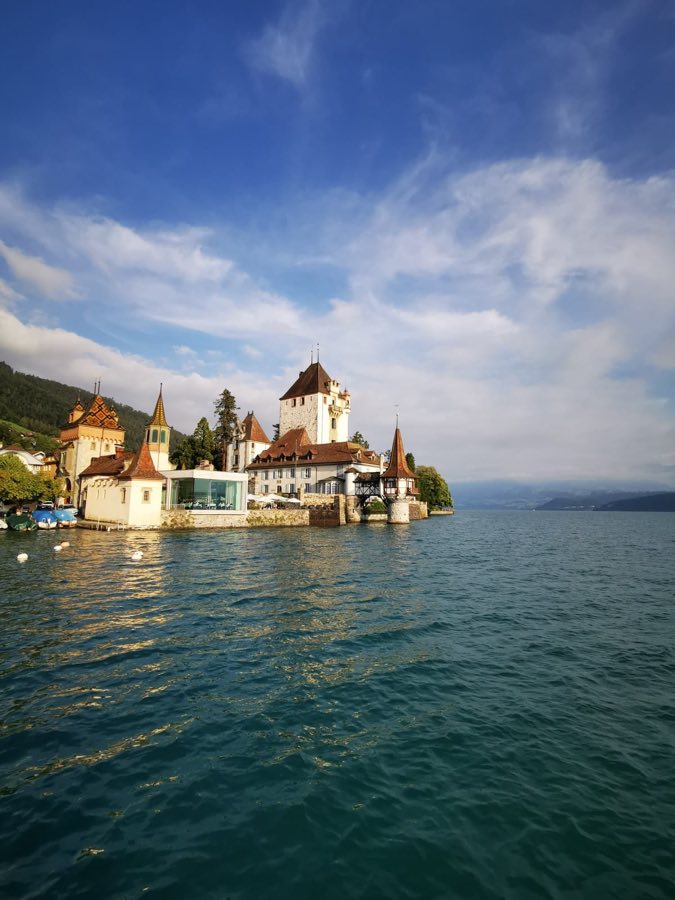
No. 29032
Oberhofen Castle
Switzerland
CastleIntact13th century
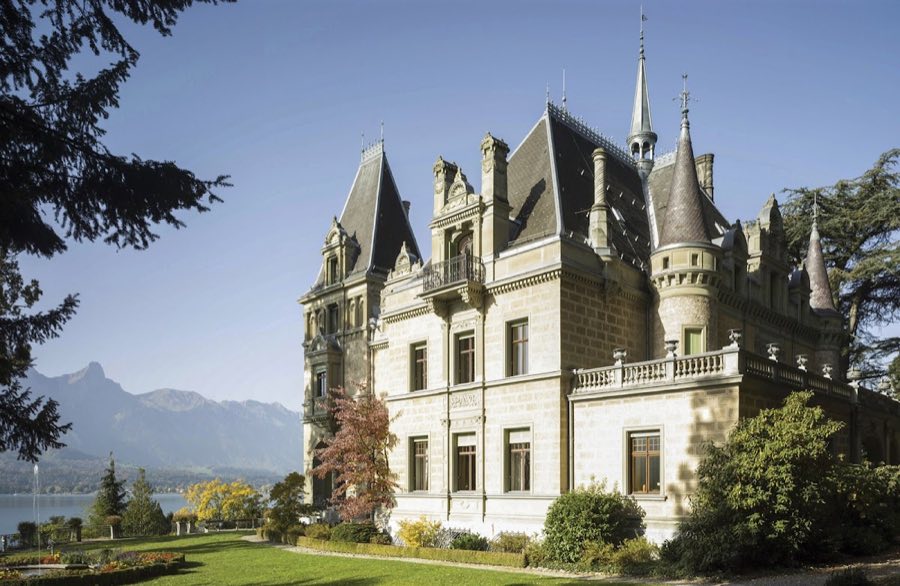
No. 23737
Castle · Switzerland
No. 23737 · 46.738 N, 7.655 E
Quick summary
Hünegg Castle is a castle in Switzerland with origins associated with the 19th century.
See all castles in SwitzerlandHünegg Castle in Hilterfingen, Switzerland, is a lakeside 19th-century residence built for a Prussian noble, erected between 1861 and 1863 in a historicist manner drawing on Loire Renaissance château models. Constructed during the mid-1800s, the house represents a fashionable revival of earlier French Renaissance forms and later became notable for its richly furnished interiors and its role as a cultural property of national importance in Switzerland.
The estate was commissioned by Prussian Baron Albert Emil Otto von Parpart and completed in the early 1860s. The first owner died in 1869. By 1883 the property had passed to his nephew, who dispersed the household art collection. In 1893 the nephew sold the castle to Karl Lehmann, a commercial judge from Berlin.
Around the turn of the century the building changed hands again, and a new owner carried out an extensive redecoration of the interior in the Art Nouveau style that was current at that time. Small additions were made to the house during these renovations. At the opening of the Second World War the castle was sold to Oscar Haag of Küsnacht. In 1958 the Canton of Bern acquired the property.
Under cantonal ownership the rooms were arranged to display domestic interiors from Historicism and Art Nouveau, and the house was made available for temporary exhibitions. A long-running display program has included a museum devoted to Renaissance Revival and Art Nouveau domestic culture, and between summer 2018 and the end of 2022 the site hosted the Swiss Gastronomy Museum. The castle also mounted a special exhibition about Swiss mountain railways in 2012 and 2013, with a subsequent return planned, featuring loaned original objects, model reproductions, photographs, documents, video presentations and dioramas of the Vitznau–Rigi and Pilatus rack railways. Conservation and restoration projects have been carried out on key fittings, including work on the chandeliers between 2016 and 2018. The building and its grounds remain protected as cultural property of national importance.
The property sits directly on the shore of Lake Thun and is set within a landscaped park notable for its mature and remarkable trees. The main house dates to the mid-19th century and was executed in a historicist fashion that borrows proportion and decorative motifs from Loire Valley châteaux. The overall plan reads as a country residence of its period, sited to take advantage of lake views and framed by the surrounding green space.
Interior rooms reflect two principal phases of furnishing. The original mid-19th-century fittings were later complemented by a thorough reappointment around 1900 in the Art Nouveau manner, with abundant decorative fittings and selected high-quality materials used throughout. These rooms have been conserved or carefully reconstructed so that the sequence of parlors, dining spaces and private rooms conveys the sense of a late 19th-century household. Lighting fixtures received focused treatment in a restoration project carried out in the late 2010s.
Spaces within the house have been arranged to display objects and interpret domestic culture from the Historicist and Art Nouveau periods. Temporary exhibition areas have acceptable technical capacity to host loaned material, evidenced by past displays that included original railway objects, nearly two hundred model reproductions, hundreds of photographs, many archival documents and several video presentations, plus dioramas illustrating two Swiss rack railways. The estate as a whole, including the building fabric and park, survives as a largely intact ensemble in active conservation and use.
No. 29032
No. 30296
No. 80957
No. 29416
Comments
Comments for Hünegg Castle will require a verified account before posting.
We'll send a verification link before your first comment is published.