
No. 79219
Bonkyll Castle
United Kingdom
CastleRuin11th century
No. 95431
Castle · United Kingdom
No. 95431 · 55.956 N, 2.426 W
Quick summary
Innerwick Castle is a castle in United Kingdom with origins associated with the 14th century.
See all castles in United KingdomInnerwick Castle stands near the town of Dunbar in Scotland and was built during the 14th century by members of the Stewart and Hamilton families, influential Scottish noble houses of the time. Its location on the edge of a steep glen made it a strong defensive position overlooking the surrounding landscape in East Lothian.
The castle’s early history includes a notable siege in 1406 when Robert Stewart, Duke of Albany, attacked to remove forces loyal to the English Earl of Northumberland. Timber used during this siege suggests preparations for siege engines or means of gaining access to the fortress. Several centuries later, in November 1542, the castle also served as a place of refuge for Henry Ray, a Berwick Pursuivant, following the killing of an English herald near Dunbar. Sir James Hamilton of Innerwick took responsibility for the proper burial of the slain herald Thomas Trahern and cared for his servant, highlighting the castle’s role in regional affairs and alliances.
During the Rough Wooing, an aggressive campaign by England to force a marriage alliance with Scotland, James Hamilton of Innerwick was captured and held for ransom. His son sought prisoner exchanges in 1545, illustrating the ongoing conflicts affecting the castle’s occupants. The structure itself underwent extensions over time, yet it met destruction in 1547 when Edward Seymour, the 1st Duke of Somerset and English commander, led forces that entered the castle’s basement and set it ablaze, resulting in its capture.
Beyond warfare, Innerwick Castle held strategic significance along southern routes, as seen when Mary of Guise mentioned it during the 1560 siege of Leith. The castle also remained politically active in the late 16th century: Alexander Hamilton of Innerwick supported Mary, Queen of Scots by signing a bond in 1568 and fighting in the Battle of Langside, where he was captured. Later, in 1584, the Scottish crown ordered the laird of Innerwick to surrender the castle, alongside other key fortresses, consolidating royal control.
The late 1500s continue to show the castle’s occupation through records of Alexander Hamilton employing a tailor to serve his family, signifying maintained domestic life and status. However, the personal history of the family turned darker when Margaret Whitelaw, Lady of Innerwick, divorced Alexander Hamilton and was accused of witchcraft, dying in 1627. Ownership later passed to James Maxwell, who became Earl of Dirleton, before the surrounding lands were sold to the Nisbet family in 1663.
Even in the 17th century, the castle retained enough structural integrity to serve as a base for Covenanters during the Wars of the Three Kingdoms. From this position, Covenanter forces disrupted the communications of Oliver Cromwell’s army, emphasizing its continued military importance in Scotland’s civil conflicts. The site remains associated with the Barony of Innerwick, whose last known baron was Colonel Victor Charles Vereker Cowley of Crowhill, living from 1918 to 2008.
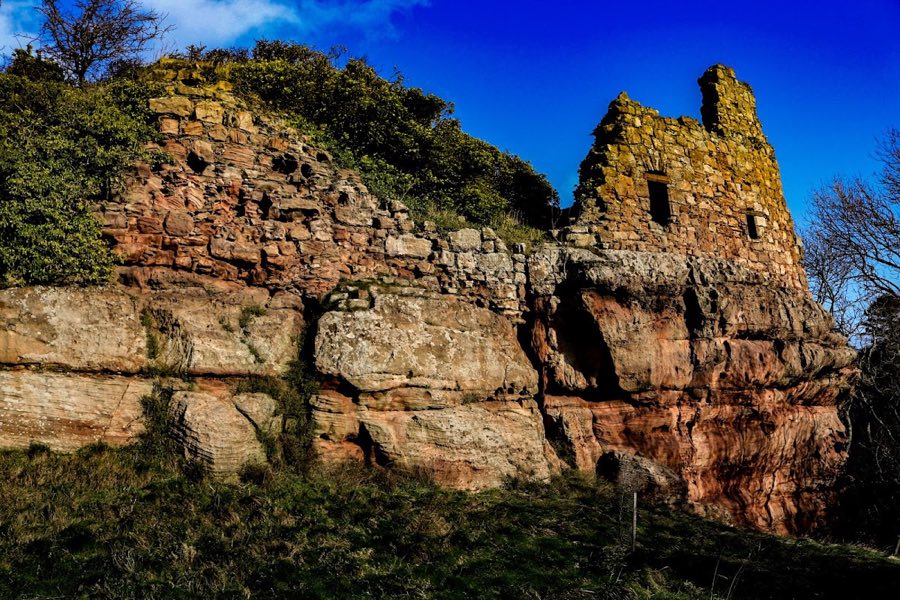
The ruins of Innerwick Castle occupy a commanding rocky outcrop overlooking Thornton Glen and the Thornton Burn. Built primarily of stone, it reflects typical medieval castle construction designed to dominate challenging terrain for defense. Though specific architectural plans have not been preserved in detail, the castle clearly consisted of multiple levels, including a basement area that was notably exploited by attackers during the siege of 1547.
This basement or cellar space may have functioned as storage or a secured chamber, but it became a focal point during the castle’s destruction when English forces gained access and set fire to the interior. The castle’s footprint expanded over time through several additions before this event, though no detailed description of these extensions survives in the historical record.
Today, the surviving remains are protected as a Scheduled Monument, ensuring their preservation within the Crowhill Estate. The surrounding area known as Thornton Glen is managed by the Scottish Wildlife Trust, highlighting both natural and historical value. The castle’s dramatic location on a cliff face has also made it a known site for climbing, although no carved inscriptions, altar fragments, or other decorative features have been recorded at the site.
What remains of Innerwick Castle presents a visible but fragmentary reminder of its medieval origins and the turbulent history it witnessed, retaining the rugged character of a fortress built to guard important routes through southern Scotland.
No. 79219
No. 28734
No. 95810
No. 27133
Comments
Comments for Innerwick Castle will require a verified account before posting.
We'll send a verification link before your first comment is published.