No. 88138
Wettin Castle
Germany
CastleRuin10th century
No. 88152
Palace · Germany
No. 88152 · 51.754 N, 11.977 E
For events
Köthen Castle is marked as a château or castle venue lead. Capacity, indoor/outdoor spaces, catering rules, and accommodation options are published only after public verification.
Event types: Private events, Cultural gatherings, Filming and photography
Quick summary
Köthen Castle is a palace in Germany with origins associated with the 12th century.
See all castles in GermanyKöthen Castle in Köthen, Germany, occupies an island site first used by Slavic settlers and later developed into a medieval stronghold by the regional Ascanian counts. The core fortress was replaced by a new castle built between 1156 and 1160 in the high Middle Ages, and the complex acquired later Neoclassical interiors in the early nineteenth century. The site mattered regionally: under the early Ascanian rulers it controlled local waterways and trade routes, and for more than six centuries it was the principal residence of the ruling house of Anhalt, shaping political and cultural life in the territory.
Early medieval activity at the island site produced a fortress that the Ascanian Counts of Ballenstedt used to control movement on the surrounding waters. Albert the Bear captured the location for the House of Ascania, and under his oversight the town developed into an important trade centre. By the thirteenth century the site had become the dynastic seat for the rulers who styled themselves Princes and later Dukes of Anhalt.
From 1244 until 1847 the palace served as the main residence for the ruling family of Anhalt; after 1603 it functioned as the seat of the Anhalt‑Köthen line. In 1806 the principality was raised to ducal rank. The Köthen male line ended with Duke Henry’s death in 1847, after which the ducal title and the castle passed to the Anhalt‑Dessau branch. The incoming duke removed much of the princely furniture and repurposed rooms for state offices and the local district court. A secondary use appeared in 1878 when a school opened in part of the ensemble.
The seventeenth century brought intellectual and linguistic activity to the site when the early German language Fruitbearing Society moved its meetings to the palace beginning in 1629. In the early nineteenth century an important natural history collection was added when Johann Friedrich Naumann’s bird specimens were acquired and the Naumann Museum established in 1835. The composer Johann Sebastian Bach held the court music post at Köthen from 1717 to 1723, producing landmark instrumental works and court cantatas while serving the prince; he continued to compose occasional pieces for the court until the prince’s death.
The complex suffered repeated damage and rebuilding. A major fire in 1547 destroyed much of the older castle, leaving primarily the northern portion. In the twentieth century the riding school burned in 1940, and air raids on 20 July 1944 struck the west wing and eastern additions, leaving ruins that were later cleared. Ownership passed to the town after 1918 and the ensemble entered the holdings of a regional foundation for historic churches and palaces in 1997. In the first decades of the twenty‑first century the former riding hall was renewed as a multi‑use concert and events centre, and the palace’s mirror hall and museum spaces underwent phased restoration and recognition as nationally valuable heritage.
The palace grounds are divided into three principal zones: a park, an outer court, and an inner island court. The central island sits over the footprint of the earliest medieval castle and is encircled by a water-filled moat crossed by three bridges. The outer palace court forms a broad, horseshoe-shaped arrangement around the island. This plan keeps the medieval pattern of an island stronghold at the heart of a later palace ensemble and shapes movement through the site today.
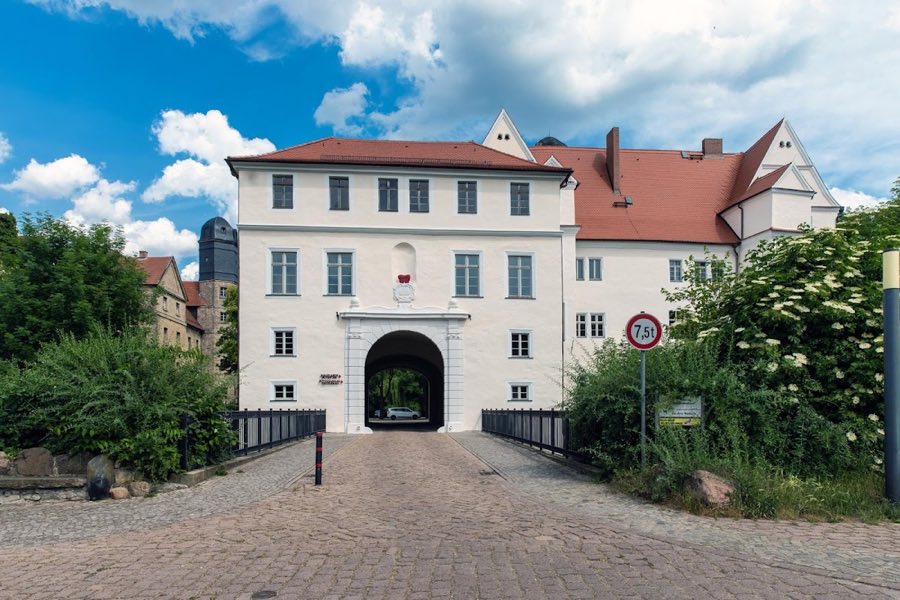
The oldest standing element began as the castle gatehouse and retains a round-arched opening from the Renaissance period, having been altered in the late sixteenth and late seventeenth centuries. One account states this gatehouse was destroyed in 1944; another records that the building has been used since 1984 to house a music school named for Johann Sebastian Bach. The building known as the Ludwigsbau dates to 1600–1608 and shows stylistic links to Upper Silesian castle models with Italianate influence; it contains the historic Throne Hall, later known as the Mirror Hall, which is finished in pale stucco tones and covered by a coffered barrel vault.
Buildings in the outer court document later eighteenth‑ and nineteenth‑century service functions. The royal stable was rebuilt in the mid‑eighteenth century in a Rococo manner, two stories tall with mansard roofs and projecting sections, and its stable gates display heraldic shields. Horses were kept in private service there until 1945; since 2010 the stable ground floor has been fitted for part of the music museum devoted to Bach. A coach house constructed in 1833, together with the riding hall, now serves as an events and concert venue.
The riding hall originally rose in the early 1820s and showed an imposing frontage with large round‑arched windows and applied decorative scrolls. A fire in 1940 reduced the structure to a ruin, but the principal façade survived and between 2004 and 2008 the remains were integrated into a multifunctional centre for concerts and assemblies, with new performance halls opened in 2008. The palace chapel dates from 1826 and was used for worship until 1870; it was later filled in, then refitted and restored in the 1960s and again at the end of the twentieth century.
Museum displays occupy upper and ground floors in the Ferdinand Building and adjacent service wings. The Naumann Museum on the upper floor presents roughly 1,300 objects arranged in 113 showcases, including mounted bird specimens, Naumann’s personal possessions, engraved bird plates, and hunting and fishing equipment. Conservation work has included interior Neoclassical refurbishment carried out in the 1820s and early 1830s and later renovations of the Mirror Hall that began in 2011. The site retains a mixture of restored and altered fabric that reflects its long sequence of use, damage, and reuse from the medieval period through the modern era.
No. 88138
No. 35281
No. 48168
No. 61825
Comments
Comments for Köthen Castle will require a verified account before posting.
We'll send a verification link before your first comment is published.