No. 38824
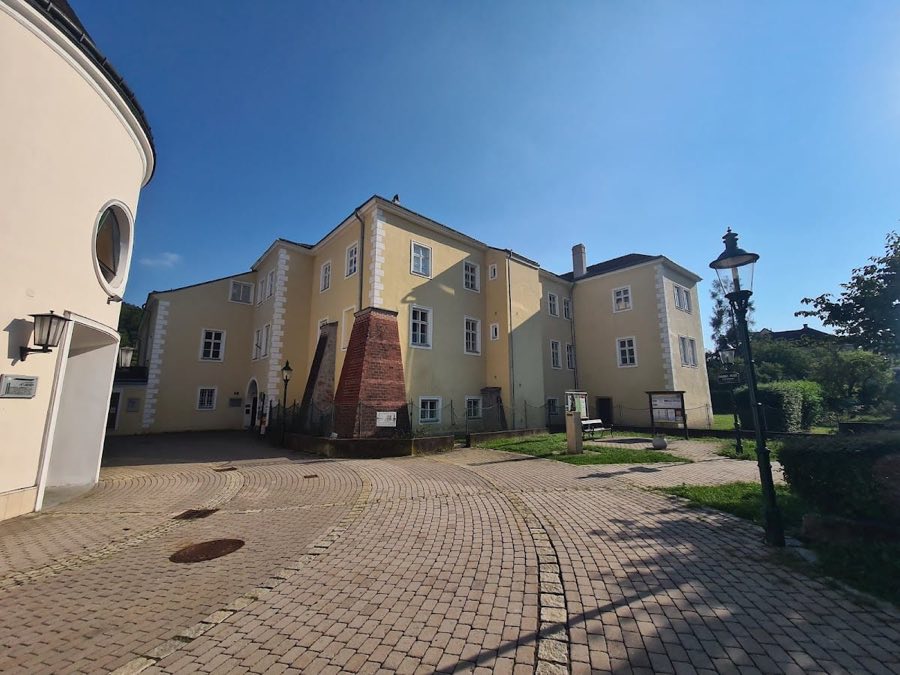
Schloss Purkersdorf
Austria
PalaceIntact11th century
No. 16838
Castle · Austria
No. 16838 · 48.215 N, 16.221 E
For rent
Laudon Palace is marked for bookable castle accommodation. Nightly pricing, sleeps count, stay rules, and amenities are displayed only when public operator data is available.
Rental type: Hotel / bookable stay, Short-stay rental
Short-term availability: Bookable accommodation signal
For events
Laudon Palace is marked as a château or castle venue lead. Capacity, indoor/outdoor spaces, catering rules, and accommodation options are published only after public verification.
Event types: Private events, Cultural gatherings, Filming and photography
Accommodation: Accommodation signal present
Quick summary
Laudon Palace is a castle in Austria with origins associated with the 18th century.
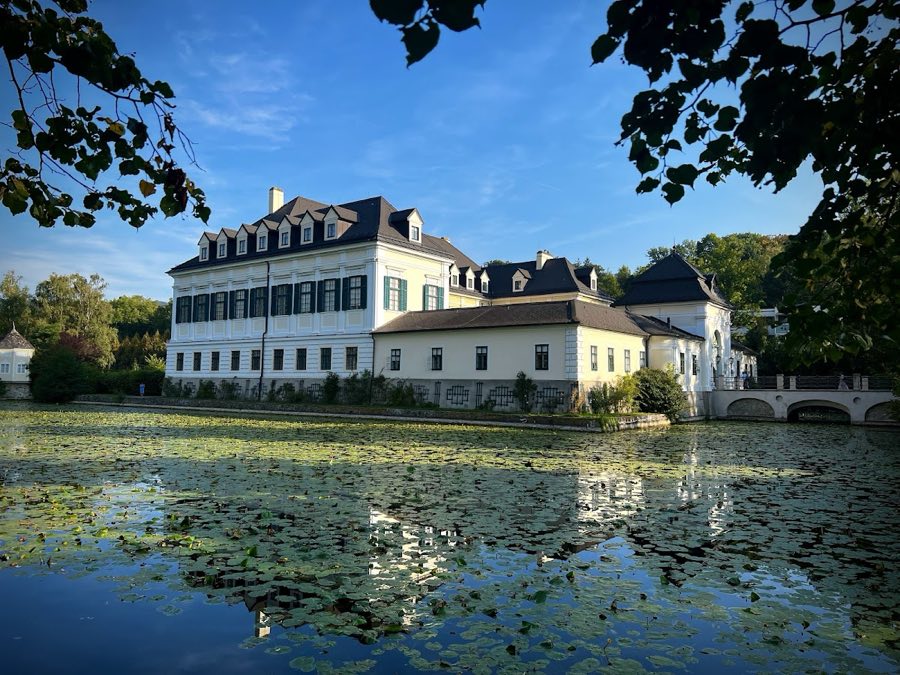
See all castles in AustriaLaudon Palace in Vienna, Austria, occupies the site of an early medieval fortified residence established by local lords in the High Middle Ages. The place is first recorded around 1130 and the complex reached its present Baroque appearance in the mid-18th century; it later became closely associated with Field Marshal Ernst Gideon von Laudon and with military events that affected the region. The building served as a noble residence, an administrative house for local forest officials, and later as a private estate and institutional property.
From its origins until the mid-14th century the manor belonged to a succession of regional lords; around 1130 the lords of Hadersdorf held the site and a fortification probably stood where the palace now rises. In 1358 the estate passed to the territorial ruler, who installed the local forester there as the palace’s resident administrator. During the 16th century the structure suffered destruction in the Ottoman campaign of 1529 and was rebuilt in the years after that fighting. Ownership changed in the following decades, passing to the Teuffenbach family in 1551 and to Sigmund von Hohenburg zu Pranckh in 1588.
The palace again felt the effect of Ottoman warfare during the 1683 campaign; after that damage it was reconstructed in an early Baroque, moated form under the direction of the imperial court. In 1654 the estate had briefly entered the imperial household when Eleonora of Mantua, wife of Emperor Ferdinand III, acquired it. In 1708 Elisabeth Christine, later the wife of Emperor Charles VI, lodged at the house for two nights, an event commemorated by a Latin chronogram carved in the stairwell. A substantial remodelling that gave the palace its current external character was completed in 1744 under the ownership of Franz Wilhelm Schellerer.
In 1776 Field Marshal Ernst Gideon von Laudon purchased the property and lived there until his death in 1790; the Laudon family kept the palace until 1925. After that year it passed into the hands of industrialist Otto Pollack von Parnegg; following 1938 the estate was subjected to the Nazi practice of “Aryanization.” Soviet occupation forces used the site from 1945 to 1955. In 1960 the sons of Pollack‑Parnegg sold the palace to the Archdiocese of Vienna, which dispersed much of the furniture at auction and then sold the property the same year to Alfred Weiss. Weiss restored the building and operated it as a luxury hotel between 1962 and 1973. From 1976 the Republic of Austria leased the property and it housed the Federal Administrative Academy; the FH Campus Wien Department Public Sector occupied the separate Octagon building in the palace park until the 2022/23 academic year. The palace is not open to the public. A large quantity of the palace’s furniture and works of art was scheduled for auction on 2 July 2024.
The palace stands as a Baroque moated castle, arranged around a square inner courtyard. Three sides of the courtyard are formed by a two‑storey main wing and the southeast side by a single‑storey service wing. Water fills the surrounding moat from the nearby Mauerbach stream. The overall plan and wet defensive setting reflect the early Baroque reconstruction that followed late‑17th‑century damage.
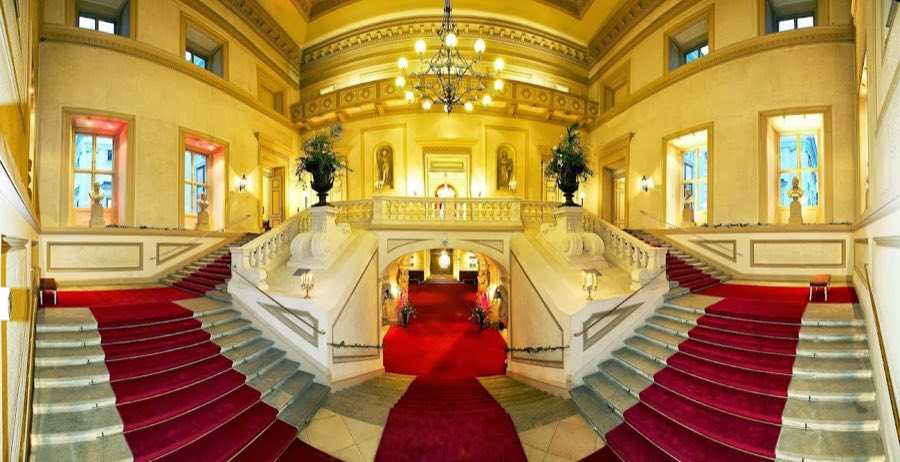
Inside, many fixtures and fittings date to the time of Field Marshal Laudon. The Neoclassical library survives intact; its bookcase doors and the canvassed wall panels are decorated with grisaille paintings, a technique using shades of grey to imitate sculpted reliefs. The painted subjects include mythological figures after designs by Giovanni Antonio Gori and scenes copied from Monumenti antichi inediti by Johann Joachim Winckelmann, preserving the room’s late 18th‑century decorative program.
A large ceiling and wall cycle by Johann Bergl, painted about 1770 and salvaged from the demolished Schloss Donaudorf in 1954, was installed in 1963 in a room adjoining the library. The grounds laid out by Laudon around 1780–1790 survive in fragments; remaining sculptural staffage includes two large boar figures and a statue that represents Laudon as an ancient philosopher, probably created originally for a funerary context by an unknown hand.
A western portion of the former park, long known as the Turkish garden, once displayed a group of inscribed and ornamented stone blocks that Laudon brought from Belgrade, some taken from the Stambuler Gate and others from a tomb associated with a fortress commander. Those stones were set near a small waterfall in the Turkish garden. The garden itself is now overgrown and lies outside the present park, the carved stones were later reassembled into a wall‑like monument called the “Turks stones” with an explanatory text by Joseph von Hammer‑Purgstall, and only a small spring remains where the waterfall once ran.
Laudon’s tomb is a Neoclassical monument completed in 1791 for his widow Klara and executed by sculptor Franz Anton Zauner. The monument is a cuboid with a gabled roof and bears relief roundels of mythological figures on all sides. Each long face carries a Latin inscription; one is a dedication by his widow and heirs dated 1790, the other lists his campaigns and places of service. A life‑size figure of a mourning knight stands beside the tomb. The original enclosing wall had been replaced by a lance‑style railing by 1835, and the monument now stands in a modest wooded spot on the northeastern side of Mauerbachstraße, outside the main park. One account states Laudon was placed in an underground crypt at that site and never moved. Other accounts describe the visible monument as a cenotaph and say his exact burial place within the palace grounds is unknown.
No. 38824
No. 44281
No. 14248
No. 74700
Comments
Comments for Laudon Palace will require a verified account before posting.
We'll send a verification link before your first comment is published.