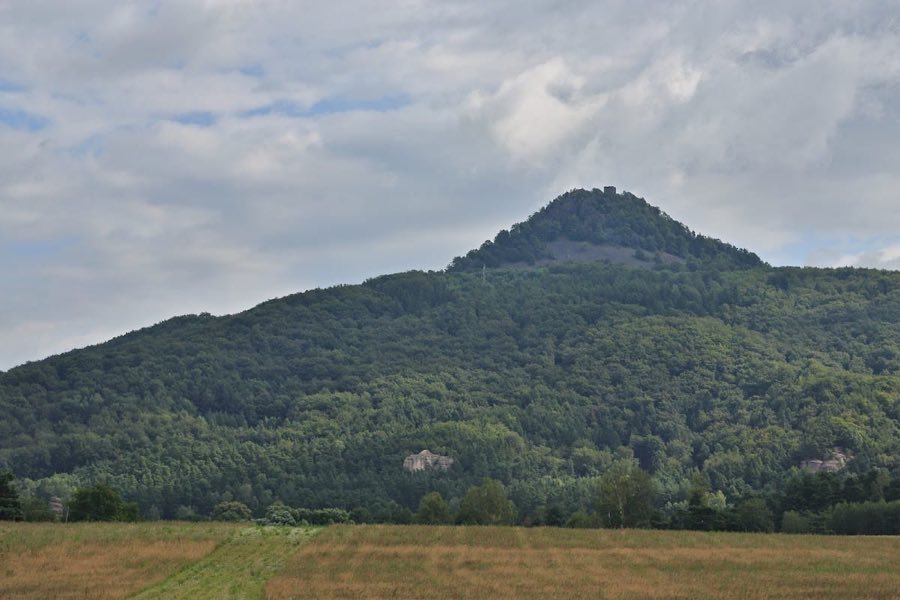
No. 82697
Ralsko Castle
Czechia
CastleRuin20th century
No. 22298
Château · Czechia
No. 22298 · 50.706 N, 14.800 E
For events
Vartenberk Castle is marked as a château or castle venue lead. Capacity, indoor/outdoor spaces, catering rules, and accommodation options are published only after public verification.
Event types: Private events, Cultural gatherings, Filming and photography
Quick summary
Vartenberk Castle is a château in Czechia with origins associated with the 13th century.
See all castles in CzechiaVartenberk Castle in Stráž pod Ralskem, Czechia, is a medieval stronghold built by the Bohemian nobility and first recorded in the late 13th century, with origins reaching back into the 12th–13th centuries and an original Gothic character. From its earliest phase the site played a strategic role, guarding routes toward Zittau and acting as an auxiliary post to the larger fortress at Ralsko, and it later became associated with the powerful Vartemberk family who exercised regional authority.
The castle’s founding owners are traditionally linked with Marquard (Markvart) of Březno and his son Beneš of Vartemberk. In the 14th and 15th centuries the Vartemberk house expanded its influence, and Beneš rose to the office of Prague burgrave. Beneš’s four sons established the principal branches of the family at Veselí, Kumburk, Kostel, and Děčín, reinforcing the site’s role within a wider noble network.
During the Hussite wars the fortress became contested ground. In 1426–1427 forces under the Hussite captain Jan Čapek ze Sán besieged and occupied the castle, and Čapek took up lordship there while many former retainers entered his service. In 1438 the stronghold passed into the hands of Moravian troops led by Johann Sokol von Lamberg and, following his death, it came under Diepold of Riesenberg.
Ownership shifted frequently in the later 15th and early 16th centuries. In 1504 the Hiršperger (Hirschperger) of Königshain acquired the property and over the first half of the 16th century converted the defensive complex into a Renaissance château, a process that reached visible completion in 1563 with an exterior sgraffito dated above the gate. Subsequent possession moved briefly among the noble houses of Liechtenstein and Hartig, and for a short interval Prince Albrecht von Wallenstein is recorded as residing there.
The Thirty Years’ War brought severe damage. Swedish troops plundered and ravaged the castle in 1639 and then stormed and set fire to it in 1645. Jan Jiří III (Johann Georg III), identified at court as the last Vartemberk of his line, allied with rebellious peasants during the wider conflict and briefly recovered lordship, but after the defeat at the Battle of White Mountain he was dispossessed by Emperor Ferdinand II, banished, fled to Saxony, and probably died in either 1631 or 1647 (the date is uncertain).
In the 19th century the Hartig family attached the estate to their manor at Mimoň and, after finishing their house there in 1830, made that their primary residence while continuing to use Vartenberk for guests and as the centre of their vineyard operations. The botanist Heinrich Moritz Willkomm lived and worked at the castle until his death in 1895. A small turret above the chapel was removed in 1903 when parts of the building were let to summer visitors.
The castle’s twentieth-century history was turbulent. In 1922 the property was nationalized and sold for a nominal sum to the teacher and writer František Melichar, who established a schoolroom before his death three years later. After World War II the site served as a company recreation facility for ČKD Praha, and Renaissance sgraffito on the inner façade was restored with the participation of sculptor Olbram Zoubek. Military occupation by the Soviet Army began in 1969, during which the buildings suffered damage, and a catastrophic fire in 1987 left the complex almost entirely destroyed. Emergency stabilisation and a new roof were erected starting in the 1990s. Larger restoration work commenced in the 2000s, reconstruction activities were reported from 2006 onward, a major fundraising appeal began in October 2010, and exterior restoration continued across about two decades, leading to the site being presented to the public in May 2024. Since 1995 the whole complex has been protected as a cultural monument of the Czech Republic, registry number 1000153330.
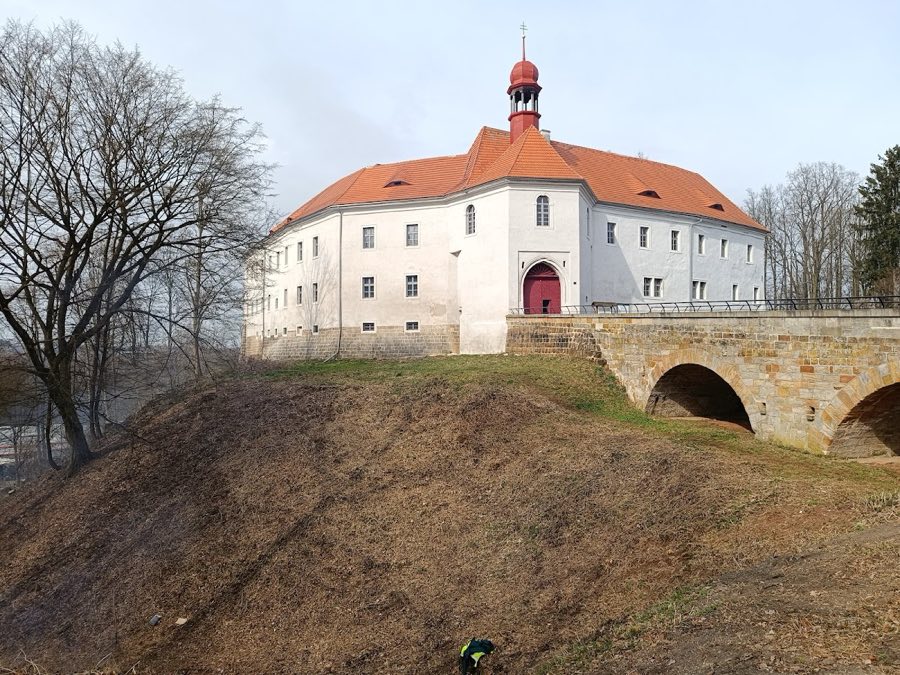
The castle perches on Castle Hill, 352 metres above sea level, overlooking the Ploučnice valley to the northeast of Stráž pod Ralskem. The plan preserves a long, elongated footprint with the medieval core set on the northwest slope of the hill and the main fortified tower projecting north from the outer ward. The visible fabric combines heavy medieval masonry and later Renaissance facing, the principal façades and surviving wing walls standing atop earlier enclosure walling.
Large defensive elements survive in place, notably very heavy barrel vault (a continuous arched ceiling) constructions and thick stone walls that once formed strong interior chambers and circulation spaces. A surrounding ditch is evident in the arrangement of the site, and the east side retains the location of a gate that originally had a drawbridge spanning that ditch. Older descriptions also mention a substantial central tower that once occupied the heart of the complex, and the present courtyard and wing walls rest on those earlier foundations.
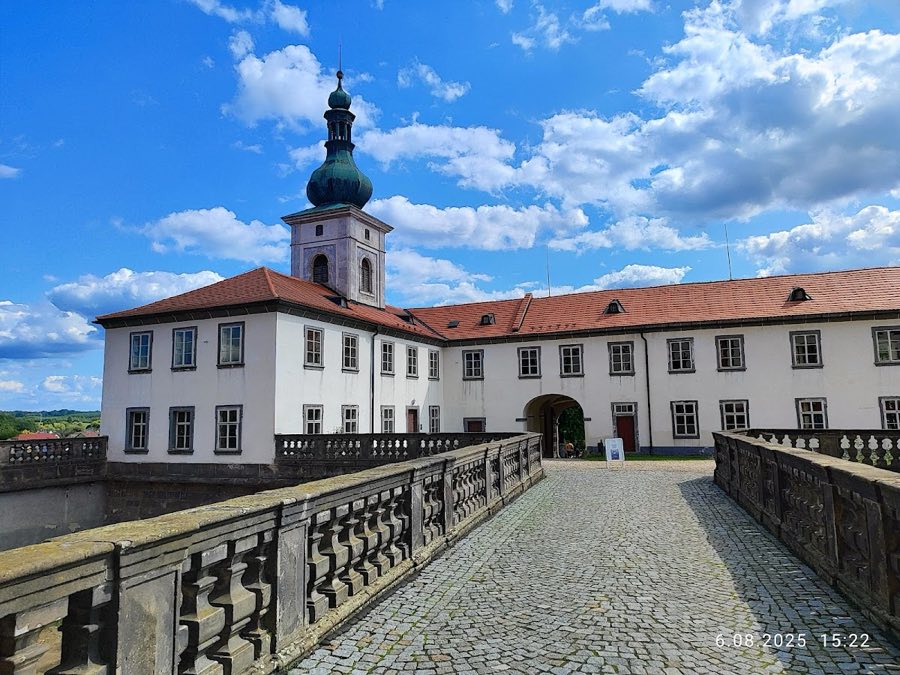
The sixteenth-century remodelling left clear Renaissance signs. A sgraffito (scraped-plaster decoration) dated 1563 is set above the main gate and matching decorative work was restored on the inner façade during 20th-century repairs. A long access bridge leads into a projecting portion of the frontage where a large late‑Gothic entrance portal remains, linking the defensive past with the later residential château form. The chapel on the site is dedicated to St. John of Nepomuk; a small turret that stood above that chapel was removed in 1903.
The castle sits within a substantial planted park that grew up around the house when it served both as a noble residence and later as a managed estate centre. Over time several outer defensive features were lost, and twentieth‑century events inflicted heavy harm on the buildings, culminating in an almost complete burn‑out in 1987. Emergency repairs in the 1990s stabilised walls and provided a new roof, and lengthy external conservation and reconstruction carried the site back to a condition in which it could be publicly presented in 2024. Much of the masonry and the major entrance elements remain in situ, some areas are restored, and others retain the evidence of successive building phases from Gothic fortification to Renaissance château.
No. 82697
No. 35503
No. 54860
No. 42608
Comments
Comments for Vartenberk Castle will require a verified account before posting.
We'll send a verification link before your first comment is published.