No. 42350
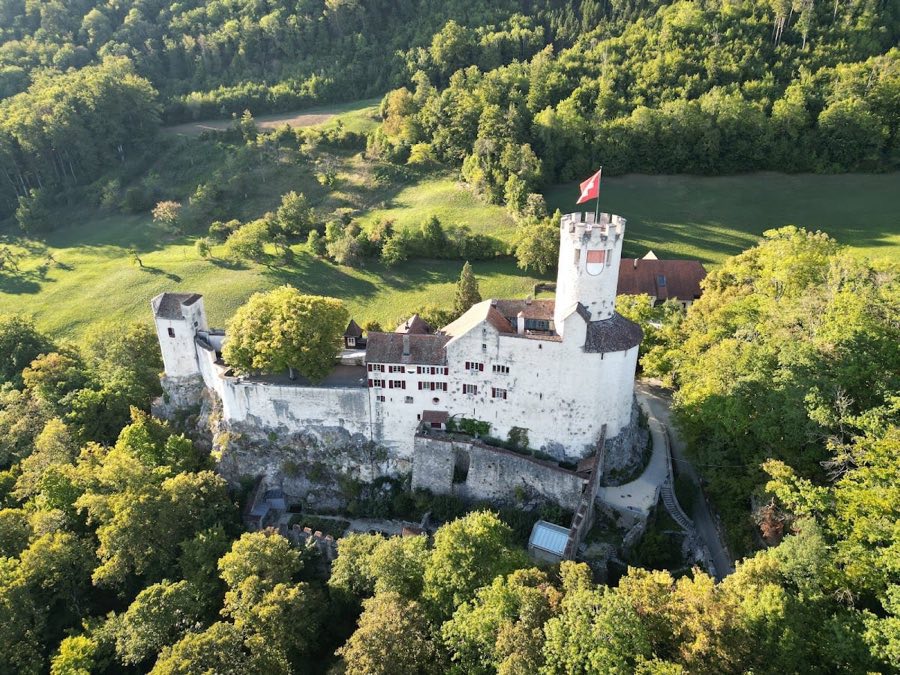
Neu Bechburg Castle
Switzerland
CastleRestored13th century
No. 27157
Castle · Switzerland
No. 27157 · 47.323 N, 7.710 E
For events
Neu-Falkenstein Castle is marked as a château or castle venue lead. Capacity, indoor/outdoor spaces, catering rules, and accommodation options are published only after public verification.
Event types: Private events, Cultural gatherings, Filming and photography
Quick summary
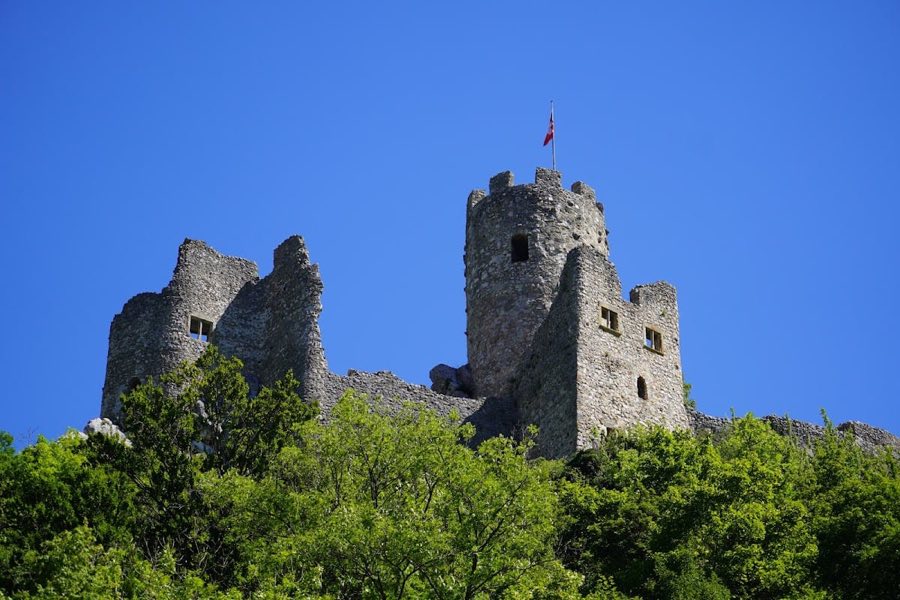
Neu-Falkenstein Castle is a castle in Switzerland with origins associated with the 12th century.
See all castles in SwitzerlandNeu-Falkenstein Castle stands in the municipality of Balsthal, Switzerland. Constructed during the medieval period, it was likely established in the early 12th century by a local noble family aiming to assert control over their territory.
The castle’s earliest possible owners are mentioned in a disputed document from 1145, which refers to brothers Welf and Ulrich von Falkenstein, who may have been responsible for its initial construction. By the late 12th century, the estate was held as a fief by the Freiherren von Bechburg under the authority of the Bishop of Basel. Although the Bechburg family controlled Neu-Falkenstein, they kept it distinct from their other lands. In the early 13th century, a branch of the Bechburg line settled at the site, adopted the title Counts of Falkenstein, and enhanced the fortress with a large residential palace and a new circular bergfried, a type of tall tower typical in medieval castles.
Rudolf von Falkenstein, son of Rudolf von Bechburg, emerges as the first documented owner in the mid-13th century. During this time, he also developed nearby Alt-Falkenstein and added a fortified outer bailey around 1250, expanding the defensive complex. Shortly before 1300, control returned to the main Bechburg line, though part of the castle was owned by Rudolf III von Wart until 1305.
In 1308, Rudolf von Wart was involved in the assassination of King Albert I of Germany. Afterward, he sought refuge at Neu-Falkenstein but sold his shares of the castle in 1309 prior to his arrest and execution. These events placed the castle in the midst of regional turmoil in the early 14th century.
The castle sustained severe damage in the devastating 1356 Basel earthquake. The repairs that followed were so extensive that they nearly amounted to a full rebuilding, which likely contributed to the addition of “Neu” (meaning “new” in German) to the castle’s name. Further destruction occurred during the Safran War of 1374, a regional conflict involving multiple powers.
During this war, Henmann von Bechburg, who had supported the Bishop of Basel without receiving recompense, attacked a merchant convoy from Basel. This act prompted a fourteen-week siege led by a coalition including Bern, Basel, and several noble families. The castle was overcome, partially destroyed, and its defenders executed. The victors divided the captured goods among themselves.
Following the war, Henmann received 5800 gulden to restore the fortress but soon pawned it to Rutschmann von Blauenstein in 1380. Upon Henmann’s death six years later, full ownership passed to the von Blauenstein family. Disputes over the castle with Henmann’s sister Margarete von Heidegg and the counts of Thierstein were eventually resolved when Hans von Blauenstein sold Neu-Falkenstein to the city of Solothurn in 1402. The city formally took possession in 1417 after compensating Margarete. Despite this transfer, the Bishop of Basel remained the castle’s overlord until 1669.
Neu-Falkenstein served as the residence of the Solothurn bailiff, an administrative official, until 1798. Over these centuries, the castle underwent several modifications but suffered a destructive fire at the hands of rebelling peasants during the Helvetic Revolution. After the fire, it was abandoned, falling into ruin.
Restoration efforts began in 1900, led by a local society from Balsthal focused on preserving the site’s heritage. The initial work concentrated on stabilizing the bergfried. Excavations carried out in 1938 and 1939 exposed parts of the ruins but were conducted improperly, causing the loss of numerous archaeological finds. Investigations revealed at least four major construction phases: several dating from the 11th to 12th centuries, modifications from the late 13th century, and work around 1640. The outer bailey’s precise date remains undetermined.
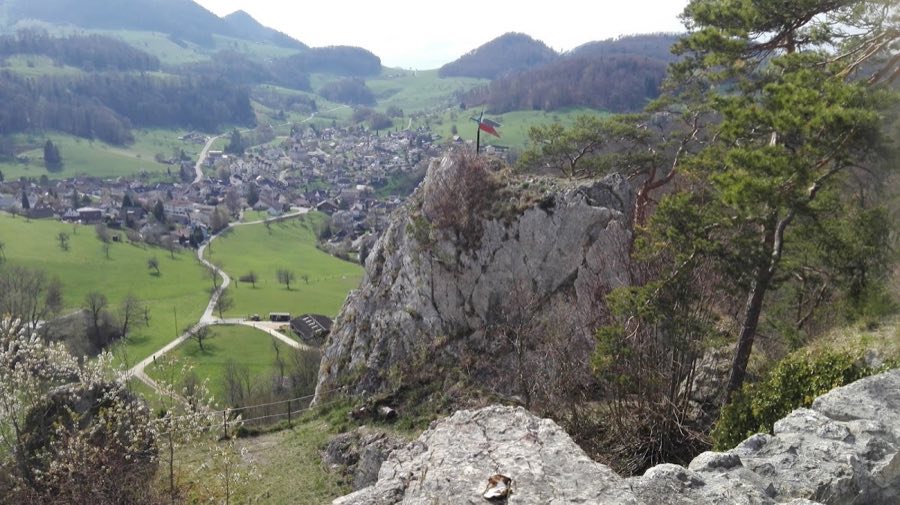
Neu-Falkenstein Castle occupies a hilltop position at 595 meters above sea level, offering strategic oversight of the surrounding landscape. The fortress is organized into two principal core sections, connected by outer defenses including a zwinger, which is a narrow enclosed area between walls designed to trap attackers.
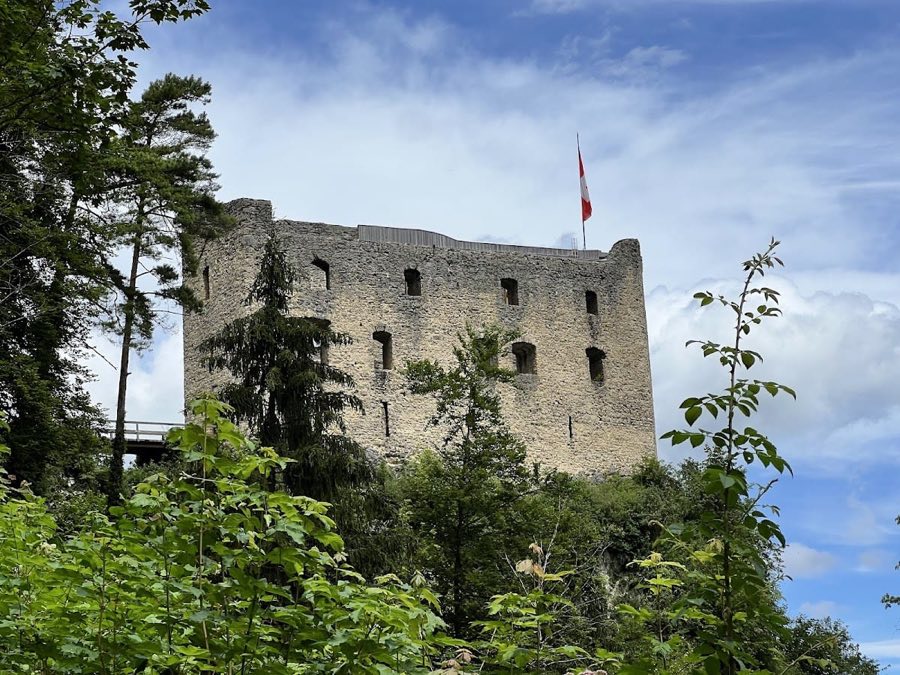
The western section is dominated by a tall, round tower, identified as the bergfried. This tower features a stone staircase with 62 steps leading to a platform situated about 15 meters above ground level. From this vantage point, one can observe extensive views across Balsthal and the Jura hills. The bergfried stands partially restored, serving as a prominent remnant of the castle’s defensive structures.
The older eastern portion contains the foundations of a trapezoidal residential wing, marking the earliest habitation within the complex. Nearby remain traces of a chapel, highlighting the site’s religious function in the medieval period, along with foundations of several other residential and economic buildings. These structures formed the living and operational core of the castle’s community.
Approach to the castle was guarded by an expanded entrance area, including a forecourt and gatehouse, accompanied by the zwinger, which added layers of defense by creating a controlled space between the outer and inner walls. Terraces in the forecourt have been identified as garden spaces, and evidence indicates later additions of an artillery bastion, reflecting adaptations to changing military technology.
The castle first existed as two separate fortifications built during different phases but later joined into a single, larger complex. The layering of construction phases is visible in the layout of the ruins, illustrating the evolution of the site through the medieval period.
While many finds from the excavations have been lost due to early 20th-century digging methods, the exposed foundations and partially restored structures provide insight into the castle’s architectural development and function. The ruins today reflect its history as both a noble residence and a military stronghold, standing as a testament to the region’s medieval past.
No. 42350
No. 70091
No. 20538
No. 97107
Comments
Comments for Neu-Falkenstein Castle will require a verified account before posting.
We'll send a verification link before your first comment is published.