No. 70091
Burg Rifenstein
Switzerland
CastleRuin12th century
No. 97107
Castle · Switzerland
No. 97107 · 47.384 N, 7.607 E
Quick summary
Gilgenberg Castle Ruin is a castle in Switzerland with origins associated with the 14th century.
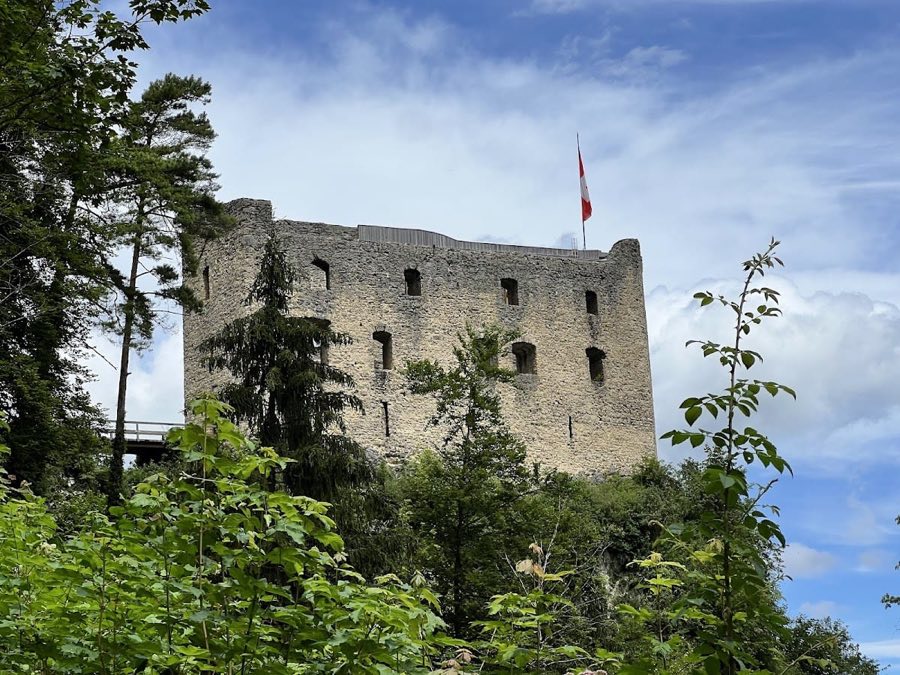
See all castles in SwitzerlandGilgenberg castle ruin stands above the municipality of Zullwil in Switzerland, built by a medieval European noble family. Its earliest origins trace back to around 1200, when an initial structure was established on the site, later expanded into a fortress in the early 14th century.
Around 1300, the Lords of Brislach, who later adopted the name von Ramstein, constructed the hilltop fortress that became Gilgenberg castle. As ministeriales—unfree knights serving higher lords—the von Ramsteins were vassals of the Bishop of Basel. Their allegiance during the late 13th-century conflicts lay with the Habsburg dynasty. The castle did not replace their original family seat, which had been destroyed by forces from Basel in 1303; instead, Gilgenberg served as an administrative hub for the family’s extensive lands, which they increased through land clearing and purchase. The site is first mentioned in historical documents in 1312.
The mid-14th century brought a significant event when the Basel earthquake of 1356 struck the region, damaging the castle to an unspecified degree. Originally held as an allodial estate—owned outright without feudal obligation—the castle’s status shifted to that of a fief granted by the Bishop of Basel. This change, noted in a 1371 document, was likely a strategic move to provide better defense against outside threats. This letter detailed the castle’s jurisdiction over several nearby villages and estates, cementing its role as a center of local governance.
Near Gilgenberg’s main buildings once stood a separate tower on a rocky spur about 180 meters to the south, which disappears from records after 1400, its fate unclear. Throughout the 15th century, the von Ramstein family retained the castle as a fief, though they often lived elsewhere, leaving the fortress staffed by an appointed bailiff.
When Rudolf von Ramstein died in 1459, an inheritance dispute arose due to the presence of his illegitimate son, Hans Bernhard von Gilgenberg. Despite controversy, Hans Bernhard inherited the castle and later died in 1474 while serving under Charles the Bold, Duke of Burgundy. His son, Hans Imer von Gilgenberg, carried forward the family tradition as a military leader and assumed civic duties as mayor of Basel.
During the Burgundian and Swabian wars in the late 15th and early 16th centuries, Solothurn troops occupied Gilgenberg castle. Conflicts over jurisdiction with the city of Basel eventually led to Solothurn acquiring the fortress and its surrounding villages in 1527. The Bishop of Basel formally relinquished his rights over the property in 1580. Under Solothurn’s authority, the castle became the center of a bailiwick, a district governed by a bailiff, colloquially called the “Geissenvogtei,” a nickname referencing its modest income.
The castle saw several repair and modification phases during its later history: in 1576, its buildings were restored; in 1678, the south-facing windows were enlarged to allow more light; and in 1734, further interior enhancements were made, including the addition of a small bell tower above the castle chapel. Gilgenberg’s active use ended dramatically when it was set on fire during the turmoil of the Helvetic Revolution in 1798, after which the site was quarried for building material.
Efforts to conserve the ruins began in the early 20th century, with initial restoration works in 1930. Ownership was transferred to the Stiftung Schloss Gilgenberg foundation in 1941, ensuring continued protection. The last significant masonry stabilization occurred in 1982, preserving the remains for study and public understanding.
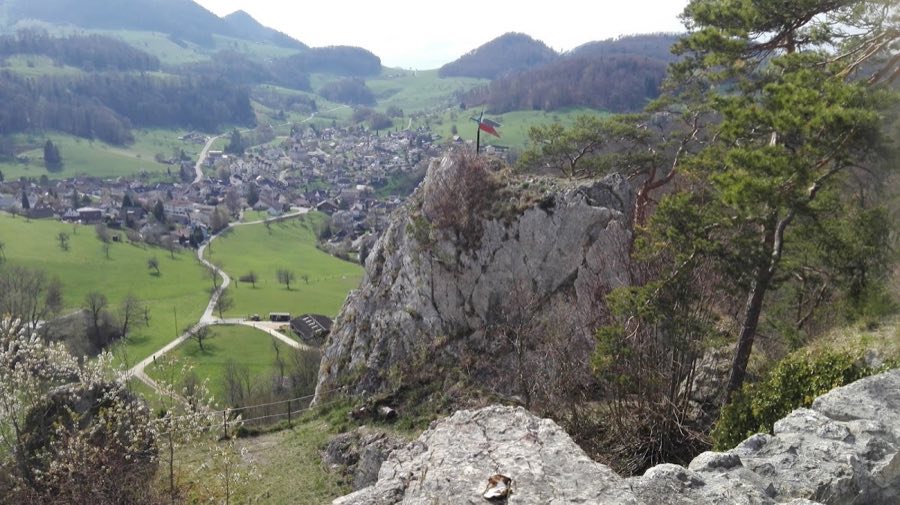
Gilgenberg castle ruin occupies a rocky hilltop at about 710 meters above sea level, set within a wooded valley basin southeast of Zullwil. The core of the fortress is a long, fortified residential building known as a palas, rising five stories and shaped roughly like a hexagon. Its ground plan spans approximately 30 meters in length and 10 meters in width, reflecting the substantial scale of a noble dwelling from the early 14th century.
Access to the stronghold was carefully controlled. Visitors approached from the southwest via a covered bridge that crossed a man-made neck ditch—an artificially dug trench designed to isolate the castle’s hilltop spur from surrounding terrain. Beyond this bridge lay a small zwinger, an outer defensive ward that would have acted as a killing zone to slow and expose attackers before reaching the gate. The main entrance was fortified by this arrangement, emphasizing security.
Near the castle’s main residence were a number of economic buildings supporting daily life and operations, such as storerooms and workshops. Some remains of these auxiliary structures have survived, allowing a glimpse into the working environment of the castle. In 1734, a new small bell tower was added atop the chapel, marking its religious use and reflecting ongoing modifications into the early modern era.
A separate tower once rose on a rock outcrop about 180 meters south of the main complex, positioned on a flattened natural platform. While the tower no longer stands, this platform remains as evidence of its former presence, recorded in historical documents until the 15th century. This structure likely served as an additional defensive or watch post linked to the castle’s strategic control of the area.
The masonry of the palas and other buildings has undergone several conservation campaigns, particularly in 1930 and 1982, aimed at stabilizing the remaining stonework. These efforts have maintained the imposing ruins visible today, which continue to illustrate the castle’s medieval origins and its adaptations over centuries.
No. 70091
No. 36414
No. 53257
No. 39869
Comments
Comments for Gilgenberg Castle Ruin will require a verified account before posting.
We'll send a verification link before your first comment is published.