No. 38873
Burgruine Groppenstein
Austria
CastleRuin14th century
No. 46249
Castle · Austria
No. 46249 · 46.923 N, 13.240 E
For rent
Niederfalkenstein Castle is marked for bookable castle accommodation. Nightly pricing, sleeps count, stay rules, and amenities are displayed only when public operator data is available.
Rental type: Hotel / bookable stay, Short-stay rental
Short-term availability: Bookable accommodation signal
Quick summary
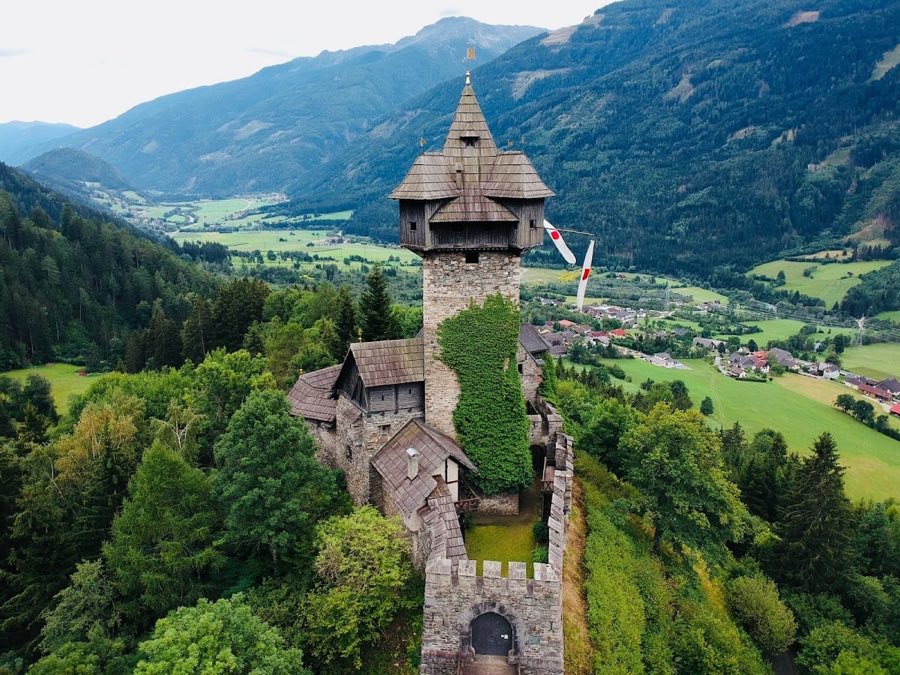
Niederfalkenstein Castle is a castle in Austria with origins associated with the 5th century.
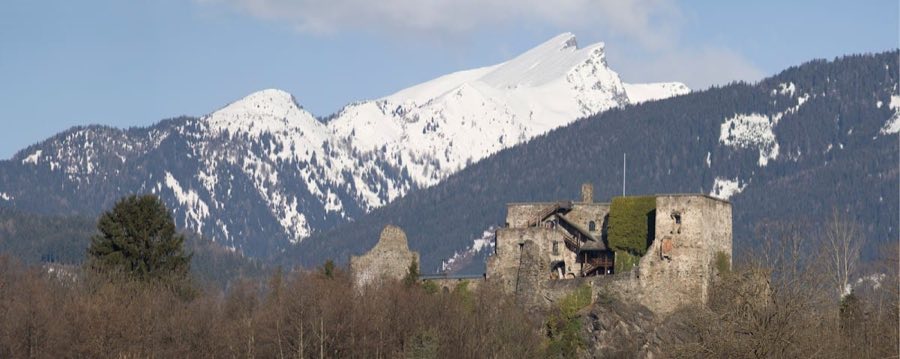
See all castles in AustriaNiederfalkenstein Castle is located near Obervellach in Carinthia, Austria, positioned on a rocky ridge above the Möll Valley. The site was first recorded in 1164 under the name Valchensteyn, suggesting an earlier settlement possibly connected to the nearby Roman town of Teurnia. It is believed that inhabitants from Teurnia retreated to this valley before 600 AD, laying the groundwork for the castle’s origins.
In the medieval period, Niederfalkenstein served as a ministerial seat under the Counts of Gorizia and Gradisca. Early records mention Gumpoldus de Valchenstein, a ministerialis serving Count Engelbert I. Around 1200, the ruling counts began styling themselves as von Görz. The Falkenstein family, who once held the castle, became extinct around 1300. Subsequently, the Counts of Görz appointed different ministeriales to oversee Oberfalkenstein and Niederfalkenstein separately.
By 1394, the upper castle was pledged to Duke Albrecht III of Austria and later confirmed as Habsburg property through the Peace of Pusarnitz. During the 15th and 16th centuries, the castle changed ownership several times. In 1462, Andreas von Graben zu Sommeregg held the castle. Later, in 1504, Julian, Count of Lodron, purchased it from Emperor Maximilian I for 7,500 gulden.
Apollonia Lang von Wellenburg, widow of Count Lodron and sister to Archbishop Cardinal Matthäus Lang of Salzburg, married Croatian Count Kristof Frankopan, who became the castle’s owner. Frankopan died in conflict with the Habsburgs. Around 1510, Apollonia funded restorations of the castle and donated a notable altar painting by Jan van Scorel to the local church.
During the 17th and 18th centuries, the castle fell into neglect under the barons von Sternbach, who preferred their residence at Groppenstein Castle. Niederfalkenstein deteriorated as a result. In 1905, Ferdinand Kaltenegger von Riedhorst acquired the castle and restored it, shaping its current appearance. After his death in 1912, ownership changed hands multiple times, including Georg Friedrich Scheier (1939–1947) and Anni Helene Johanna Oehmichen from 1959, who invested heavily in restoration efforts.
A burglary in 1969 caused a fire that destroyed the main building and valuable interiors. The culprit was soon apprehended. Oehmichen restored the castle once more and was honored with a plaque by the Obervellach community. She lived there until her death in 1987. Ownership then passed to her nephews, Rolf-Peter Oehmichen and Erhard Christian Mahnke. Rolf-Peter continued restoration work, repairing roofs and battlements. In 1989, the castle was sold to entrepreneur Weissmann, and in 1998 it was acquired by the Fersterer family, hotel owners from Saalbach.
Since 2016, Niederfalkenstein Castle has been accessible to the public during summer months. It was also featured on an Austrian postage stamp in 1973 and has a detailed 1:87 scale model produced by the company Kibri.
Niederfalkenstein Castle forms part of a two-castle complex with Oberfalkenstein, situated about 25 minutes apart on a rocky ridge at roughly 843 meters above sea level. The castle was originally constructed in the Romanesque style. Today, the four-story residential palace survives only as ruins, while the square bergfried, or keep, has been fully restored.
The castle was once enclosed by a ring-shaped stone wall. Although partially destroyed over time, this wall was repaired and reinforced during the construction of the nearby Tauern railway to protect it from vibrations caused by blasting. Access to the castle is provided by a wooden bridge, which replaced an earlier drawbridge.
Near Niederfalkenstein, the ruins of Oberfalkenstein include a Romanesque chapel dedicated to Saint John the Baptist. First mentioned in 1246, the chapel was expanded in Baroque style in 1772 and remains in use. It retains its original Romanesque core walls and features a two-story wooden gallery. Inside, visitors find a high altar, ceiling paintings depicting the Baptism of Christ, and a pulpit adorned with full-figure images of the Gospels.
The chapel also houses a 16th-century panel painting of Saint Barbara, the patron saint of miners, along with several 18th-century altars and sacred artworks. The castle site overlooks the Mölltalstraße (B106) and lies close to the Tauern railway tunnel, which passes beneath the ridge. The original tunnel measured 67 meters in length but was replaced in the 1970s by a 396-meter-long arched bridge spanning between Ober- and Niederfalkenstein.
No. 38873
No. 75241
No. 96568
No. 88422
Comments
Comments for Niederfalkenstein Castle will require a verified account before posting.
We'll send a verification link before your first comment is published.