No. 19710
Hardegg Castle
Austria
CastleRuin13th century
No. 95631
Castle · Czechia
No. 95631 · 48.838 N, 15.907 E
Quick summary
Nový Hrádek Castle is a castle in Czechia with origins associated with the 14th century.
See all castles in CzechiaNový Hrádek is a castle ruin located near the village of Lukov in the present-day Czech Republic. It was established in the mid-14th century by the Moravian Margrave John Henry of Luxembourg, a member of the influential Luxembourg dynasty and the brother of Emperor Charles IV.
The castle’s early history is closely connected to the Luxembourg family. Around 1403, Jobst of Luxembourg, John Henry’s son, granted Nový Hrádek to his supporter, Přech of Kojetice. Within a few years, by 1418, ownership shifted to Osvald of Eytzing, an Austrian noble who also controlled the nearby Kaja Castle situated across the Dyje River.
During the 15th century, Nový Hrádek underwent significant changes. It was expanded and rebuilt in several stages, including the construction of a younger castle section, which resulted in the double castle layout seen today. By the beginning of the 16th century, the castle had reached its current overall dimensions.
Throughout the 16th century, the castle passed through the hands of several noble families. These included the Lords of Kunštát, Krajíř of Krajk, Dietrichstein, Tetour of Tetov, Čertorejský, and Štrejn of Schwarzenau, reflecting the complex patterns of landownership in the region during this period.
In the 17th century, the Althann family, who held the nearby Vranov Castle, acquired Nový Hrádek. The castle’s military significance was tested during the Thirty Years’ War, when Swedish forces led by General Lennart Torstenson occupied it around 1645. The castle suffered extensive damage in this conflict.
Following its destruction, Nový Hrádek was no longer used as a noble residence. Instead, it served mainly as a storage site. In the early 19th century, later owners Mnizský and Stadnický made adaptations to parts of the castle, converting some rooms for living purposes and transforming the courtyard’s former farm buildings into a gamekeeper’s lodge.
During the period of the First Czechoslovak Republic in the early 20th century, local organizations such as the Czech Tourist Club utilized the castle for public access, even establishing modest tourist lodging within the ruins.
After World War II and the establishment of communist rule in 1948, Nový Hrádek fell within a highly restricted border zone, making it inaccessible until the early 1990s. Since then, efforts have been made to stabilize the site and open viewpoints to appreciate its location over the Dyje valley. The castle is now protected as a National Cultural Monument and lies within the core zone of the Podyjí National Park.
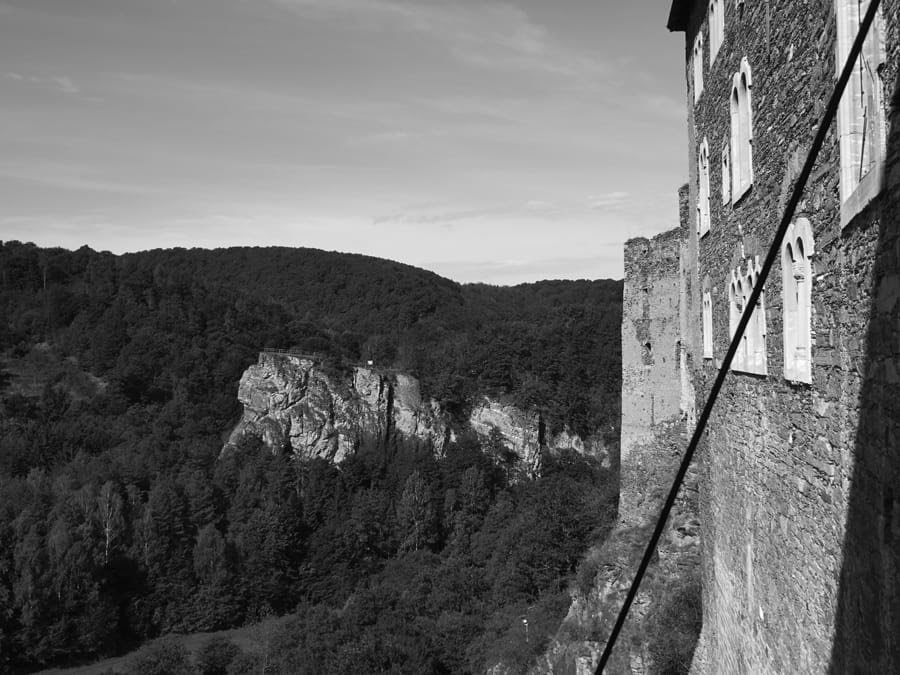
Nový Hrádek sits atop a hill overlooking the Dyje River, characteristic of a shell-keep castle, where a stone defensive wall encloses the inner courtyard. The castle’s layout is composed of two main parts: an older lower castle and a younger upper castle, which together create a double castle complex. The younger section was added during the 15th-century expansions that extended the original fortifications.
The castle walls are constructed primarily from local stone, taking advantage of the limestone-rich terrain surrounding the site. This natural limestone scree, noted for its calcium content, supports rare plant and animal species in the area.
Within the courtyard, remnants of farm buildings once connected to the castle survive. In the 19th century, these were repurposed by the owners Mnizský and Stadnický into a gamekeeper’s lodge, reflecting the castle’s later shift from defensive stronghold to a rural estate center. Some rooms in the main castle were adapted for habitation during this time, marking a period of partial reuse.
Several restoration projects in the late 20th century have shaped the present-day appearance of the ruins. The entrance gate was reconstructed and installed in 1992, helping to define the castle’s original access point. A wooden viewing platform was added in 1995 along the wall crown of the younger castle section, allowing panoramic views of the Dyje valley, thereby integrating the ruins with their natural surroundings.
Photographs and lithographs from the 19th century document the visible remains of both the older and younger courtyards, which continue to convey the castle’s multi-phase development. The site is preserved as a state-owned monument, ensuring protection of these historic structures amid the Podyjí National Park.
No. 19710
No. 64104
No. 41132

No. 53963
Comments
Comments for Nový Hrádek Castle will require a verified account before posting.
We'll send a verification link before your first comment is published.