No. 64216
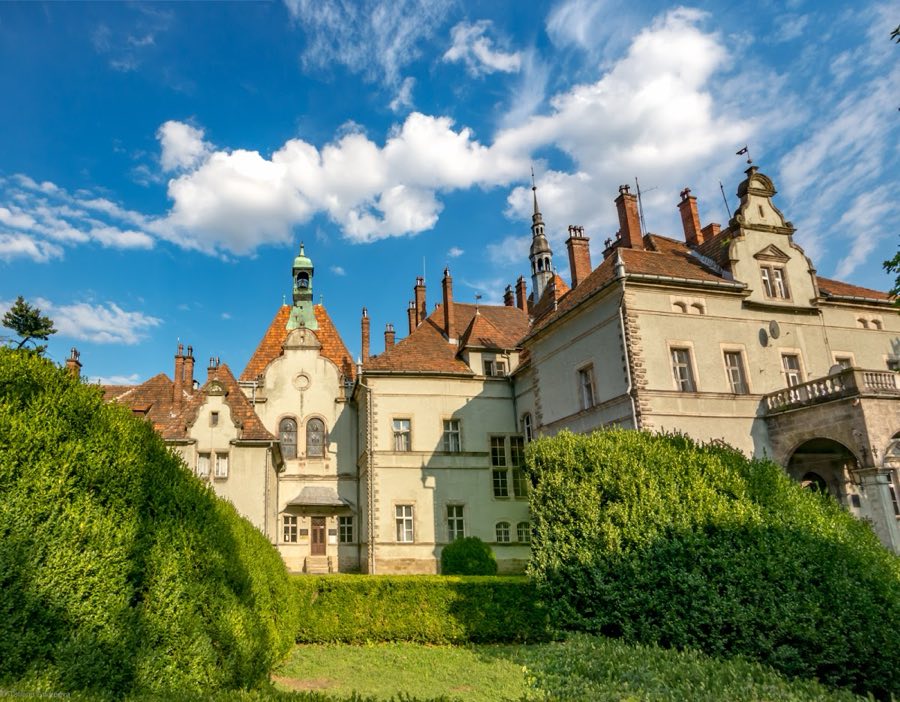
Schönborn Palace (Chynadiyovo)
Ukraine
CastleRestored12th century
No. 84500
Castle · Ukraine
No. 84500 · 48.432 N, 22.688 E
For events
Palanok Castle is marked as a château or castle venue lead. Capacity, indoor/outdoor spaces, catering rules, and accommodation options are published only after public verification.
Event types: Private events, Cultural gatherings, Filming and photography
Quick summary
Palanok Castle is a castle in Ukraine with origins associated with the 11th century.
See all castles in UkrainePalanok Castle, also known as Munkács Castle, is a medieval fortress located in Mukachevo, Ukraine. Its origins trace back to the early medieval period, built by the Hungarian civilization, although archaeological evidence reveals the site was inhabited much earlier, from the Neolithic era through the Bronze and Iron Ages. Before the stone fortress existed, a wooden stronghold occupied the hilltop during the Hungarian conquest.
The castle is first mentioned in written records from the 11th century and was an important fortification during the reigns of Hungarian kings Stephen I and Ladislaus I, who strengthened its walls. Throughout its early history, it successfully withstood attacks from the Pechenegs in 1086 and the Mongol invasion of 1241. These events underscore its strategic importance on the frontier of the kingdom.
In the 14th century, Prince Theodor Koriatovych undertook major expansions and fortifications, transforming the castle into his principal residence and carving a deep well into the rock to secure water supplies. Over the following centuries, ownership shifted among notable noble families, including the Esterházy and Rákóczi dynasties. Under the Rákóczi family, the castle became the capital of the Rákóczi principality until 1711.
During the later 17th and early 18th centuries, Palanok Castle played a vital role in resisting Habsburg rule. It was notably the last fortress to surrender during the siege led by Ilona Zrínyi from 1685 to 1688, defending the supporters of Prince Imre Thököly. The castle’s prominence continued during Francis II Rákóczi’s War of Independence (1703–1711), serving as Rákóczi’s residence and military headquarters.
Following the failure of anti-Habsburg uprisings, the fortress lost much of its military significance and was repurposed as a prison from the late 18th century until the end of the 19th century. During this time, it held numerous political prisoners, including revolutionaries and writers. Between December 1805 and March 1806, the Hungarian Holy Crown was hidden within its walls to protect it during the Napoleonic Wars.
In the 20th century, the castle was used as military barracks by various occupying forces, including Czechoslovak, Hungarian, and Soviet troops. It also served as an agricultural machinery school. Starting in the 1970s, restoration efforts began to preserve the site and adapt it as a museum and cultural center. Among the castle’s stories is a local legend about the well’s construction involving a pact with the devil, reflecting its rich folklore. The castle has also been featured in films and houses a memorial room dedicated to Prince Theodor Koriatovych.
A notable cultural landmark was the Turul bird monument, a large bronze statue atop a 33-meter obelisk erected in 1896. This symbol experienced removal and destruction during the 20th century, was recast and reinstated in 2008, and subsequently removed in 2022 amid contemporary political changes, replaced by the Ukrainian trident emblem.
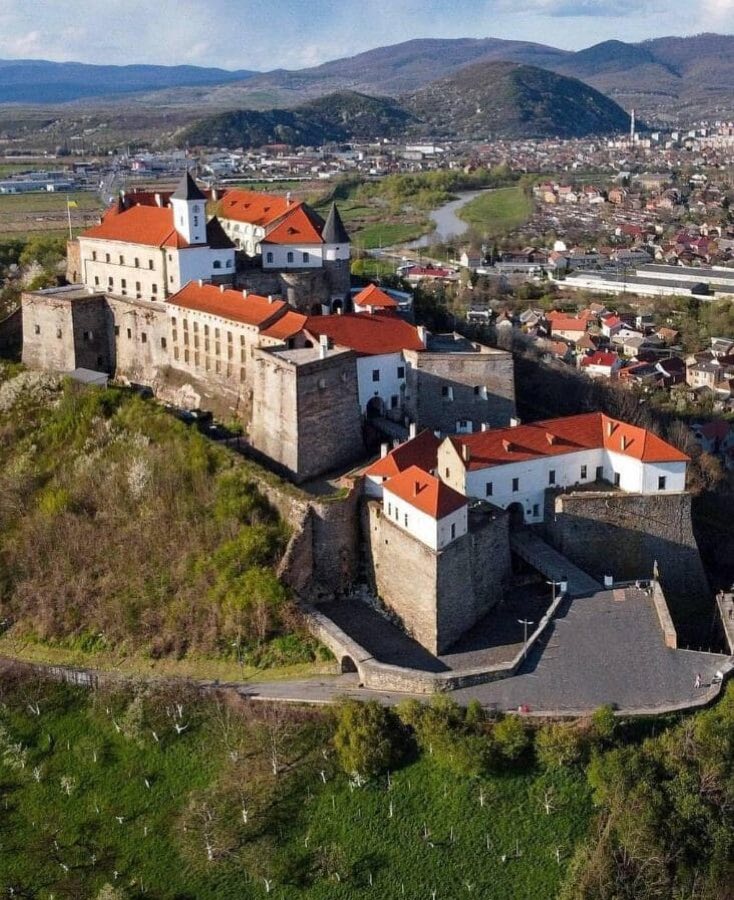
Palanok Castle occupies a volcanic hill rising about 68 meters above the surrounding plain and covers an area close to 14,000 square meters. The fortress is arranged on multiple terraces rising one above the other: the upper terrace contains the oldest and central stronghold known as the citadel; the middle terrace features the main castle complex; and the lower terrace includes the outer defenses. Historically, there was a fourth terrace featuring a gate bastion, which protected the southern approach, but it no longer survives.
The castle’s defensive systems are composed of thick walls—up to 3.8 meters wide—and a combination of eight angular bastions designed in the Italian style, alongside three round bastions. Prominent bastions such as the German and Hajdú flank the entrance to the lower castle, while the Hussar and Wheelwright (Wagner) bastions guard the middle castle’s gate. Within the citadel, the Lorántffy, Rákóczi, and Freedom Tree bastions stand as key defensive points. The highest tower neighbors the Lorántffy bastion, providing connections to other bastions and the citadel area.
A defining feature within the citadel is the covered well carved directly into the rock. It measures 2.5 meters across in diameter and reaches a depth of 86 meters, ensuring water supply during sieges. At a depth of 71 meters, there is a secret tunnel connecting the well to the nearby Latorca River, offering a discreet water source or potential escape route.
The castle’s courtyard, known as Rákóczi Square, is surrounded by two to three-story buildings that historically served different purposes such as barracks, ammunition storage, a knights’ hall, and food supplies. The palace inside the citadel is a multi-story building featuring arcaded galleries on three sides, which functioned as the residence and court of the castle’s lords.
Defensive measures also included a dry moat or ditch between the lower and middle castles, about 10 to 12 meters deep, and a water-filled moat encircling the base of the hill. The marshy terrain surrounding the castle’s foundation further enhanced its defenses by limiting attackers’ access.
During the early 18th century, the castle’s fortifications were modernized under the supervision of French military engineers in response to ongoing military conflicts, with construction continuing until about 1710. A significant fire in 1834 destroyed all wooden structures within the castle, leading to rebuilding efforts that replaced original shingle roofs with more durable tiled coverings.
Today, Palanok Castle houses the Mukachevo Historical Museum and features the Lehoczky collection, alongside a number of restored rooms and exhibition spaces. The Turul monument, once a dominant decorative symbol atop the castle grounds, has undergone cycles of removal and reinstatement, most recently replaced by the emblem of Ukraine, reflecting the site’s ongoing cultural and political significance.
No. 64216
No. 25240
No. 29965
No. 56653
Comments
Comments for Palanok Castle will require a verified account before posting.
We'll send a verification link before your first comment is published.