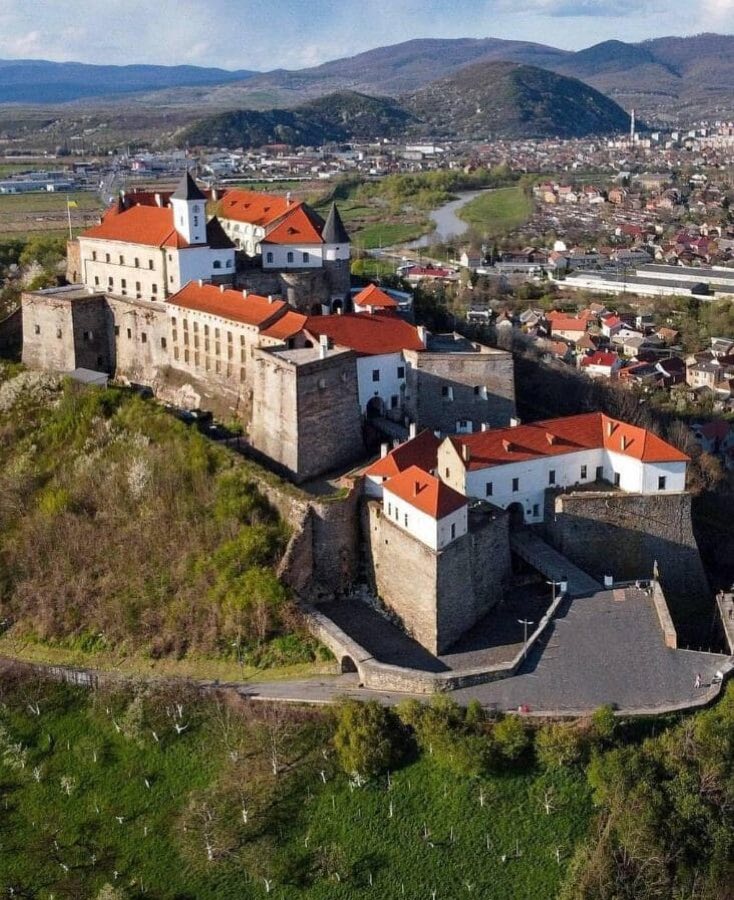
No. 84500
Palanok Castle
Ukraine
CastleRestoredFor events11th century
No. 64216
Castle · Ukraine
No. 64216 · 48.525 N, 22.875 E
Quick summary
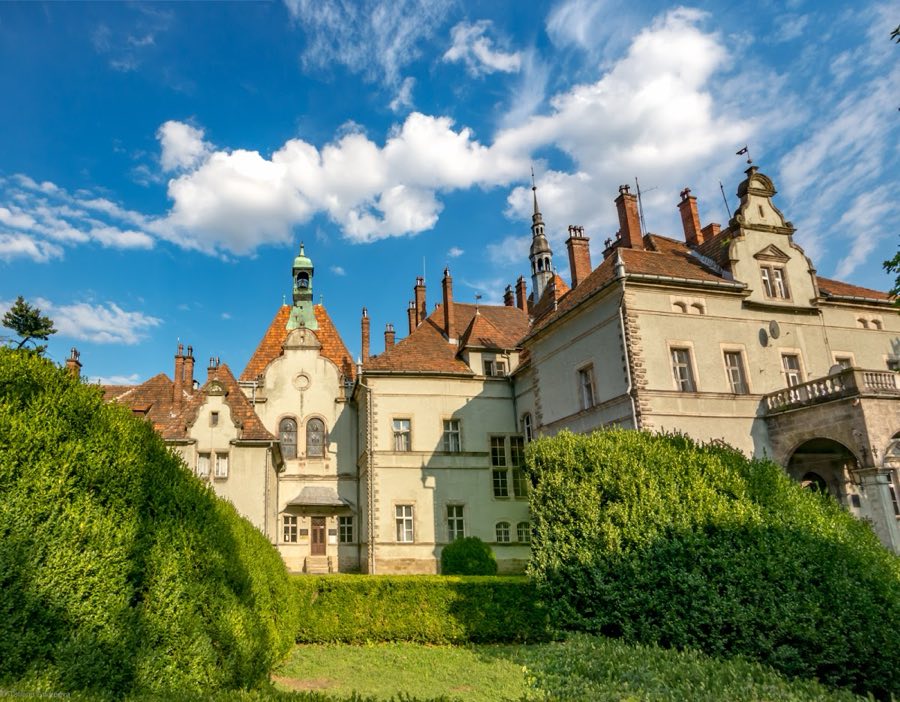
Schönborn Palace (Chynadiyovo) is a castle in Ukraine with origins associated with the 12th century.
See all castles in UkraineSchoenborn Palace stands in Mitterberg, Ukraine, and was built and developed by members of the Schönborn noble family.
On 31 July 1728 Emperor Charles VI granted the Mukachevo–Chynadiyiv estate to Lothar Franz von Schönborn. Management of the property passed to his cousin Friedrich Karl von Schönborn, who organized settlement and economic measures on the estate, encouraging German colonists and arranging tax exemptions for artisans and peasants. In 1734 the Szentmiklós, now called Chynadiyovo, castle was repaired for the Schönborns. The former Rákóczi residence in Mukacheve, known as the White Palace, underwent rebuilding and enlargement in 1746–1747 with the involvement of the architect Balthasar Neumann.
At the end of the nineteenth century the family replaced an older wooden lodge with a new hunting palace. Between 1890 and 1895 Erwein‑Friedrich von Schönborn‑Buchheim commissioned the present lodge as a purpose-built hunting estate and seasonal home. The Schönborns regularly held organised hunting parties at the estate. A chapel was introduced in the early twentieth century where originally a passage had stood.
After the First World War Transcarpathia became part of Czechoslovakia. In 1928 the Mukachevo–Chynadiyiv estate was broken up under a Czechoslovak land reform, and ownership of the hunting lodge and related holdings was transferred through the companies Bignon and Latoritsa in a transaction arranged by Count Schönborn‑Buchheim. The last family owner of the lodge, Count Georg‑Erwein von Schönborn‑Buchheim, departed Mukachevo in September 1944.
Following the Second World War the Transcarpathian region was annexed by the Soviet Union. The palace was nationalized and converted for collective use, becoming a rest house. From 1946 the building has functioned as the Karpaty sanatorium, and in 1958, after a visit by Nikita Khrushchev, the site was designated the first climatological sanatorium in Transcarpathia. From 2010 the sanatorium broadened its medical services to include musculoskeletal rehabilitation, treatment for gastrointestinal conditions, and a department for pregnancy pathology. Furniture and other interior valuables from the palace were transferred to the collections of the Uzhhorod Local History Museum. The site is registered as an architectural monument of national significance (No. 1128), and in 2011 it was held by the organization ZAT Ukrprofzdorovnytsia. The palace has also been used as a film location for productions such as The Snow Queen and Seventeen Moments of Spring. Local tradition records a legend that the building contains 366 windows, 52 rooms, and 12 entrances, with variant versions giving 365 windows or 52 chimneys.
The palace follows a picturesque, neo‑romantic composition that blends Romanesque and Gothic motifs with forms that echo French Renaissance castles. The design treated individual architectural elements, such as chimneys and towers, as decorative features. Construction employed brick as the primary material and the roofs and façades are accented with shaped tiles. The wing nearest the lake was completed as a two‑storey block. A tower clock with chimes is reported to continue working.
Decorative carving and sculptural work form an important part of the building’s appearance. Bas‑reliefs, a series of weather vanes, areas of stained glass, and heraldic ornamentation refer to the Schönborn family across façades and interior spaces. The palace originally contained a passage where a chapel was later inserted in the early twentieth century, and that liturgical room remains part of the complex’s fabric.
The palace stands within a planned dendrological garden whose central feature is a decorative lake excavated at the end of the nineteenth century. The outline of that pond was arranged to symbolically reproduce the map of Austria‑Hungary. The grounds contain a Hungarian commemorative inscription stone and two figurative sculptures titled The Deer and The Bear with Cubs. The park was planted with a variety of non‑local trees and shrubs, recorded among them boxwood, catalpa, Weymouth pine, Canadian spruce, Japanese cherry, pink beech, and Italian honey locust, together with ornamental shrubs such as deutzia and hydrangea. Today the grounds form the park of the Karpaty sanatorium.
Interior fittings and movable valuables have undergone later dispersal and preservation. Several pieces of furniture and other items from the palace interior were transferred to the Uzhhorod Local History Museum. The main building has been adapted for use as a medical sanatorium since 1946, and the ensemble is officially listed as a nationally significant architectural monument (No. 1128). The site’s visual character and surviving decorative program have also made it a setting for film productions.
No. 84500
No. 25240
No. 29965
No. 56653
Comments
Comments for Schönborn Palace (Chynadiyovo) will require a verified account before posting.
We'll send a verification link before your first comment is published.