No. 97034
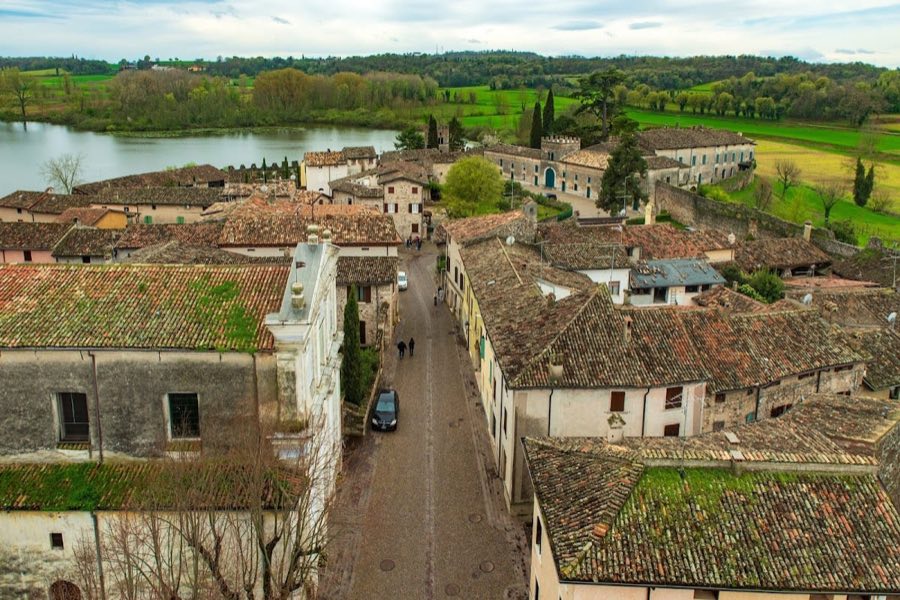
Castello di Castellaro Lagusello
Italy
CastleRestored13th century
No. 44405
Palace · Italy
No. 44405 · 45.161 N, 10.789 E
Quick summary
Palazzo D'Arco is a palace in Italy with origins associated with the 18th century.
See all castles in ItalyPalazzo D’Arco in Mantua, Italy, is an aristocratic residence begun in the late 18th century and remodelled in the neoclassical style. The building was created by the Italian D’Arco family, a noble line that moved from Trento to Mantua, and its construction and later reworking placed the palace among the city’s important private complexes. Over time the house accumulated art, books and objects that document both the family’s tastes and changing cultural fashions in northern Italy.
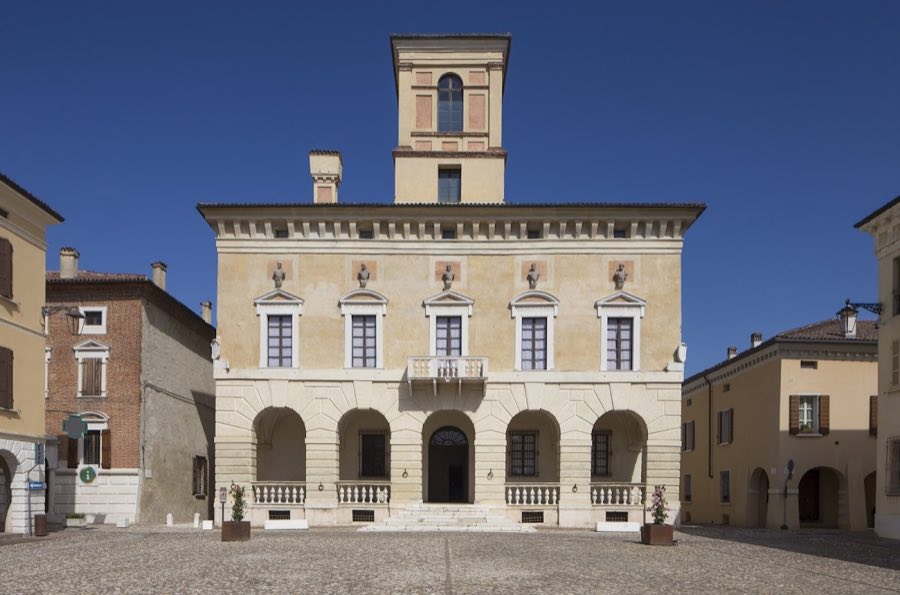
The D’Arco family established itself in Mantua after moving from Trento in 1740. In 1784 the family began a major programme of works that gave the palace its present neoclassical appearance, adopting ideas drawn from Andrea Palladio and reshaping an earlier urban residence into a more formal, classical palace. This phase created the principal entrance and the grand approach that mark the building today.
During the 19th century the complex grew through further acquisitions. In 1872 Francesco Antonio D’Arco purchased adjoining Renaissance buildings and the garden from the Marquises Dalla Valle, linking a fifteenth-century wing and its green space to the main house. Count Carlo D’Arco (1799–1849), a collector of historical documents and a prominent local figure, lived in the palace and served as podestà, or mayor, of Mantua between 1847 and 1848.
The twentieth century saw a change from private home to cultural institution. Giovanna dei Conti D’Arco Chieppio Ardizzoni, the last descendant of the line, established the Fondazione D’Arco and provided in her 1956 will that the palace and its collections — including an herbarium, paintings, archives, a library, musical instruments, furniture and weapons — should pass to the public after her death. She died in 1973 and the residence was converted into a museum that year. A prefectural decree dated 29 September 1978 formally recognized the donated holdings as a museum. In 1946 the former stable wing had already been converted into a small theatre, and since then that space has housed a theatrical academy. In 2014 a further donation from Marquis Federico Cavriani added works now displayed in a dedicated room bearing his name.
The garden contains a small Renaissance building notable for an early sixteenth-century fresco cycle. The painted decoration is attributed to the Veronese artist Giovanni Maria Falconetto and his workshop, and it dates to around 1510–1520. The palace complex therefore preserves layers from the Renaissance through the nineteenth century and documents the D’Arco family’s role in Mantua’s civic and cultural life.
The palace stands as an ensemble of connected buildings organized around a garden enclosed by an exedra, a curved wall feature that closes the green space. The main façade faces Carlo D’Arco square and presents a neoclassical frontage with the principal doorway at its centre. An eighteenth-century remodelling added a three-flight stair that rises to the piano nobile, the noble floor from which the interior route begins.
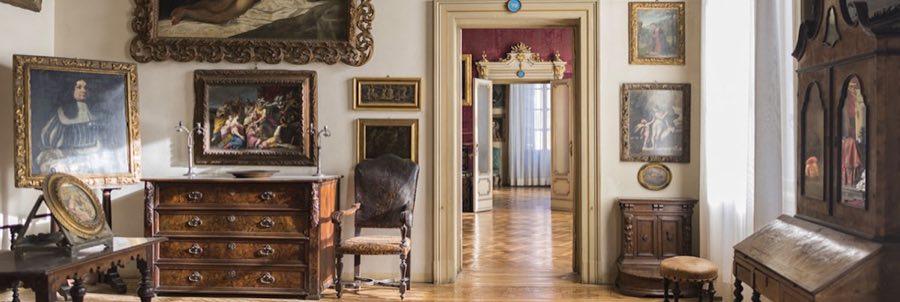
Inside, rooms retain rich furnishings and specialized collections. A long hall called the Sala degli Antenati displays sixty family portraits. The library occupies a neoclassical room and holds more than ten thousand volumes, including a copy of Antonio Canova’s Three Graces. A nineteenth-century historic kitchen remains as a preserved service room, and other chambers contain musical instruments and the picture gallery, which holds paintings by artists such as Niccolò da Verona, Bernardino Luini, Alessandro Magnasco, Frans Pourbus the Younger, Anthony van Dyck and a cycle by Giuseppe Bazzani. The movable heritage includes an herbarium, archives, furniture and weapons alongside the printed and painted collections.
To the left of the main complex the former stables were adapted after 1946 into the Teatrino d’Arco, a small theatre that houses the Francesco Campogalliani Theatrical Academy. In the garden a pair of small Renaissance buildings from the fifteenth century open onto the green and one of these contains the Sala dello Zodiaco, a single-volume interior measuring about 9.70 by 15.40 by 6.30 metres. The Zodiac Room is covered with a painted program produced around 1515 by Giovanni Maria Falconetto with his pupils. All four walls display zodiac groups, with one sign on each short wall and five signs on each long wall so that opposite signs face one another; the image of the Scales (Libra) was partly lost when a fireplace was inserted, probably in the seventeenth century.
Decoration in the Zodiac Room combines repeated keystone masks and mascarons, heads including a bull and a Jupiter Ammon type, an eagle, grotesque ornament frames and medallions bearing portraits of emperors. Sixteen central narrative scenes draw mainly on Ovid’s Metamorphoses and typically show monthly activities in the foreground set against classical or late-antique building forms in the background. Below the Zodiac Room lies the Sala dei Cesari, which preserves copies of eleven imperial portraits originally executed in 1536 by Titian for Frederick II of Mantua.
A room named the Sala Cavriani displays works given to the foundation in 2014. Overall the complex presents a sequence of structural and decorative elements from the Renaissance through the neoclassical period, with later reuse evident in the theatre conversion and in nineteenth-century insertions such as the kitchen and the fireplace that altered parts of the painted cycle.
No. 97034
No. 68984
No. 30747
No. 48723
Comments
Comments for Palazzo D'Arco will require a verified account before posting.
We'll send a verification link before your first comment is published.