No. 45344
Palazzo Gerolamo Grimaldi
Italy
PalaceRestored16th century
No. 63286
Palace · Italy
No. 63286 · 44.411 N, 8.934 E
Quick summary
Palazzo Gio Battista Spinola is a palace in Italy with origins associated with the 16th century.
See all castles in ItalyPalazzo Gio Battista Spinola in Genoa, Italy, is a mid-16th-century urban palace built for a Genoese patrician family during the Renaissance and retaining mannerist interior elements. Erected in the 1560s, it joined the network of grand private residences that were obliged to host state visitors, giving the building an official public role in the city’s diplomatic life. The house appears among the recorded palaces of that system and was reproduced in a 1622 plate series of Genoese residences, a sign of its standing in the city.
The plot passed hands at auction in 1551 and was acquired by the Spinola brothers, who commissioned the palace in 1563. One brother gave his share to the other in 1566, and construction was almost finished by 1567. Over the late 16th and early 17th centuries the house was repeatedly listed among the city’s top-ranked palaces, appearing in the official rolls between 1576 and 1664 and ranked mostly in the highest class, with a lower ranking recorded in 1588.
In May 1684 the palace suffered heavy damage during a French naval bombardment of the city. Repairs and alterations followed, including the addition of an extra floor and a redesigned street face during the post‑bombardment rebuilding. A later account attributes the present appearance of the front elevation to a remodelling carried out in 1758. Ownership passed within the Spinola line and later moved into the Doria family, with one source giving 1723 as the year of Doria purchase and another indicating a member of that family already held the house at the time of the 1684 damage. Under the Dorias the interior was furnished with a private picture gallery; part of that collection was sold in the 19th century to a local savings bank. The palace is one of the group of city palaces inscribed in the UNESCO listing of Genoa’s principal streets and palaces in 2006, remains in Doria ownership, and continues to serve as a residence while only its exterior and selected interior areas are opened to the public.
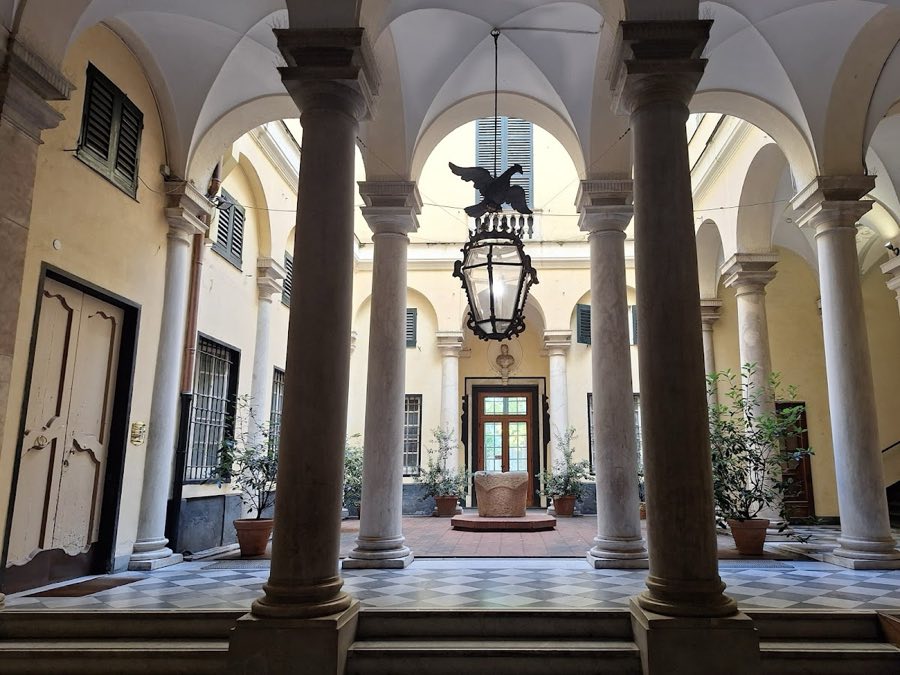
The palace occupies a sloping site along Strada Nuova (Via Garibaldi) with a terraced garden rising behind the house. The plan preserves a clear axial sequence of entrance hall, inner courtyard and garden as laid out in the 16th century, so that visitors pass directly from the street portal and entrance hall into the raised courtyard and then to the terraces beyond. The sloping plot required stepped garden levels, and the overall distribution of rooms and open spaces follows the original Renaissance arrangement for an urban noble house.
The entrance area, or atrium, contains a large suspended lantern topped by a heraldic eagle bearing the Doria coat of arms. The inner courtyard sits two steps higher than the atrium and is surrounded by a covered walkway supported by columns, a colonnaded ambulatory that opens on either side with three arches onto the courtyard. After the 1684 bombardment the building was raised by one additional story and the street elevation was redesigned; one account records a mid-18th-century remodelling that gave the façade its present stucco surface, with paired flat vertical bands between the window openings as decorative articulation.
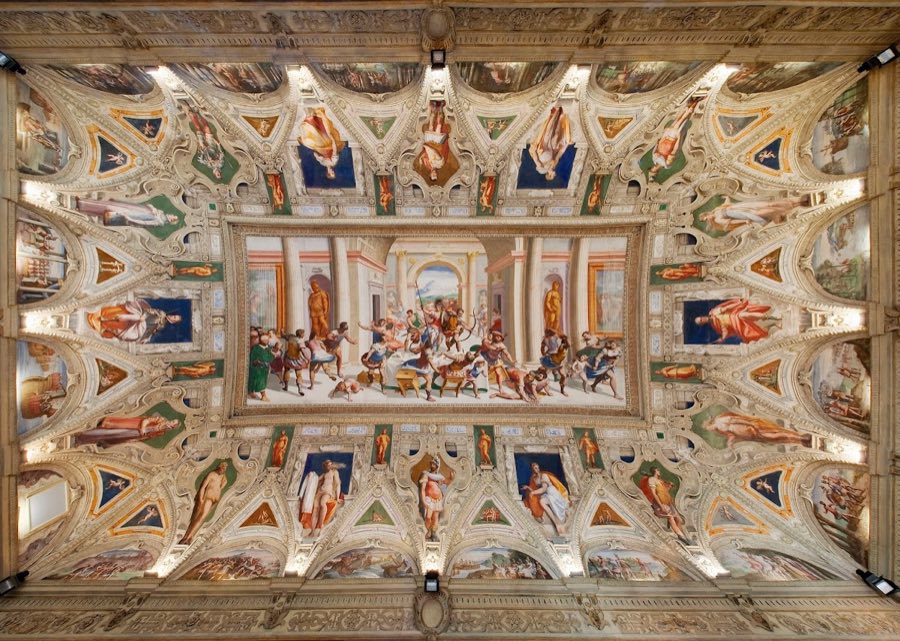
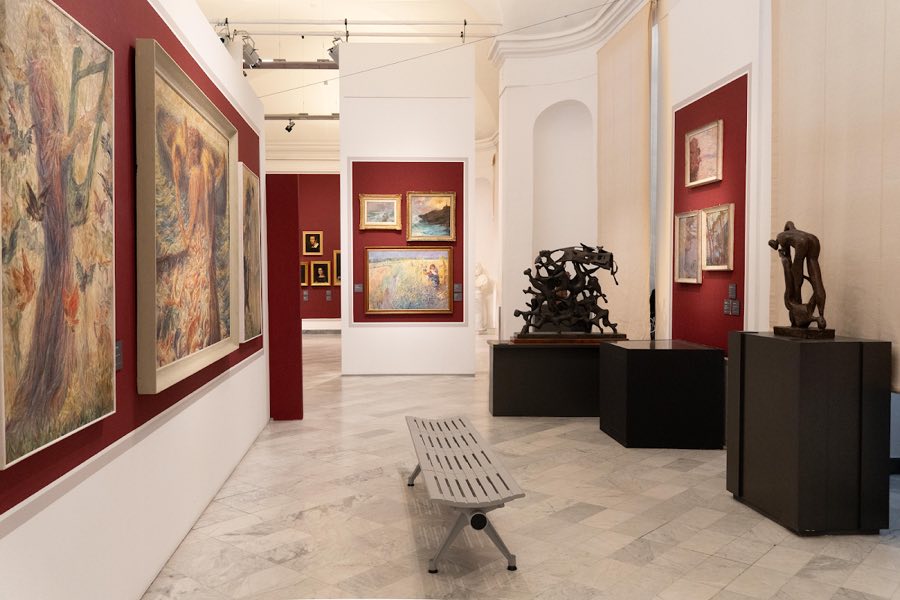
The principal floor, the piano nobile (main noble floor), contains a large hall facing the street dominated by a 16th-century marble fireplace carved in a mannerist style. Vaulted ceilings on this level carry painted cycles that illustrate episodes in the Spinola family history, including a representation of an embassy to Emperor Frederick I (Barbarossa), together with mythological scenes in a smaller salon. Five late 16th-century Flemish tapestries showing scenes from the life of Abraham hang on the piano nobile walls. The Dorias assembled a private picture gallery here, once hung in an eighteenth-century manner and containing works by notable local painters; part of that collection was dispersed in the 1800s to a regional savings bank. The building’s street face was also reproduced in an early 17th-century series of plates, and the palace today remains a private residence, with exterior views and limited interior spaces available for public access.
No. 45344
No. 92780
No. 79162
No. 86094
Comments
Comments for Palazzo Gio Battista Spinola will require a verified account before posting.
We'll send a verification link before your first comment is published.