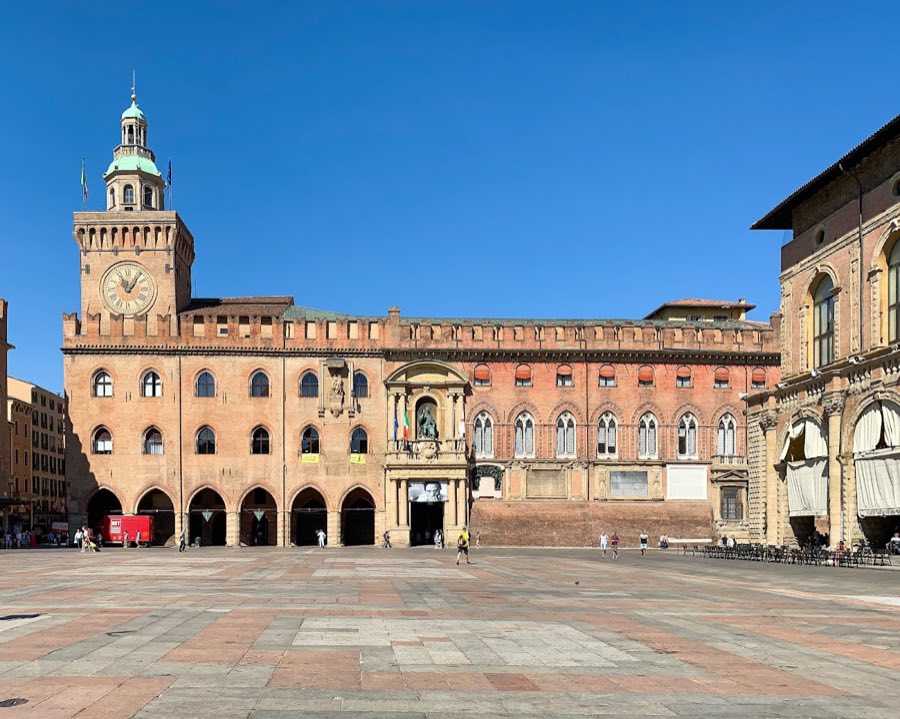
No. 65333
Palazzo d'Accursio
Italy
PalaceRestored13th century
No. 60138
Palace · Italy
No. 60138 · 44.497 N, 11.352 E
Quick summary
Palazzo Poggi is a palace in Italy with origins associated with the 16th century.
See all castles in ItalyPalazzo Poggi in Bologna, Italy is a Renaissance palace erected in the mid-16th century by members of the Poggi family. Built between 1549 and 1560 as a private residence, the building took on greater civic and cultural weight in later centuries because of its decoration and its role as the seat of important scholarly institutions.
The palace began life as the urban home of Alessandro Poggi and his brother Giovanni Poggi, who later became a cardinal. In the second half of the 1500s the family carried out substantial remodelling that produced the large interior courtyard with a loggia and a grand stair that leads up to the piano nobile (main floor). During this period the palace received extensive fresco programs, and one painter who worked there returned to Bologna in 1555 to complete fresco cycles that are commonly regarded as his finest achievement.
In the early 1700s the palazzo became linked to a new scientific academy established by Luigi Ferdinando Marsili. Between about 1710 and 1714 institutional arrangements and related academies took shape, and the complex acquired a dedicated observatory tower between 1712 and 1725. A specially built library followed in 1744, and a large ceremonial hall on the building’s north side opened in 1756. Under the protection of Pope Benedict XIV the institute grew into a leading model of systematic learning in Enlightenment Europe.
The Napoleonic era brought administrative reorganisation that dispersed the institute’s instruments and moved its collections into different university faculties and museums, while the palace library remained and formed the core of what became the university library. At the end of the twentieth century the University of Bologna promoted a cultural programme to bring back and reassemble collections that had been scattered. Today the palazzo serves as one of the University of Bologna’s principal buildings and houses the university headquarters and the rectorate.
The building presents a compact urban plan centered on a large square courtyard. The courtyard is surrounded by a loggia, and a wide staircase rises to the piano nobile, the main reception floor. These internal arrangements date to the sixteenth-century remodelling commissioned by the Poggi family and remain the organising core of the palace.
Rising from the palace complex is La Specola, the tower observatory, constructed between 1712 and 1725. The tower functioned as a place for astronomical observation and stands as a clear early-18th-century addition to the Renaissance body of the building. It survives as an attached vertical element that marks the site’s scientific use in the Enlightenment.
A separate library building was added in 1744 and a monumental assembly or great hall was opened on the north side in 1756. These eighteenth-century constructions were created to serve the needs of the Institute of Sciences and the expanding university collections, and they form an integral part of the palace complex today.
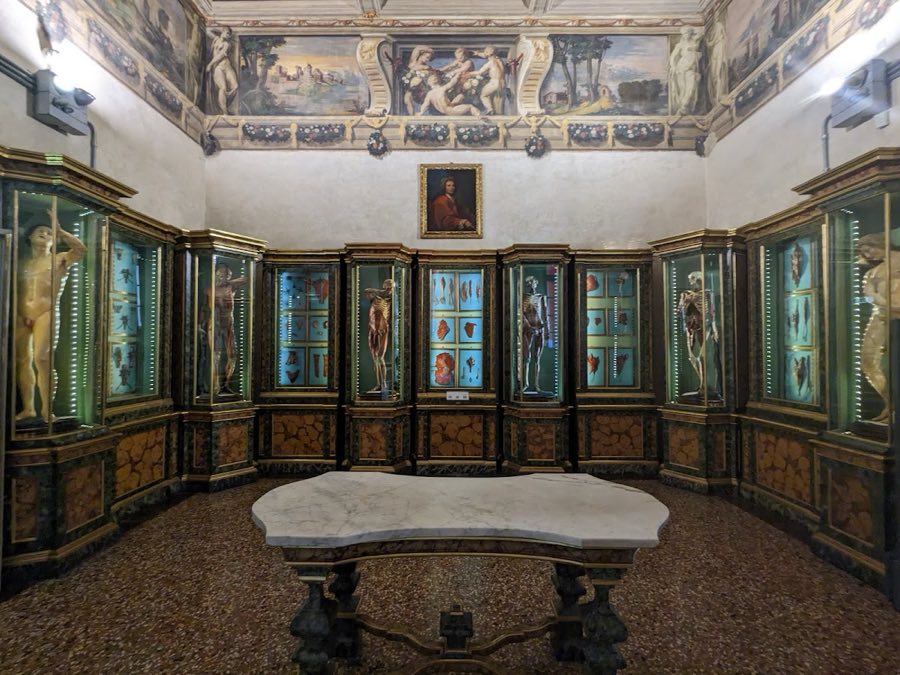
Interior decoration is extensive and concentrated on wall and ceiling frescoes executed in Mannerist and early Baroque styles. The decorative scheme follows a combined symbolic and naturalist programme and includes named cycles: the Rooms of Moses, David, and the Sphinxes; the Rooms of Susanna and of the Zodiac; the Rooms of Camilla and landscape scenes; a concert hall decorated with representations of the Labors of Hercules and putti at work in winemaking; and rooms of grotteschi and powerful telamons. These frescoed chamber ensembles remain an essential component of the palace’s artistic fabric.
Ground-level spaces include an assembly room dedicated to the poet Giosuè Carducci, where he lectured for decades, and the Hercules Room, which contains a large statue of the mythological hero carved in 1730. The palace also houses a suite of university museums and the main university library, together with a picture gallery holding more than six hundred portraits and a seventeenth-century globe by Vincenzo Maria Coronelli.
Collections related to anatomy, natural history and the Marsili collections are preserved within the building. Anatomical exhibits comprise wax models and childbirth models, including the celebrated “Venerina” by Clemente Susini, waxes by Ercole Lelli and by Giovanni and Anna Morandi Manzolini. Historical natural-history holdings include material associated with Ulisse Aldrovandi as well as the Luigi Ferdinando Marsili collections. These artefacts and displays remain installed within rooms of the palace and form the core of its museum holdings.
No. 65333
No. 37029
No. 18623
No. 25454
Comments
Comments for Palazzo Poggi will require a verified account before posting.
We'll send a verification link before your first comment is published.