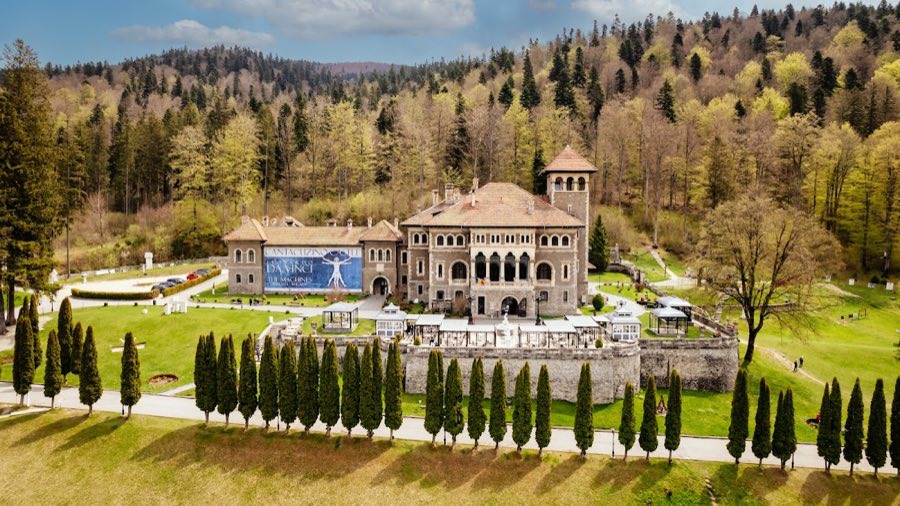
No. 52236
Cantacuzino Castle
Romania
ChâteauRestored20th century
No. 93012
Palace · Romania
No. 93012 · 45.361 N, 25.539 E
Quick summary
Pelișor Castle is a palace in Romania with origins associated with the 20th century.
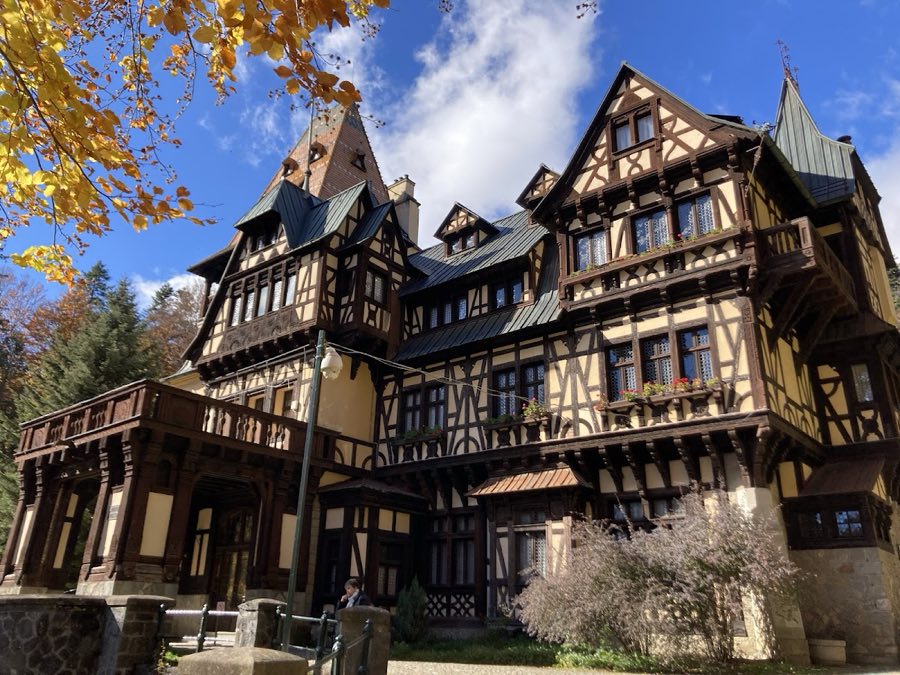
See all castles in RomaniaPelișor Castle in Sinaia, Romania, is a small royal palace built for the Romanian royal family under King Carol I at the turn of the 20th century. Constructed around 1899–1902 (with some sources extending to 1903), the building was created in the modern Art Nouveau style and formed part of the same complex as the larger Peleș Castle. From its construction onward the palace played a central role for the heir to the throne and his family, serving as a private summer residence and as the setting for the childhoods of several members of the royal household.
Work on the palace began by royal commission in the final years of the 19th century, and the interiors were given a strongly personal character under the queen’s supervision. The queen developed an original decorative program that blended Art Nouveau with Byzantine and Celtic motifs, shaping key rooms and a distinctive central salon. Furnishings for at least one bedroom were produced locally in 1909 to match those designs. From 1903 the building was the principal summer home for the heir and his family, and their children—among them the future King Carol II, and daughters who later became queens consort in other Balkan states— were raised there.
After the 1947 abdication of King Michael I, the state took ownership of the royal properties, including Pelișor. Many paintings, pieces of furniture, tapestries, decorative objects and books were transferred to the National Museum of Art in Bucharest, and in May 1948 further items were distributed to cultural institutions in Bucharest, Brașov and Sibiu. Beginning in 1953 the palace’s buildings were used to house writers, artists and musicians who were aligned with the ruling regime. In 1975 the royal complex was closed for conservation work.
The palace reopened to the public in 1993 as a museum devoted to its Art Nouveau interiors and collections. In 2006 the government announced the return of the complex to the former king, and a 2007 agreement restored Peleș and Pelișor to his patrimony while leaving them under state administration; that agreement for Pelișor lapsed in 2009, and a separate extension was applied to Peleș in 2010.
Pelișor forms a compact palace set beside Peleș Castle and exhibits an exterior that mixes timber-frame, or fachwerk-type, elements with traditional Romanian decorative motifs. Two sandstone towers rise from the structure and are finished with brightly colored tile cladding that draws on the roof patterns of Bukovina churches. Contemporary descriptions record the building as small in scale, with published room counts varying between seventy and ninety-nine spaces.
The principal public space is the central salon known as the Golden Room. Its walls are covered with gilded stucco worked into leaf designs inspired by the thistle or burdock plant, and the ceiling contains a skylight shaped like a Celtic cross, admitting daylight into the salon. Furniture and decorative surfaces in this room combine Celtic knotwork and Byzantine-inspired ornament. Adjacent to the central salon, the Hall of Honor is lined with oak panelling and is described in some accounts as rising through three storeys, lit by tall windows beneath a glass or stained-glass ceiling that functions as a skylight.
Private apartments include a Golden Bedroom whose furnishings were carved in linden wood at local workshops in 1909 and are decorated with Celtic interlace and Byzantine animal motifs. The queen’s suite includes a chapel entered through a gilded arch and lined with Ruschița marble, and the queen’s study is appointed with columns and a fireplace in a Romanian historicizing style, its furniture bearing personal emblems associated with the queen. The heir’s study follows a restrained German neo‑Renaissance taste and contains a notable walnut desk carved with three panels showing the castles Peleș, Pelișor and Foișor.
The palace preserves a collection of decorative artworks associated with the Art Nouveau movement, including pieces attributed to makers and designers active in that period. Among the movable holdings are a painted manuscript on parchment presented to the queen in 1906 and several watercolours by her hand. Over the mid-20th century many principal objects were relocated to national and regional museums; the building itself was closed for conservation in 1975 and later reopened as a museum in 1993, while the original decorative ensemble remains the defining feature of the palace interior.
No. 52236
No. 38716
No. 52719
No. 50293
Comments
Comments for Pelișor Castle will require a verified account before posting.
We'll send a verification link before your first comment is published.