No. 38716
Bran Castle
Romania
CastleRestored13th century
No. 50293
Castle · Romania
No. 50293 · 45.354 N, 24.635 E
For events
Poenari Castle is marked as a château or castle venue lead. Capacity, indoor/outdoor spaces, catering rules, and accommodation options are published only after public verification.
Event types: Private events, Cultural gatherings, Filming and photography
Quick summary
Poenari Castle is a castle in Romania with origins associated with the 14th century.
See all castles in RomaniaPoenari Castle stands near the commune of Arefu in modern-day Romania and was originally constructed by the Wallachians in the early 1200s. During the 14th century, this fortress served as the primary stronghold of the Basarab dynasty and was then known as Castle Arges.
In the mid-15th century, Vlad III, often called Vlad the Impaler, undertook extensive repairs and strengthening of the castle in 1459. He rebuilt it on the left bank of the Argeș River, using stones taken from a previous, lower castle on the opposite bank. Vlad used Poenari not only as a military fortress but also as a residence and a secure place to hold boyars—noblemen—who were considered disloyal or traitorous. According to the Cantacuzino Chronicle, there is a tradition that some boyars from Târgoviște who betrayed Vlad’s family were punished by being forced to build this fortress.
After Vlad’s death in 1476, the castle continued to be in active use for several decades, fulfilling administrative and defensive functions, including serving as a treasury. However, it began to decline in importance during the early 1500s and was eventually abandoned in the first half of the 16th century. Over the following century, the fortress fell into ruin. Its position on a steep cliff made it difficult for enemies to conquer but also exposed it to natural threats such as earthquakes and landslides, which damaged the structure in 1913, 1940, and 1977. Partial repairs have been made following these events. Since 2009, the site has been managed by the Argeș County Museum and is officially recognized as a monument of national importance.
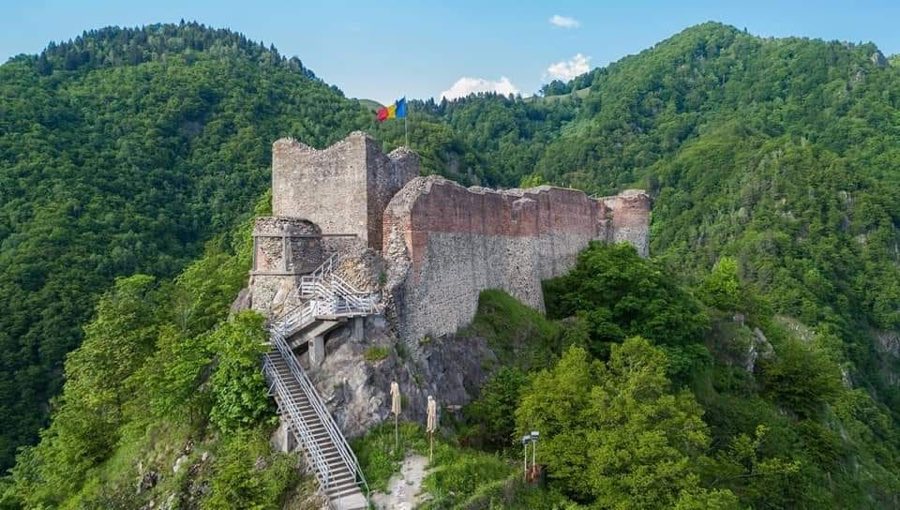
Poenari Castle occupies a commanding position atop Mount Cetatea, overlooking the Argeș River valley. Its elongated layout is enclosed by robust walls that are two to three meters thick, reflecting medieval defensive design. The fortress includes five towers, four of which are round and one prismatic in shape, indicating varied structural elements within the fortifications.
The walls and towers are constructed from stone, notably sourced from the earlier, lower castle that once stood on the right side of the river. Despite partial collapses linked to earthquakes and subsequent landslides over the 20th century, several sections have been stabilized and repaired to prevent further deterioration. The remnants still rise prominently above the landscape, offering expansive views across the valley and toward the nearby Făgăraș Mountains.
Access to the castle is possible only by ascending a series of 1,480 concrete steps that wind through dense beech woodland, highlighting the fortress’s strategic placement on a steep precipice. This difficult approach underlines the castle’s original defensive advantages. The surviving walls and towers remain in situ, providing a tangible connection to the site’s centuries of military, administrative, and residential use. These ruins stand as a witness to the fortress’s layered history and enduring presence in the region.
No. 38716
No. 93012
No. 52236
No. 52643
Comments
Comments for Poenari Castle will require a verified account before posting.
We'll send a verification link before your first comment is published.