No. 79278
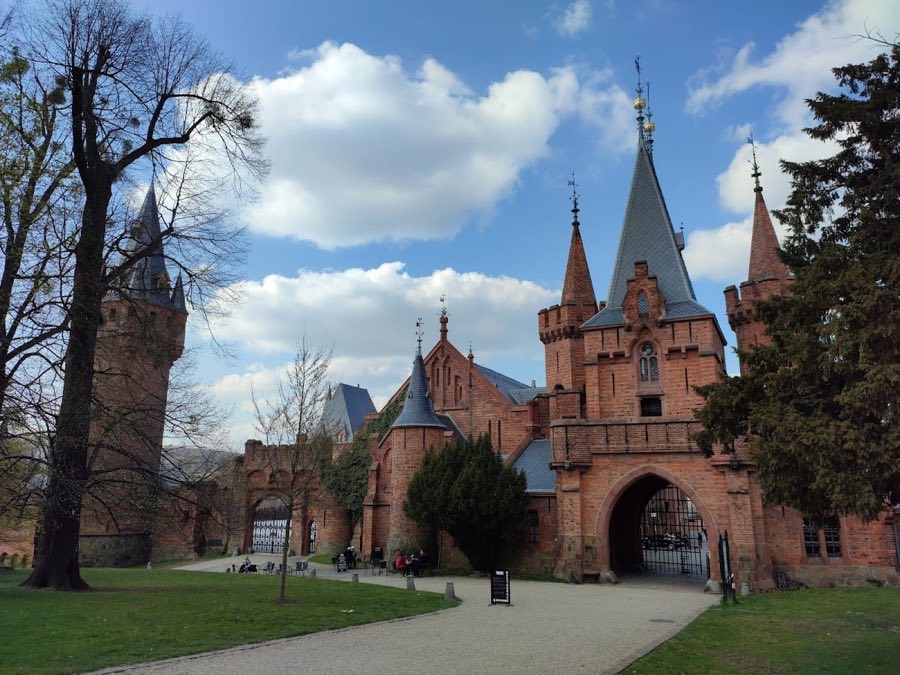
Hradec nad Moravicí Castle
Czechia
CastleRestored8th century
No. 33079
Castle · Czechia
No. 33079 · 49.891 N, 17.944 E
Quick summary
Raduň Castle is a castle in Czechia with origins associated with the 19th century.
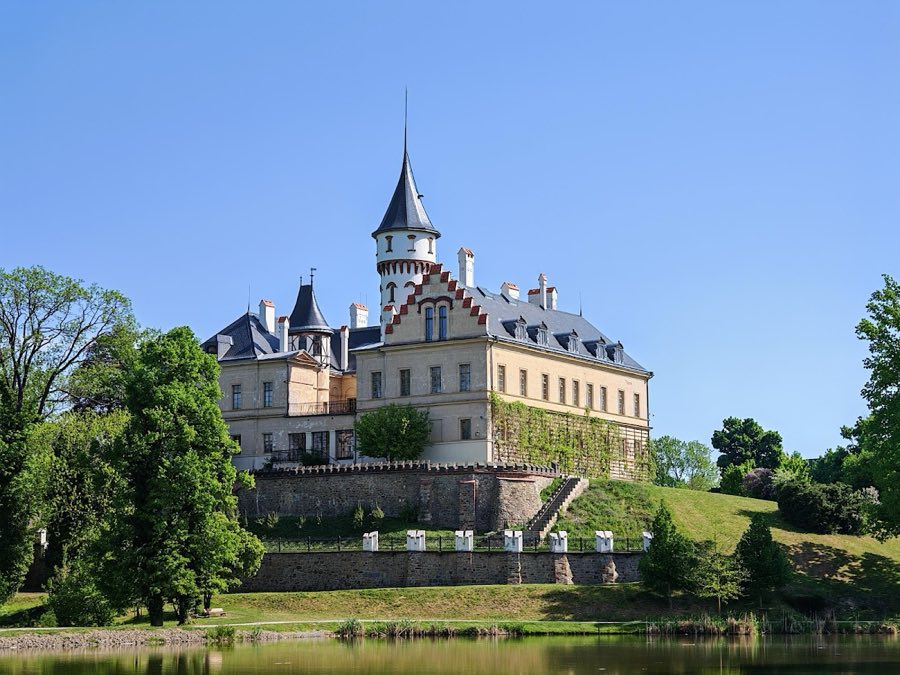
See all castles in CzechiaRaduň Castle in Raduň, Czechia, began life as a medieval fortress, with a recorded existence by 1320, and today displays a built character shaped by Renaissance and Baroque phases later overlaid by an early 19th-century Empire, or Neoclassical, remodelling. The site mattered as a landed noble seat for successive families who transformed the building to match changing tastes and needs, and it remained an estate center into the modern era.
From the late fifteenth century the property belonged to the Tvorkovski (Tvorkov) family of Kravaře. The family held the estate from 1481 into the following century and carried out a major Renaissance rebuilding; the rebuilding is variously dated to the sixteenth century or placed slightly later in the seventeenth century. This phase produced the core of the palace that would survive into later remodelling.
In the early decades of the nineteenth century the palace underwent a substantial remodelling that reshaped its outward appearance toward the Empire, or Neoclassical, fashion popular at that time. Work on a building phase dated 1816–1822 began under Count Johann Josef Larisch‑Mönnich and was completed under his wife, Anna Maria von Mönnich, after his death in 1820. That campaign imposed the early 19th-century appearance now evident above the older Renaissance–Baroque fabric.
In 1832 ownership passed into the Blücher von Wahlstatt family, following a marriage linking the two houses in the early 1830s. Members of the Blücher family used Raduň as a residence through the nineteenth century, and the family carried out repair work on towers and on the west-side gables during the 1830s. The estate remained in private hands under the Blücher family into the twentieth century, with family presence at least until the start of 1949.
After the Second World War the state took the castle into public ownership. The palace then underwent state-led restoration and was opened to the public in the late twentieth century, with reopening activity recorded in the period from the late 1970s into the 1980s. The orangery was restored in 2004 and has been accessible since that work. The whole complex, including the castle, park, and associated buildings, is protected as a national cultural monument of the Czech Republic, catalog number 1000124525.
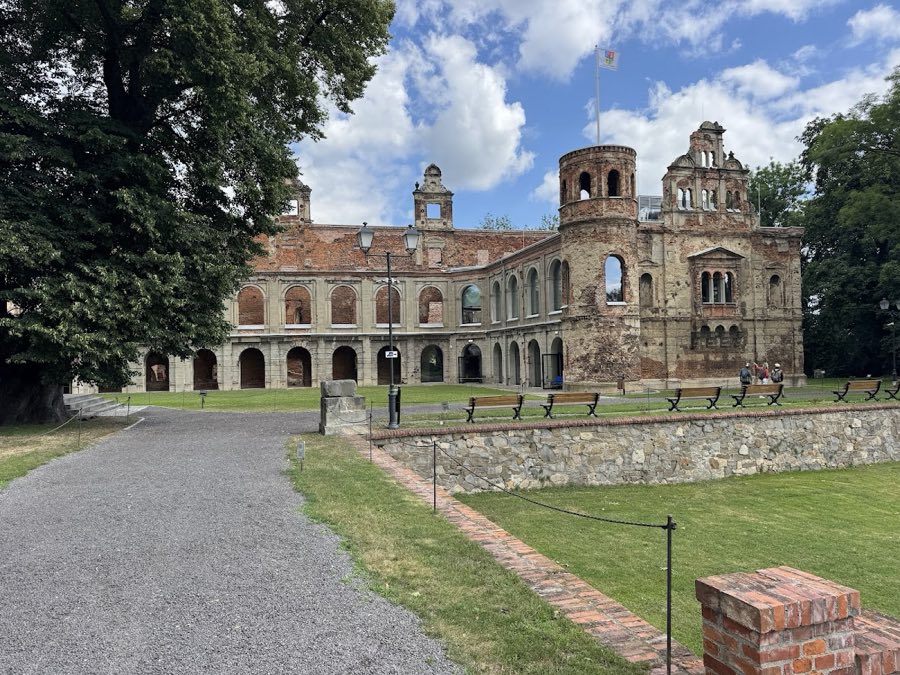
The ensemble is dominated by a large, four-wing palace set around an inner courtyard, built in masonry and layered in time. The building preserves an older Renaissance and Baroque structural core, while the outer façades and overall silhouette reflect the early nineteenth-century Empire, or Neoclassical, reconstruction. A conspicuous round tower projects above the roofline and defines the ensemble’s external profile.
Inside the palace several rooms retain historic functions and fittings. A library occupies dedicated space and is reached by a wooden staircase; the library holds a collection of about 16,000 volumes. A suite of formal rooms used by the noble household, described as state or representative chambers, and an armory also form part of the interior layout, reflecting the building’s role as a noble residence.
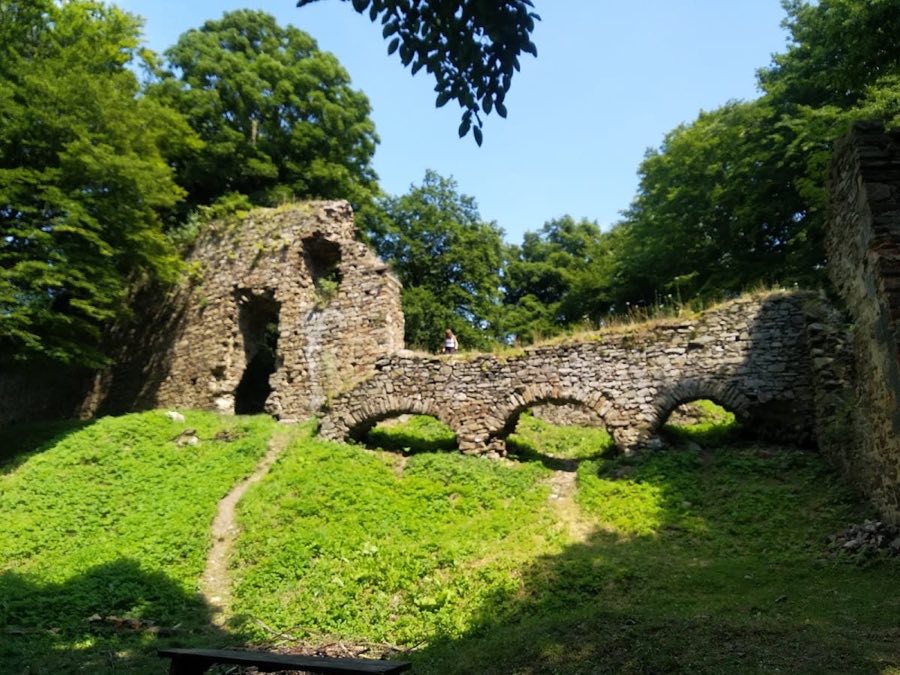
The surrounding park is extensive and varied in its layout and includes a large body of water at its heart. Scattered across the grounds are several ancillary structures that relate to the estate’s long use. The remains of the older medieval castle stand within the park as a low, elongated building on a rectangular plan, with twenty-one window axes and a hipped, pavilion-style roof, reflecting its earlier, utilitarian form.
A two-storey granary from the mid-eighteenth century remains on the site; it is built of dressed quarry stone and has a plastered exterior, its simple rectangular plan serving the agricultural needs of the estate. Nearby is the orangery, constructed in 1825–1826 to serve as a heated plant house and winter garden; it was restored in 2004 and has been open to the public since that restoration.
Conservation interventions have altered and repaired parts of the complex over time. In the 1830s the owners undertook repairs to the towers and to the gables on the west side, and twentieth-century state restorations consolidated the palace and made it accessible. The complex today presents a combination of restored and conserved elements that document its medieval origin, early modern transformation, and nineteenth-century remodelling.
No. 79278
No. 39076
No. 45787
No. 53690
Comments
Comments for Raduň Castle will require a verified account before posting.
We'll send a verification link before your first comment is published.