No. 25839
Burgruine Windegg
Austria
CastleRuin13th century
No. 34296
Palace · Austria
No. 34296 · 48.364 N, 14.581 E
For events
Reichenstein Castle is marked as a château or castle venue lead. Capacity, indoor/outdoor spaces, catering rules, and accommodation options are published only after public verification.
Event types: Weddings, Private events, Cultural gatherings, Filming and photography
Ceremony spaces: Ceremony setting to verify
Quick summary
Reichenstein Castle is a palace in Austria with origins associated with the 20th century.
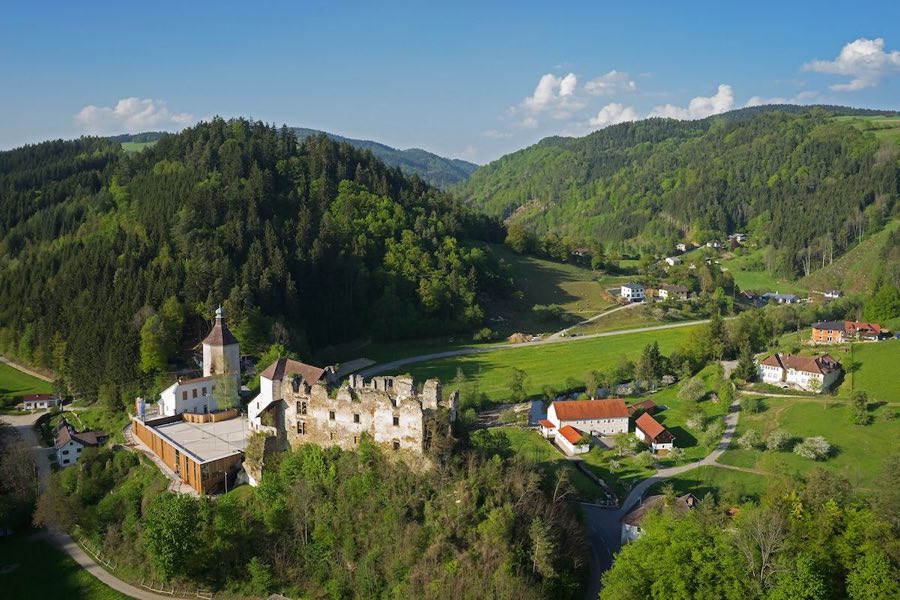
See all castles in AustriaReichenstein Castle stands above the village of Reichenstein in the municipality of Tragwein, Austria; it was built by medieval regional nobility during the High Middle Ages. The name Ulrich von Reichenstein appears in a document dated 1230, and the original hill castle was erected sometime between 1230 and 1300. Ownership moved through several regional families in the later medieval centuries, including the Kapeller family (who appear as partial or sole owners between 1295 and 1406), and later the Wallseer and the Liechtensteiner families.
In 1565 Christoph Haym purchased the complex and, after being enfeoffed with the lordship of Reichenstein by the Emperor in 1567, began transforming the medieval stronghold into a Renaissance palace. Local opposition accompanied this rebuilding. On 1 January 1569 subjects led by Siegmund Gaisrucker gathered and plundered two demesne farms attached to the castle, an event recorded as the start of the Reichenstein robot uprising. Christoph Haym was ambushed and shot in 1571; his body was interred in the crypt at Wartberg ob der Aist.
Hans von Haim, son of Christoph Haym and born 12 February 1544, assumed sole lordship in 1575 and carried on the conversion into a Renaissance residence. From 1603 until the end of 1605 he served as administrator of the provincial government of Austria above the Enns. The Starhemberg family acquired Reichenstein in 1729. Occupants left the site in 1750 and thereafter the complex fell into ruin.
Interest in conservation began in the late 20th century and work on the ruins has continued since 1989. During construction for a new museum building in 2012 archaeologists uncovered important remains of an earlier predecessor castle. In 2013 a partly subterranean museum building opened on the site to house the Upper Austrian Castle Museum together with a Natura 2000 information office. The Starhemberg family foundation remains the owner and has leased the ruin to an association charged with restoration and cultural use; the castle steward is Roland Huber. Today the site functions as a museum with displays spanning roughly the 11th to the 17th centuries and Natura 2000 subjects, and as a cultural centre hosting exhibitions, music, theatre, children’s programmes and sculpture projects.
The castle occupies a narrow, steep rock ridge above a pronounced bend of the Waldaist River, with the village of Reichenstein lying at the slope’s base. Much of the visible fabric dates to the late 16th-century remodelling, and surviving elements form a compact group along the ridge rather than a spread-out site.
The chapel survives from the medieval hill castle and has retained an important funerary monument. It contains the epitaph of Christoph Haym and was adapted for parish use between 1785 and 1816. The chapel continues to be used for church festivals such as weddings and baptisms, and stands as one of the better-preserved components of the site.
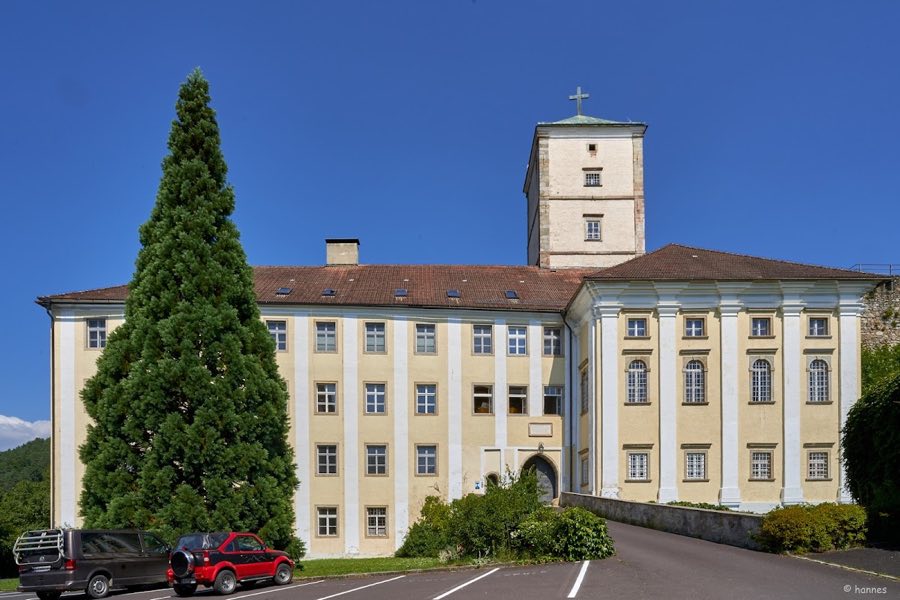
A Renaissance residential wing erected in 1576 replaced the medieval palas and now provides most of the standing palace fabric. Within this wing, the knights’ hall preserves fragments of wall painting and a series of paired window arches that reflect its late 16th-century design. These decorative traces remain visible in situ and testify to the building campaign carried out under Christoph Haym and his son.
Portions of the gate block and one of the flank towers that belonged to the Renaissance phase still rise above the courtyard area. The northern flank tower survives in part, and a section of the gate tract remains. That gate tract was later reused as the local parsonage, a secondary use that helped secure its preservation through later centuries.
Archaeological work during the museum project in 2012 revealed significant structural traces of an older predecessor castle beneath the later phases. These discoveries are preserved as important archaeological remains on the site and informed the design of the new museum, which occupies a partly subterranean building completed in 2013. That building houses the Burgenmuseum Reichenstein and the Natura 2000 information point and sits within the historic castle area, linking the exposed medieval and Renaissance remains to the recent finds uncovered during construction.
No. 25839
No. 45529
No. 49887
No. 11611
Comments
Comments for Reichenstein Castle will require a verified account before posting.
We'll send a verification link before your first comment is published.