No. 36182
Hof Iben
Germany
CastleRuin18th century

No. 93479
Castle · Germany
No. 93479 · 49.808 N, 7.850 E
Quick summary
Rheingrafenstein Castle is a castle in Germany with origins associated with the 12th century.
See all castles in GermanyRheingrafenstein Castle stands in Bad Kreuznach, Germany, and was erected by the Counts of Nahegau of the Emichones family.
Construction likely began in the 11th or 12th century on a porphyry outcrop that, a thousand years ago, carried the name Huhinstein. The stronghold became the ancestral seat of the Lords of Stein; that family later took the names Wildgraves and Rhinegraves and kept possession of the hilltop estate until the upheavals of the French Revolution. Members of the Lords of Stein are recorded in the 12th century, while the castle itself is first clearly mentioned in records of the 13th century.
In 1196 a member of the family, Wolfram of Stein, adopted the title Rhinegrave, and that title became associated with the castle. Following the 1279 Battle of Sprendlingen, Siegfried II forfeited his lands on the right bank to the Archbishop of Mainz. He transferred his residence to the rock and began referring to the site as Rheingrafenstein.
Through marriages in the 14th and 15th centuries the Rhinegraves added the Wildgraviate and one half of the County of Salm to their possessions. A distinct Rheingrafenstein branch of the family was established in 1610. During the Thirty Years’ War the castle passed into foreign hands at times; historical records note captures by Spanish forces and by Swedish forces. French troops commanded by General Mélac destroyed the fortress in 1688–1689. In 1721 parts of the ruined site were incorporated into a salt works, the last resident princely household moved its seat to Gaugrehweiler, and descendants repurchased the ruined property from the municipality in 1835.
Perched atop a porphyry tower rising roughly 136 metres above the immediate terrain and about 245 metres above sea level beside the river Nahe, the site is a classic rock‑castle with building fabric set against and into the living stone. The southern flank of the outcrop contains a lower outer ward known historically as Affenstein, forming the approach and supporting ancillary buildings below the main summit.
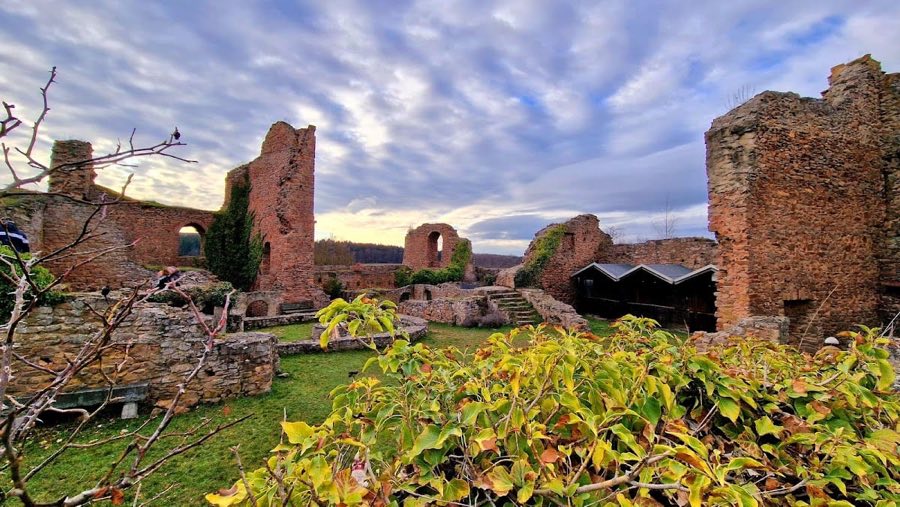
Surviving masonry includes stretches of the former curtain wall, which served as the medieval defensive perimeter and was built directly onto the rocky promontory. A vaulted cellar is preserved within the ruinous mass, a space that would originally have provided secure storage; its barrel vault and stone construction reflect medieval building methods. Close by are a small flight of steps that once belonged to the residential tower or keep, and the cut foundations of a tower stair, which mark the footprint of that vertical circulation within the stronghold.
A narrow staircase has been hewn through the rock to reach a high viewing platform, showing how access routes were integrated with the natural formation. Over time the ruined castle fabric was quarried and reused for later construction; in 1721 material and parts of the remains were taken into the salt works established on the site. Today the structures survive only in fragmentary condition, with remnants of walls, cellar vaulting, step fragments, and foundation traces visible in situ.
No. 36182
No. 80194

No. 61332
No. 17841
Comments
Comments for Rheingrafenstein Castle will require a verified account before posting.
We'll send a verification link before your first comment is published.