No. 72102
Neu-Süns Castle
Switzerland
CastleRuin13th century
No. 95008
Castle · Switzerland
No. 95008 · 46.736 N, 9.448 E
Quick summary
Rietberg Castle (Pratval) is a castle in Switzerland with origins associated with the 13th century.
See all castles in SwitzerlandRietberg Castle, Pratval, Switzerland, was constructed in the medieval period for the Lords of Rietberg, members of the region’s feudal society.
The oldest fabric of the site dates to the 13th century, when the central rectangular tower was raised, probably around the remains of an even older 12th-century tower. By 1286 the men of Rietberg held the site as vassals of the Freiherr von Sax‑Misox. During the 14th century they served as ministeriales of the Bishop of Chur, and the bishop asserted control over the castle and its estates in the mid‑1300s. Claims and counterclaims over this period were settled by payments and agreements that continued through 1388.
From the late 14th century the bishopric treated the castle and the associated office of vogt as assets that could be pledged. In 1398 the property was granted to Jakob von Castelmur. In 1409 it was placed with Conradin Rambach and the cathedral chapter. Subsequent transfers recorded the castle with Bartolomäus Planta in 1426, Hans Wellenberg in 1447, and Hans Ringg in 1450; Ringg’s share passed to his son Wilhelm in 1483. In the early 1500s further changes took place when the castle was associated around 1530 with Anton von Travers and in 1554 with Hercules von Salis‑Soglio.
Titles and ownership were divided and sold in the 17th and 18th centuries. In 1617 parts of the estate went to branches of the Planta family, while other shares went to the Salis family and to Pompejus Planta. Christoph von Rosenroll bought the Salis portion in 1664 for 9,000 gulden. A half interest passed to the Buol family in 1670, and the Buols acquired the remaining Planta share in 1758, becoming sole owners. In 1798 Johann von Buol‑Schauenstein sold the castle to his brother, Bishop Karl Rudolf of Chur, who intended to convert the building into a seminary. The French invasion of 1798 and the abolition of the prince‑bishop’s secular power prevented that plan. During the 19th century the property changed hands among private owners, including the Casparis family in 1822, and in 1917 a branch of the Planta family again took ownership.
Rietberg Castle was directly involved in the violence of the Bündner Wirren. Pompeius Planta was living at the castle when anti‑Habsburg forces under Jörg Jenatsch attacked on the night of 24–25 February 1621. Pompeius died as he attempted to escape the assault; one account says he hid in a chimney, was found by a dog, and was killed by Jenatsch with an axe. Jörg Jenatsch later embraced Catholicism and on 24 January 1639 he was killed during Carnival in Chur by an assailant disguised as a bear. The murderer’s identity remains uncertain, and contemporary accounts present two possibilities: the attacker may have been a son of Pompeius Planta, or an assassin employed by local aristocrats.
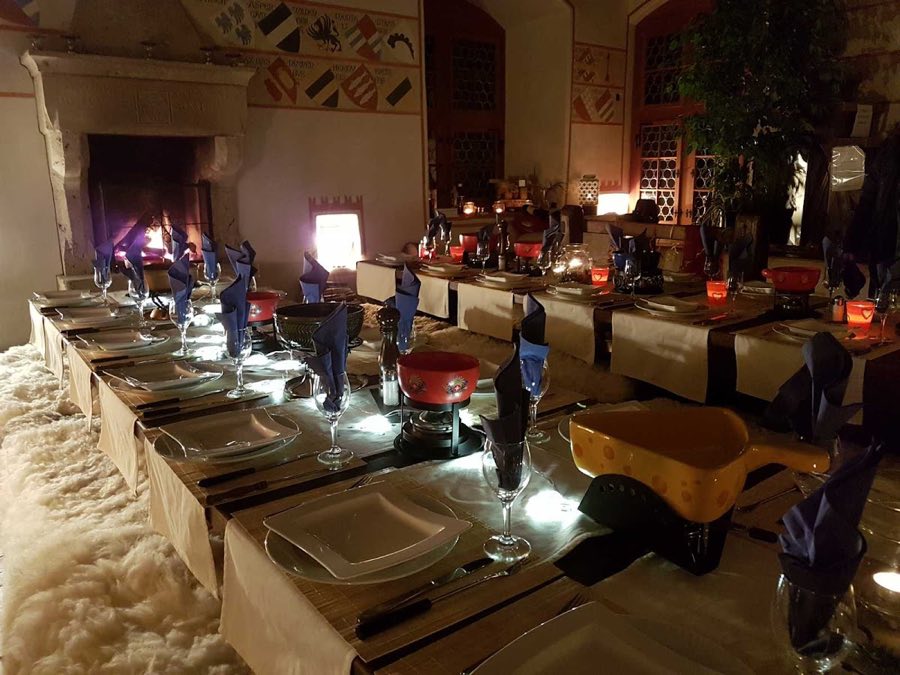
Major rebuilding in the 17th century produced much of the castle’s present appearance. Interior work has continued into recent times; for example, the knight‑hall apartment was renovated in 2018 and is now used as guest accommodation. The site is recognised as a cultural property of national significance.
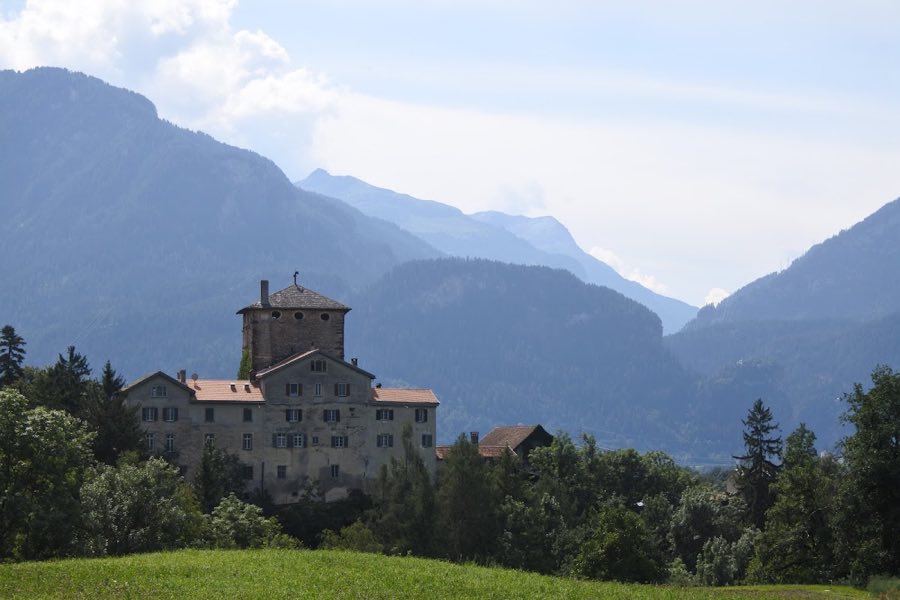
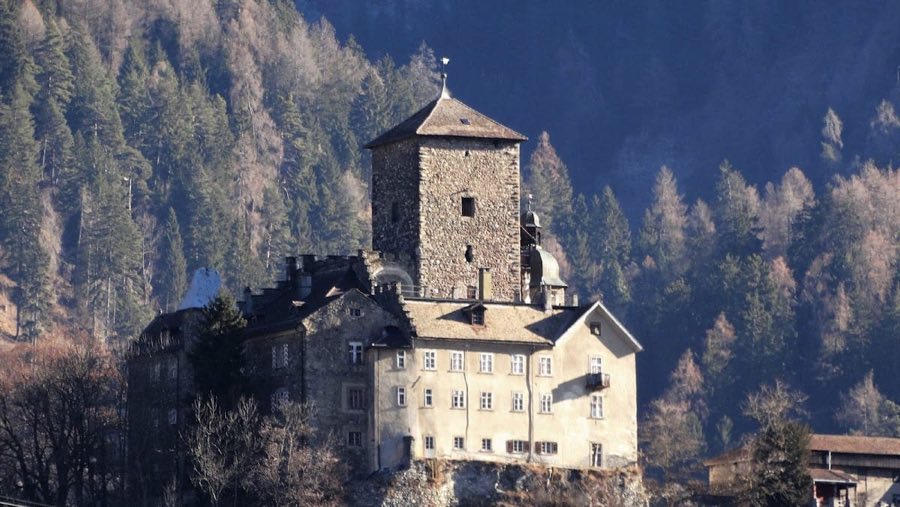
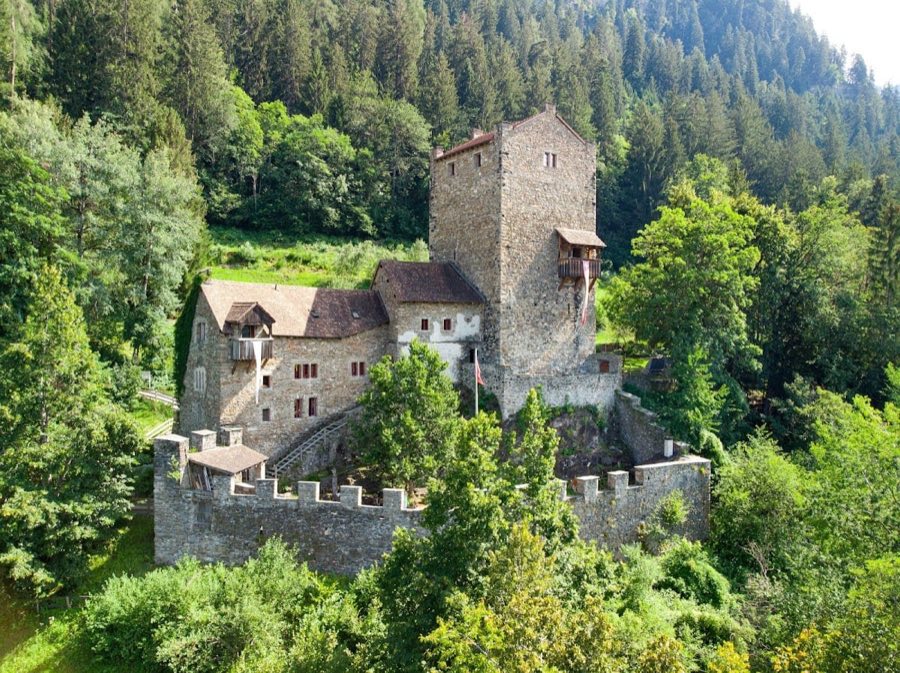
The castle stands around a dominant rectangular tower, with additional residential wings and enclosing defensive works arranged on its north side and within a surrounding wall. Construction combines deep medieval stone foundations and later early modern rebuilding that reshaped the upper parts of the tower and the domestic ranges.
The central tower is the oldest visible element and dates to the 13th century, though its base encloses the footings of an earlier 12th-century keep. The basement walls are massive, reaching up to 2.5 metres in thickness, and these heavy stone works surround the older tower foundations. The original entrance to the high floors was probably placed on the third level, on the north face, and at later dates larger windows and doors were cut into the tower to suit changing domestic needs. Above the fourth floor there was once a substantial wooden defensive platform formed by large beams; a rebuilding campaign in the late 1600s inserted characteristic round “ox‑eye” openings into the upper tower, and the crenelations were partly filled in on three sides during the 18th century. The present roof of the tower was added in the last century.
To the north of the tower two residential buildings rest on medieval foundations but were completely rebuilt in the 17th and 18th centuries. Vaulted cellars survive, and a principal living room on the third floor is dated to about 1601. On the first residential floor an alliance stone bearing the combined arms of Planta and Jecklin is inscribed with the year 1601, marking a household connection at that time. The knight‑hall was refitted in modern times and underwent renovation in 2018.
A medieval cistern lies in the courtyard to the north‑east of the tower. It can be reached through an underground tunnel cut from the residential wing, and in the 17th century a Baroque round tower was built directly over the cistern, transforming its profile in that quarter of the site. Defensive works were expanded in the early modern period by the addition of a crenelated ring wall during the 17th century. The wall on the south side is recorded as a modern construction, and the main entrance gate carries the date 1792.
A neck ditch had been cut on the north‑east approach, but later filling altered that feature’s visibility in the landscape. Inside the tower, the second‑highest floor provides seasonal shelter for a large colony of greater mouse‑eared bats. In warm months, based on 2021 observations, their numbers range from roughly fifty to several hundred animals, which use the former door opening to the old defensive platform to come and go.
No. 72102
No. 17007
No. 21462
No. 50459
Comments
Comments for Rietberg Castle (Pratval) will require a verified account before posting.
We'll send a verification link before your first comment is published.