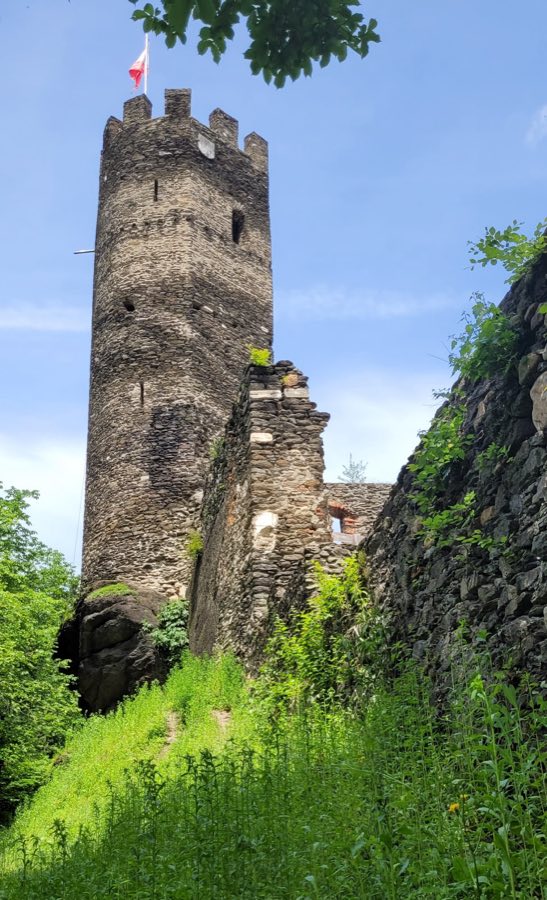
No. 52514
Burg Krems
Austria
CastleRuin12th century
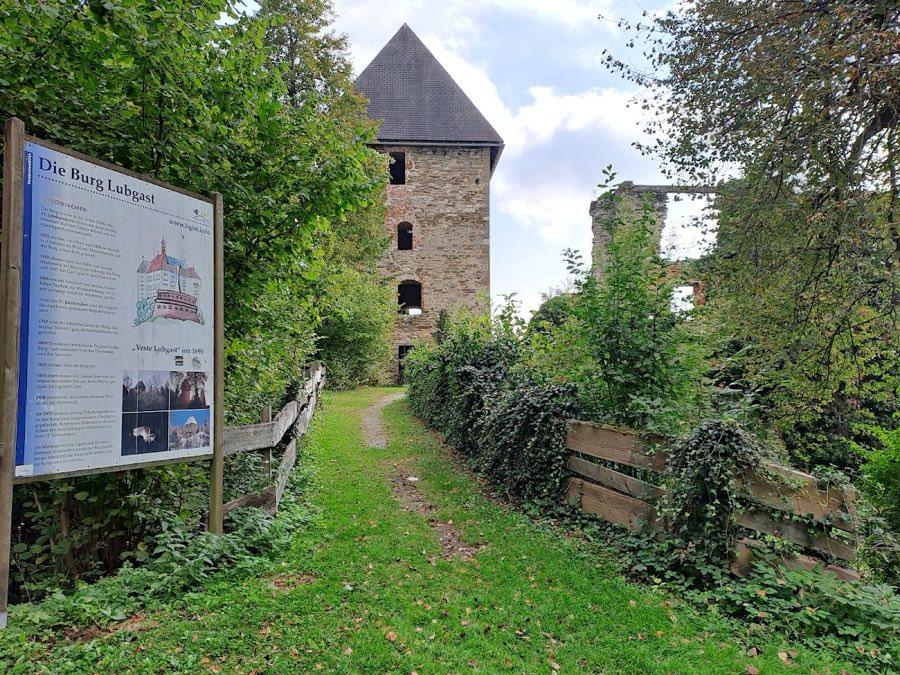
No. 99127
Castle · Austria
No. 99127 · 46.996 N, 15.206 E
Quick summary
Ruine Ligist is a castle in Austria with origins associated with the 13th century.
See all castles in AustriaRuine Ligist in the municipality of Ligist, Austria, was erected by ministerial servants serving the Eppensteiner family at the end of the twelfth century.
The site first appears in a document of 1222 naming Ulrich de Lubgast at the “Veste Lubgast.” During the thirteenth century the Lubgaster ministerial family lived at the castle. Around 1300 ownership passed into the hands of the related Herren von Saurau. A record dated about 1355 lists Starchant von Saurau as holding the estate known then as Lubgast as a free possession. The Lubgaster line disappeared shortly before 1478 after having moved their main residence to Hohenburg from about 1320.
In the middle of the sixteenth century Franz von Saurau and many of his dependents adopted Protestant belief, and the castle chapel was used for Protestant worship. Disputes over clerical appointments intensified and reached a peak in 1599 when a reform commission escorted by imperial troops expelled the Protestant pastor and caused considerable damage to the castle fabric.
A serious fire in 1621 destroyed part of the complex and the armory. Karl von Saurau carried out rebuilding work after that blaze. Over the following decades the Saurau family accumulated debts and in 1783 they moved into a converted manorial farm known as Schloss Ligist. By 1797 the castle buildings were already in poor repair.
French soldiers were stationed in the castle in 1805 and again in the winter of 1809–1810. Their quartering further damaged interior fittings and roof timbers. The site is described as a ruin in 1818 and after parts collapsed in 1820 it was allowed to fall into decay. Ownership passed to the Counts of Goess in 1870 and in 1928 the Sovereign Military Order of Malta became the property owner. From 1975 until 2011 the local castle association Burgverein Ligist carried out stabilization and conservation work, and in several seasons between 1975 and 2011 the group carried out securing and restoration tasks; the association dissolved in 2011 and the municipality has subsequently used the site for a Christmas market.
Ruine Ligist stands on a narrow spur of the Ligistberg, about forty metres above the village on a grass‑covered ridge with steep drops on three sides, the site bounded to the north and south by small streams. Approaches were cut into the slope to make the promontory defensible and the original route of access comes from the northwest.
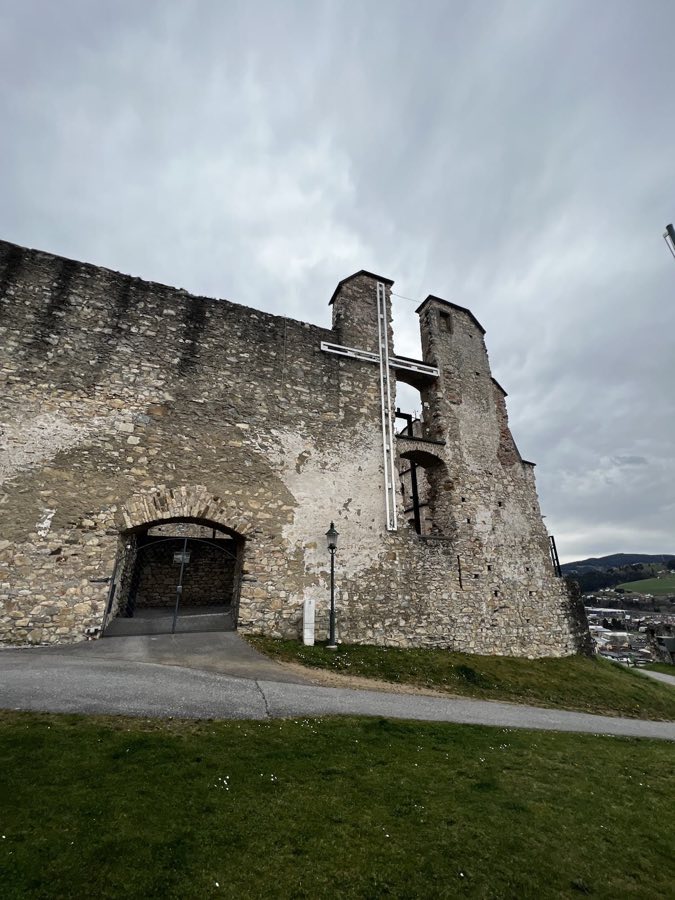
Defensive works include a deep ring moat encircling the north, east and south sides. The moat had been largely filled with collapse debris until local conservation cleared it. Adjoining the moat is an earlier defensive earthwork that survives only in part, and a perimeter wall dating to the early fourteenth century runs beside the north face of the main tower but has mostly fallen into ruin.
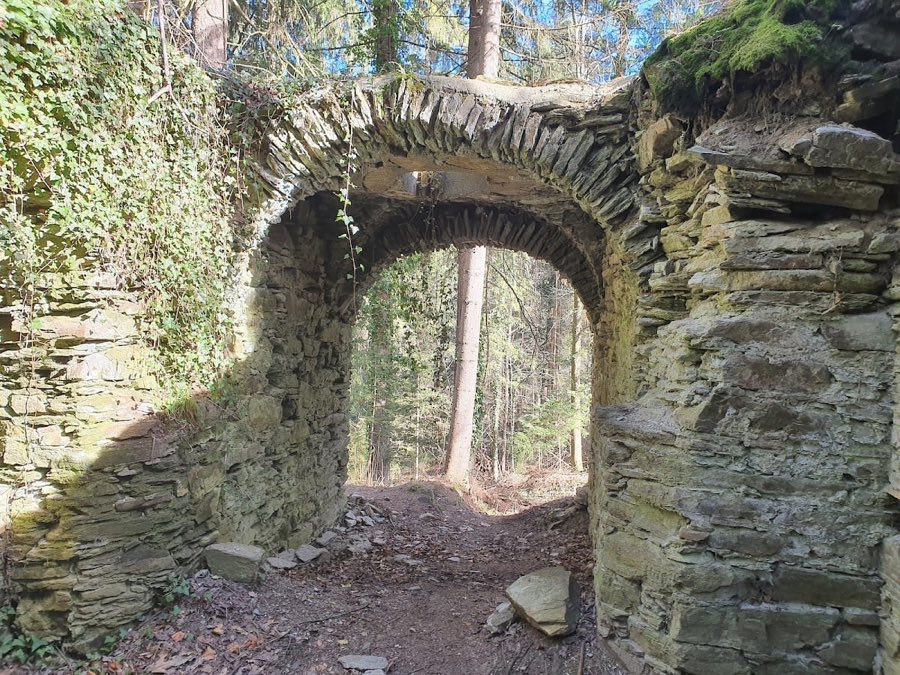
The principal entrance lay to the northwest where a stone arch bridge now crosses the moat; this masonry bridge replaced a former drawbridge at the end of the seventeenth century. The gateway was defended by a foretower and a gatehouse, the latter containing a Marian chapel established in 1636. The forecourt once held small houses, workshops and a well, the footprints of which remain as ruined foundations.
The lower outer courtyard contains the remains of small residential and economic buildings attributed to the turn of the fifteenth and sixteenth centuries. Their surviving walls were built of rubble stone with later brick repairs, and only fragments of these service buildings remain above ground.
At the heart of the castle the high ward is dominated by a tall tower house built in a single phase in the late twelfth or early thirteenth century. This five‑storey structure also functioned as living quarters. Its walls were constructed mainly of coursed rubble with squared stone at the corners and the ground floor walls are notably thick. The cellar of the tower is windowless and contains a brick barrel vault probably added in the twentieth century along with several non‑medieval openings. The ground and first floors retain an older barrel vault that dates to the Renaissance or earlier, while a later flat timber ceiling rests on corbels above. An originally external high entrance survives on the north first floor, and an internal mural stair of about twenty‑five steps has been blocked. Several slit windows were enlarged to rectangular openings in the fifteenth or sixteenth century, small embrasure holes with traces of wooden fittings remain in places, and patches of medieval plaster, the base for a tiled stove and later chimney channels are all visible within the tower.
Attached to the northeast of the tower is the main residential range built in the sixteenth century that included an arcaded small courtyard. Only parts of the arcade and the stair to the courtyard survive. A copperplate dated 1681 depicts a fireplace that no longer exists and records refer to an alchemist’s kitchen located in this area in 1669 and again in 1715.
A semicircular artillery platform was added in the sixteenth or seventeenth century on the southeast side, projecting below the high ward to accommodate cannon. Its earth and masonry traces can still be identified on the slope.
Original construction used rubble and ashlar stone, with brick appearing in later repair phases. Twentieth‑century work addressed structural problems of the main tower: a wide crack in the upper masonry was closed, the ruined wall top was rebuilt and a shallow concrete ring was inserted to carry a new roof. In 1975 the local castle association covered the tower with fibre‑cement sheets. Overall the complex has stood as a ruin since the early nineteenth century, with the tower house comparatively intact while perimeter walls and many courtyard buildings survive only as fragments; periodic excavation and consolidation took place from the 1970s through 2011.
No. 52514
No. 71315
No. 47909
No. 42191
Comments
Comments for Ruine Ligist will require a verified account before posting.
We'll send a verification link before your first comment is published.