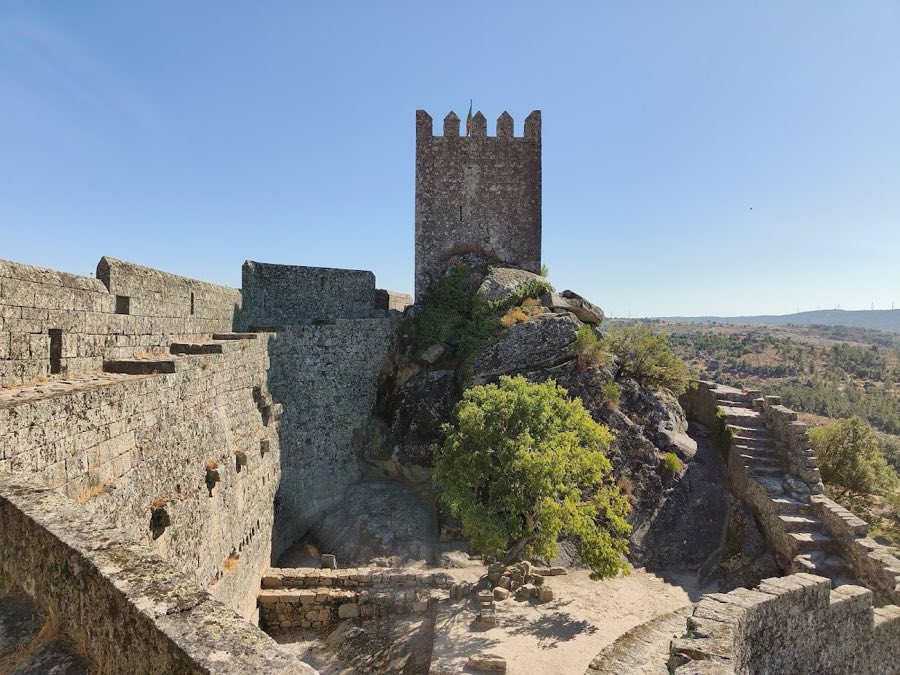
No. 79335
Sortelha Castle
Portugal
CastleRestored13th century
No. 33289
Castle · Portugal
No. 33289 · 40.351 N, 7.094 W
Quick summary
Sabugal Castle is a castle in Portugal with origins associated with the 12th century.
See all castles in PortugalSabugal Castle stands in the municipality of Sabugal, Portugal, built by the medieval Portuguese monarchy to secure a strategic position along the border with the Kingdom of León. The site commands a small plateau near the Côa River crossing, an important route since ancient times.
Archaeological signs reveal human activity here from prehistoric times, including a fortified settlement known as a castro. During the Roman conquest of the Iberian Peninsula, a military outpost likely monitored the nearby river crossing. Subsequently, the area fell under Germanic and Muslim control, though no architectural remains from these periods have survived.
In the 12th century, the Christian king Afonso Henriques took the territory during the Reconquista around 1160. Following a period of contested control that saw the territory revert to León, Alfonso IX of León founded the municipality of Sabugal in 1190. The town itself emerged around 1224, accompanied by the early development of a defensive stronghold.
The region, known as Ribacôa, returned firmly to Portuguese hands under King Dinis I (1279–1325). He granted Sabugal a municipal charter (foral) in 1296 and confirmed Portuguese sovereignty with the Treaty of Alcañices in 1297. King Dinis initiated a major reconstruction and fortification of Sabugal Castle and other border defenses. Work completed in 1303 was overseen by Frei Pedro from the Monastery of Alcobaça. In this period, King Dinis also created a sanctuary for fugitives (couto de homiziados) to encourage settlement, a privilege that persisted into the late 15th century.
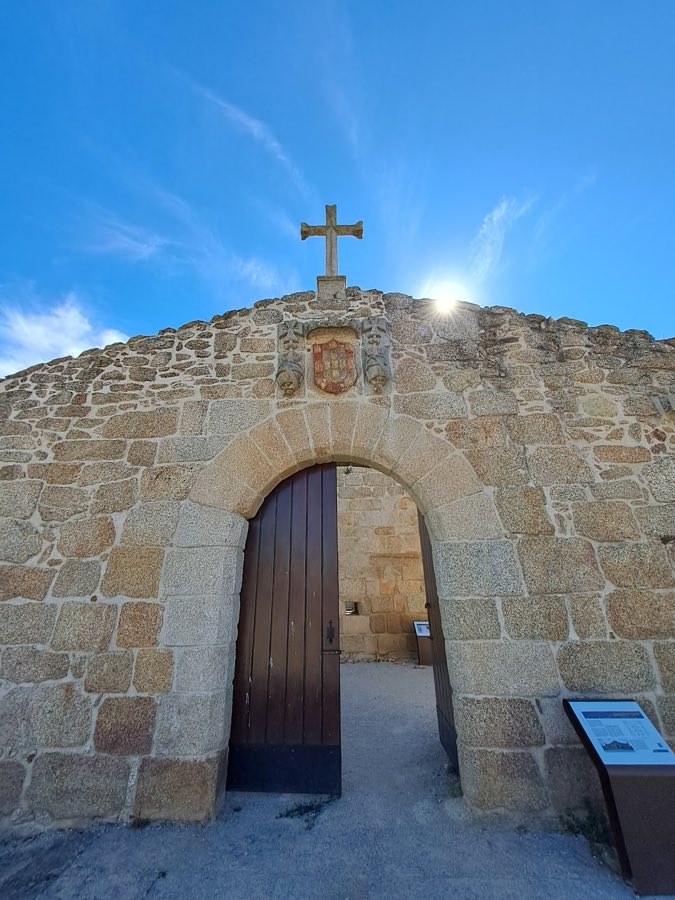
During the reign of King Manuel I (1495–1521), restoration work on the castle was completed in 1515, as commemorated by an inscription over the main gate. Manuel I also issued a new foral for Sabugal in 1515. Around 1509, the castle was depicted in drawings by Duarte de Armas, documenting its appearance and fortifications.
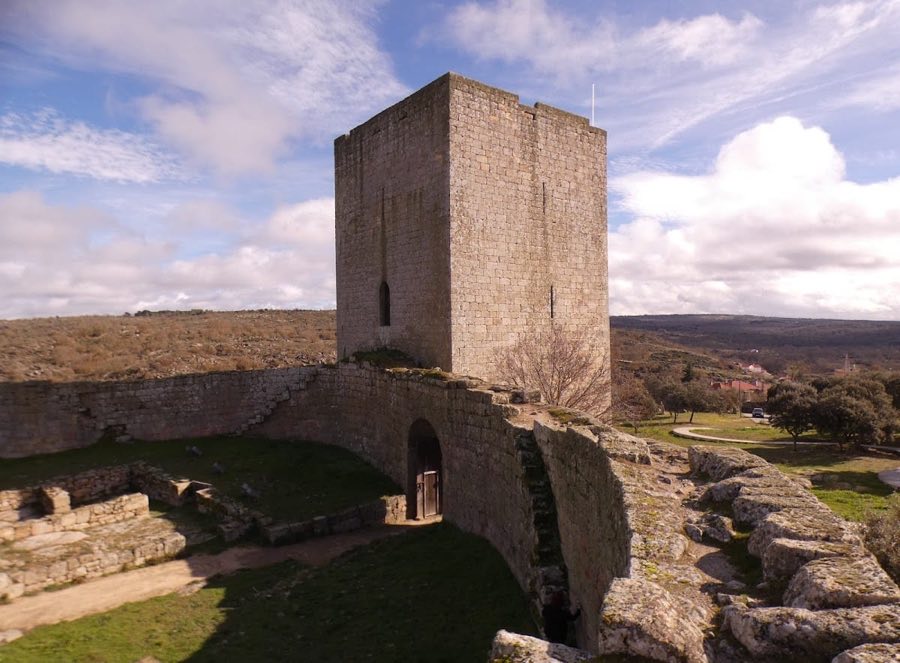
In the 17th century, the castle underwent modernization during the Portuguese Restoration War. The construction of a Clock Tower (Torre do Relógio) dates from this era. Notably, the poet and soldier Brás Garcia de Mascarenhas was imprisoned here during the same century.
In the early 19th century, Sabugal Castle hosted Portuguese and English troops fighting the retreating Napoleonic army under General André Masséna during the Peninsular War in April 1811. Following these conflicts, the fortress fell into disuse. Its courtyard became a cemetery from 1846 until approximately 1927, a change that led locals to remove stones from the walls for building materials.
The Church of Nossa Senhora do Castelo, once part of the castle complex, was demolished in 1911. Preservation efforts began in the 1940s when the Directorate-General for Buildings and National Monuments (DGEMN) intervened to stop further decay, carrying out consolidation and reconstruction. Additional restoration campaigns took place in the 1990s, aiming to revive original features. Safety works in 1999 addressed structural damage to the barbican tower and battlements. From 2003 to 2005, further restoration combined the castle’s consolidation with new facilities, preparing it for renewed use.
Sabugal Castle has been officially protected as a National Monument since 1910. Local tradition connects the castle’s main square with the Miracle of the Roses, a legend involving Queen Saint Isabel and King Dinis that remains part of its cultural heritage.
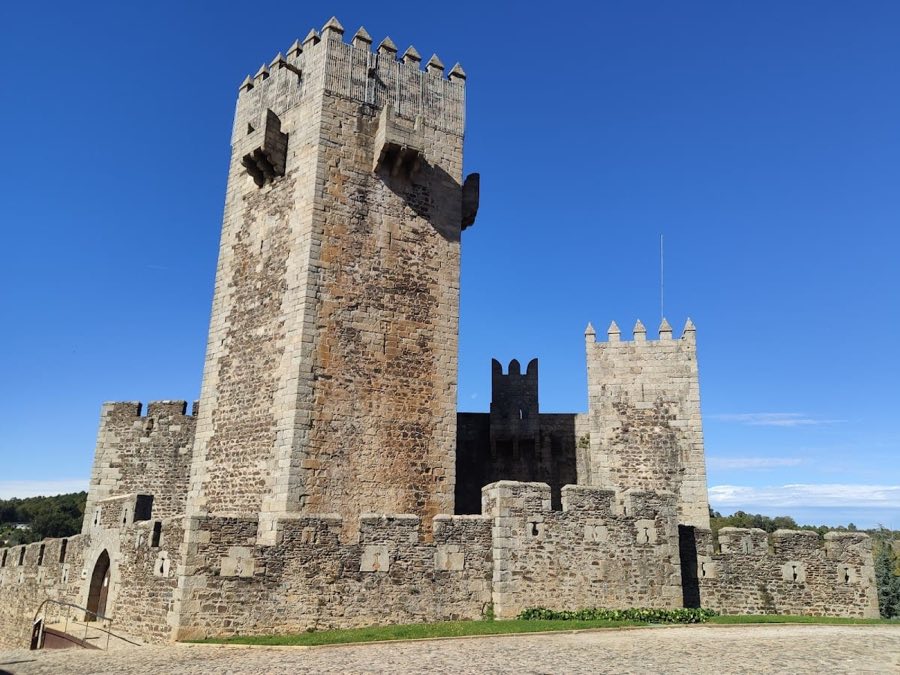
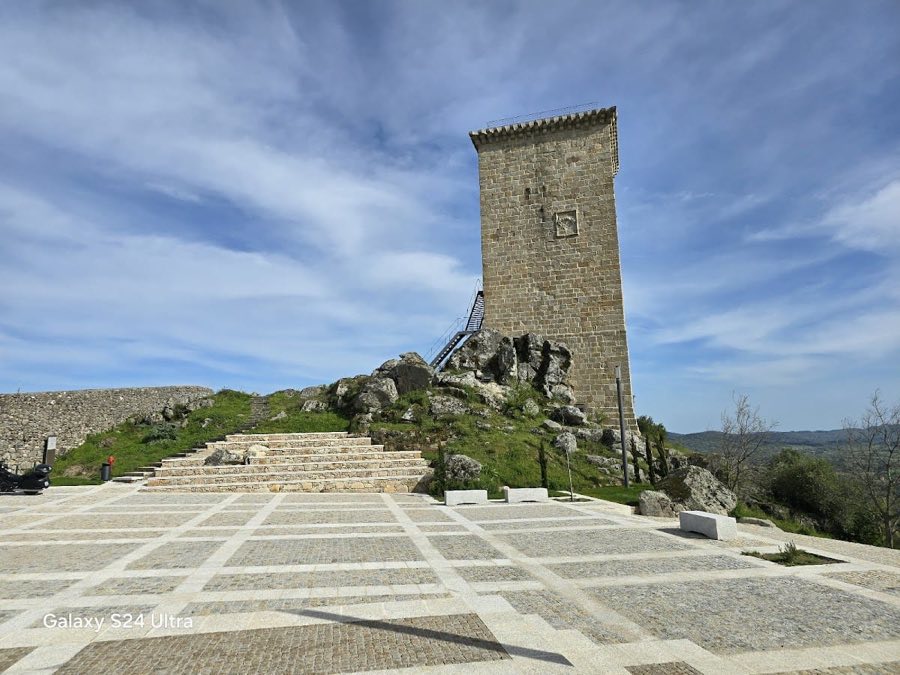
Sabugal Castle is positioned atop the highest point of a small plateau, commanding views of the surrounding landscape. The fortress follows a quadrangular plan and features walls built from a combination of finely cut granite blocks (ashlar) and roughly shaped schist masonry. Along the battlements, solid protective sections called merlons rise, pierced by cross-shaped arrow slits designed to allow defenders to shoot while remaining shielded.
Around the perimeter, a wide walkway, known as a chemin de ronde or adarve, runs atop the walls. Access to this area is provided by four internal staircases, enabling movement for the castle’s defenders. The curtain walls are strengthened by three large towers at the corners and a fourth centrally positioned on the southwest side; all towers are capped with pyramid-shaped battlements.
The castle’s keep, or Torre de Menagem, is highly distinctive due to its unusual five-sided (pentagonal) shape. This central tower protects the main entrance and displays Gothic architectural elements inside, with three floors featuring vaulted ceilings adorned with keystones decorated by the Portuguese royal quinas—a series of five heraldic shields symbolizing Portugal. The upper room of the keep receives light through doors opening onto balconies equipped with stone openings called machicolations, which let defenders drop projectiles on attackers below.
Between the keep and the eastern corner tower, a battlemented balcony overlooks the main gate into the castle’s courtyard, also known as the praça de armas. Outside the main enclosure, a barbican—a fortified outer wall—extends to provide additional defense. This corridor is similarly protected by massive merlons marked with cross-shaped arrow slits. The barbican walls are supported by two small round turrets called cubelos, near which lies a narrow gateway with a pointed (ogival) arch.
Originally, the town surrounding the castle was enclosed by an approximately oval wall, of which only fragments survive. Among these remnants is the Porta da Vila, or Town Gate, located near the Clock Tower that was added to the complex in the 17th century.
The castle yard’s use as a cemetery in the 19th and early 20th centuries contributed to the removal of stones from its walls by local residents, affecting the structure’s preservation. The main gate still bears an inscription marking the restoration completed in 1515 under King Manuel I. Efforts by preservation authorities beginning in the 20th century have stabilized and restored many parts of the castle, safeguarding its historic fabric and unique features for the future.
No. 79335
No. 62294
No. 63006
No. 95041
Comments
Comments for Sabugal Castle will require a verified account before posting.
We'll send a verification link before your first comment is published.